
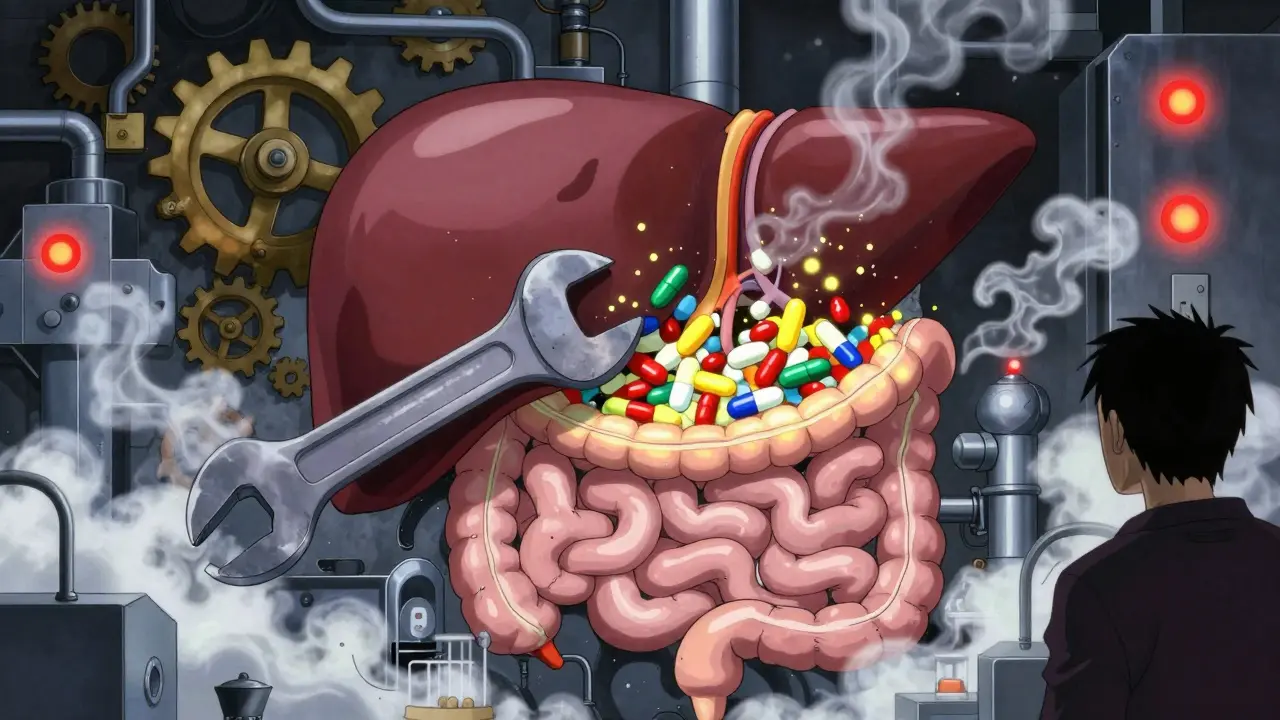
Cyclosporine is one of the most critical immunosuppressants used after organ transplants and for severe autoimmune diseases. But its power comes with a major risk: it doesn’t just affect your immune system-it also messes with how your body processes dozens of other drugs. The reason? Cyclosporine strongly inhibits CYP3A4, the enzyme responsible for breaking down nearly 60% of all prescription medications. This isn’t a minor side effect. It’s a clinical landmine that can lead to kidney damage, heart rhythm problems, or even organ rejection if not managed carefully.
Why CYP3A4 Matters So Much
CYP3A4 lives in your liver and intestines. Think of it as a factory worker that breaks down drugs so your body can eliminate them. When this enzyme is working normally, drugs like statins, blood pressure meds, and even some antibiotics get cleared at predictable rates. But when cyclosporine steps in, it blocks CYP3A4 like a wrench thrown into the gears. The result? Other drugs build up in your bloodstream to dangerous levels.
It’s not just about cyclosporine being a victim-it’s also the cause. Cyclosporine itself is broken down by CYP3A4, so anything that slows or speeds up this enzyme changes how much cyclosporine is in your blood. Too little, and your body attacks the transplanted organ. Too much, and you risk kidney failure, tremors, high blood pressure, or seizures.
How Cyclosporine Inhibits CYP3A4
Cyclosporine doesn’t just compete with other drugs for CYP3A4’s attention. Research shows it acts as a mixed inhibitor, meaning it does two things at once: it blocks the enzyme’s active site like a key stuck in a lock, and it can also damage the enzyme itself over time. This is called mechanism-based inhibition. Unlike temporary blockers, this kind of damage takes days to reverse-even after stopping the drug.
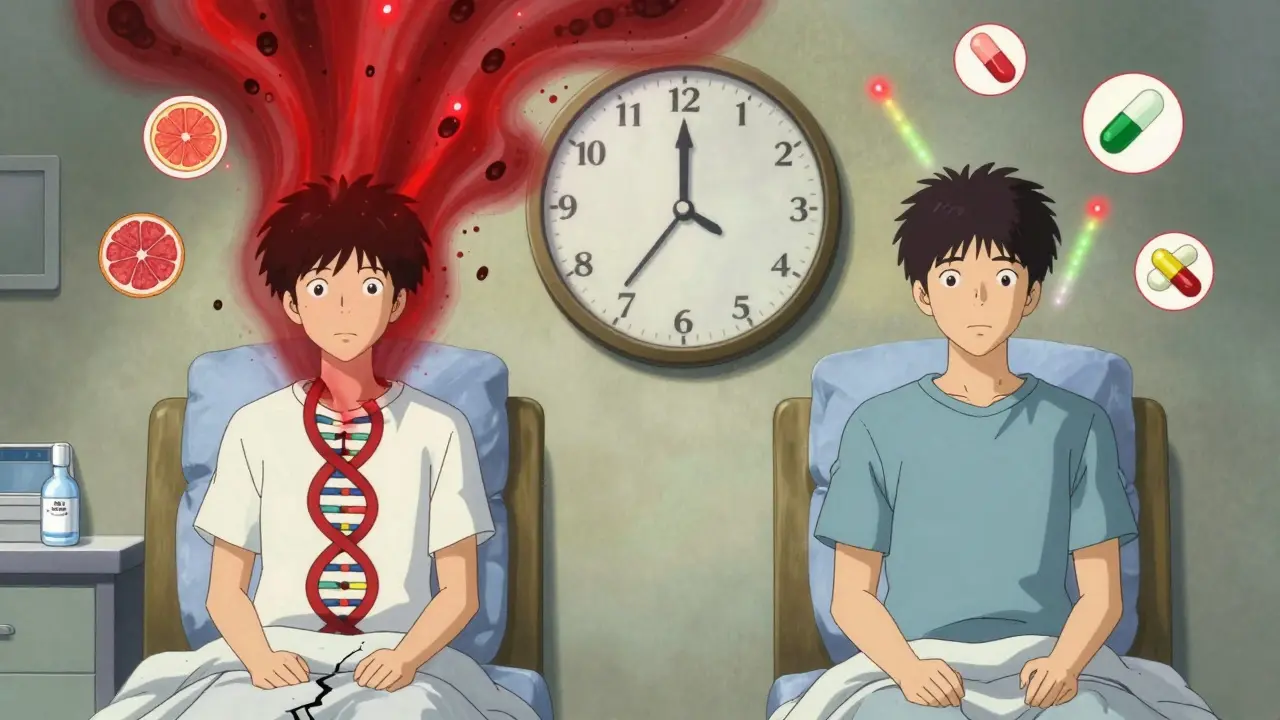
Studies from Wenzhou Medical University found that cyclosporine’s inhibition of CYP3A4 is worsened by genetic differences. Some people naturally have less active versions of CYP3A4, making them far more sensitive to interactions. For example, one common genetic variant reduces enzyme efficiency by up to 40%. That means two patients on the same dose of cyclosporine could have completely different drug levels in their blood-not because of compliance, but because of their DNA.
Drugs That Become Dangerous With Cyclosporine
Here are some of the most common and risky combinations:
- Sirolimus (an immunosuppressant): When taken with cyclosporine, sirolimus levels jump by over 200%. This can cause severe lung and bone marrow toxicity. Dose reductions of up to 70% are required.
- Diltiazem and verapamil (blood pressure meds): These are moderate CYP3A4 inhibitors themselves. When paired with cyclosporine, they can double or triple cyclosporine levels, increasing the risk of kidney damage.
- Statins like simvastatin and lovastatin: These can cause life-threatening muscle breakdown (rhabdomyolysis) when their levels rise too high. Atorvastatin is safer but still requires monitoring.
- Clarithromycin and erythromycin (antibiotics): These are strong CYP3A4 inhibitors. One case study showed a 60% spike in creatinine levels within 72 hours of starting clarithromycin in a kidney transplant patient.
- Calcium channel blockers like nimodipine: Used after brain aneurysms, nimodipine’s interaction with cyclosporine is so strong that guidelines recommend cutting the nimodipine dose in half.
Even over-the-counter supplements like St. John’s wort can be dangerous. It’s a CYP3A4 inducer, meaning it speeds up the enzyme’s activity. That causes cyclosporine levels to crash-sometimes by 80%. That’s enough to trigger acute organ rejection.
Cyclosporine vs. Tacrolimus: A Key Difference
Many people assume cyclosporine and tacrolimus are interchangeable. They’re not. Tacrolimus is primarily a substrate of CYP3A4-it gets broken down by the enzyme but doesn’t block it. That means tacrolimus is vulnerable to interactions from other drugs, but it doesn’t cause them. Cyclosporine does both.
This is why transplant teams often switch patients from cyclosporine to tacrolimus. Tacrolimus has fewer interaction risks, better long-term kidney outcomes, and is now the first-choice drug for most adult transplants. But cyclosporine still has a place-especially in children, patients with certain autoimmune disorders, or those who can’t tolerate tacrolimus’s side effects like tremors or diabetes.
Managing the Risk: What Doctors and Pharmacists Do
There’s no magic bullet. Managing cyclosporine interactions is a constant balancing act. Here’s how it’s done in real-world clinics:
- Map every medication: Every pill, patch, or supplement the patient takes gets reviewed-not just prescriptions. Even herbal teas and vitamins matter.
- Check for CYP3A4 activity: Is the drug an inhibitor, inducer, or substrate? The FDA’s official list and tools like the University of Washington’s Drug Interaction Checker are used daily.
- Adjust cyclosporine dose upfront: If a moderate inhibitor like diltiazem is added, cyclosporine is usually cut by 25-50%. For strong inhibitors like clarithromycin, the reduction can be 50-75%.
- Monitor blood levels daily: Trough levels (the lowest concentration before the next dose) are checked every day when a new interaction is introduced. The goal? Keep cyclosporine between 100-400 ng/mL, depending on the transplant type and time since surgery.
- Use alerts and pharmacists: Hospitals with electronic health record alerts for drug interactions cut adverse events by 45%, according to a 2022 study across 12 transplant centers. Pharmacists are the frontline defense-they catch what automated systems miss.

What Happens When It Goes Wrong
A 2021 study of 1,245 kidney transplant patients found that over one-third experienced a clinically significant drug interaction involving cyclosporine in their first year. Nearly 9% ended up hospitalized. One common scenario: a patient gets a sinus infection, is prescribed azithromycin (a weaker inhibitor), and doesn’t tell their transplant team. Their cyclosporine level climbs unnoticed. Days later, they’re admitted with kidney failure. Another case: a patient starts St. John’s wort for depression, stops taking cyclosporine regularly, and experiences rejection two weeks later.
These aren’t rare. They’re preventable.
The Future: Personalized Dosing and Real-Time Monitoring
Researchers are now building algorithms that predict cyclosporine levels based on genetics, age, weight, and other medications. Early versions already achieve 85-90% accuracy. In the next few years, point-of-care blood tests may let doctors check cyclosporine levels in minutes instead of waiting days for lab results. One prototype device, currently in phase 3 trials, matches lab accuracy with a finger-prick sample.
The FDA and global health agencies now require all new drugs to be tested for effects on both CYP3A4 and P-glycoprotein (another transporter cyclosporine blocks). This means future drugs will come with clearer interaction warnings-but cyclosporine will still be one of the most complex.
Despite newer immunosuppressants, cyclosporine remains in use. The global market for it was $1.87 billion in 2022, and it’s expected to grow. Why? Because for some patients, there’s no better option. But its survival depends on one thing: smarter, more informed use.
Can I take grapefruit juice with cyclosporine?
No. Grapefruit juice is a potent CYP3A4 inhibitor. Even a single glass can raise cyclosporine levels by 50% or more. This isn’t a myth-it’s backed by clinical studies. If you’re on cyclosporine, avoid grapefruit, Seville oranges, and pomelos entirely. Don’t assume "a little" is safe.
How long does it take for CYP3A4 to recover after stopping a drug?
It depends. For reversible inhibitors like cyclosporine, enzyme activity usually returns within 3-7 days after stopping the drug. But for mechanism-based inhibitors like clarithromycin, it can take 1-2 weeks because your body has to make new enzyme. This is why you can’t just stop a drug and immediately return to your old cyclosporine dose-you need to wait and retest levels.
Are there any safe antibiotics to take with cyclosporine?
Yes, but carefully. Azithromycin is generally safer than clarithromycin or erythromycin, but it still carries some risk. Penicillins (like amoxicillin) and cephalosporins (like cephalexin) don’t affect CYP3A4 and are preferred. Always check with your transplant team before starting any new antibiotic-even over-the-counter ones.
Why is therapeutic drug monitoring so important with cyclosporine?
Because cyclosporine has a very narrow window between too little and too much. A level of 80 ng/mL might mean rejection, while 500 ng/mL could mean kidney failure. Many factors affect it: your diet, other drugs, your genes, even your liver health. Blood tests are the only way to know if your dose is right.
Can I switch from cyclosporine to tacrolimus to avoid interactions?
It’s possible-and many patients do-but it’s not automatic. Tacrolimus has its own interaction profile and side effects, like higher risk of diabetes and nerve problems. Switching requires careful planning, blood tests, and close monitoring. Never switch on your own. Always work with your transplant team.
What You Should Do Next
If you’re taking cyclosporine:
- Keep a full, updated list of every medication and supplement you take-including vitamins, herbs, and OTC pain relievers.
- Share that list with every doctor, pharmacist, and nurse you see-even if they don’t ask.
- Ask: "Could this drug affect my cyclosporine level?"
- Never stop or change your dose without talking to your transplant team.
- Know your target cyclosporine range and ask for your latest blood level results.
For caregivers and family members: watch for signs of toxicity-tremors, swelling, nausea, confusion, or reduced urine output. These can be early warnings. Don’t wait for a crisis.





Cyclosporine is one of those drugs that makes you respect pharmacology. Not because it's magic, but because it's so damn finicky. I've seen patients crash and burn over a simple antibiotic they thought was harmless.
Just keep your list updated. That's it.
Grapefruit juice is a silent killer with cyclosporine. No exceptions. Even one glass can push levels into toxic range. I always tell patients: if it's citrus and weirdly bitter, skip it.
Honestly, the fact that we still use cyclosporine at all is wild. Tacrolimus is smoother, safer, and way less of a headache. But I get it - some folks just respond better to it. Still, if you're new to transplant, ask why you're not on tacrolimus first.
lol so many warnings it's like a drug manual with anxiety 😅
This is not hyperbole: cyclosporine interactions are one of the most dangerous blind spots in modern medicine. We are not talking about mild side effects here. We are talking about organ rejection, renal failure, and sudden death. This isn't a footnote - it's a red flag on every prescription.
And yet, so many patients are left to navigate this minefield alone. Shame.
i didnt even know st johns wort was a thing until my aunt tried it for her 'depression' and then her kidney started acting up. turns out she was on cyclosporine and didn't think herbs counted as 'meds'. now she's got a whole binder labeled 'DON'T TOUCH THIS' with pictures of pills and a big red X over the herbal tea section. we all laugh but seriously - it's scary how easy it is to mess this up. i just wish docs asked about supplements more often, not just 'do you take vitamins?'
If you're on cyclosporine and you're not getting your levels checked weekly, you're playing Russian roulette with your transplant.
Ah yes, the grand symphony of CYP3A4 inhibition - a masterpiece of pharmacological chaos conducted by a liver that doesn't care if you're a PhD or a 17-year-old with a Pinterest 'natural remedies' board.
Meanwhile, somewhere in a lab, a grad student is crying because their 'novel' drug interaction study got scooped by a patient who took turmeric and Clarithromycin.
The fact that we still rely on trough levels and manual charts in 2025 is ridiculous. We have AI, wearable sensors, real-time analytics. Yet we're still asking patients to remember to take a pill at 8am and then wait three days for a lab result. This is not medicine. This is guesswork with a stethoscope.
Let me tell you something - pharmacists are the real MVPs here. They're the ones who catch the interaction between your OTC cold med and your transplant drug while the doctor is scrolling through emails.
I’ve seen a pharmacist stop a discharge because of a single OTC antacid that had a CYP3A4 tweak. Saved a kidney. Saved a life.
So next time you’re at the pharmacy, say thank you. Not just because they’re nice - because they’re your last line of defense.
You guys are overcomplicating this. If you’re on cyclosporine, treat your meds like a sacred ritual. Write them down. Track them. Talk to your pharmacist. Don’t assume anything. Don’t Google. Don’t wing it.
It’s not about fear - it’s about discipline. And discipline saves lives. You got this.
I don't care what the studies say - if you're taking cyclosporine and you're not in the US, you're basically gambling. Our healthcare system at least has alerts and pharmacists. In other countries? They're using 1990s protocols. My cousin in Mexico got rejected because his doctor didn't even know about grapefruit. America > everywhere else. 💪🇺🇸
Cyclosporine is the pharmaceutical equivalent of a dramatic Shakespearean tragedy - full of hubris, unintended consequences, and inevitable downfall. We glorify it as a miracle drug, yet we treat its interactions like an afterthought. How poetic. How tragic. How utterly human.
Perhaps the real question isn't how to manage the interaction - but why we continue to rely on such a volatile, archaic compound in the age of precision medicine.
I know this sounds crazy but I'm convinced the pharmaceutical companies know about all this and they're hiding it. Why? Because if they told everyone how dangerous cyclosporine is, no one would take it. And then they'd lose billions. They want you to think it's safe as long as you 'follow the rules.' But what if the rules are designed to fail? What if the 'monitoring' is just a way to keep you dependent? I've seen the patterns. This isn't medicine - it's control.