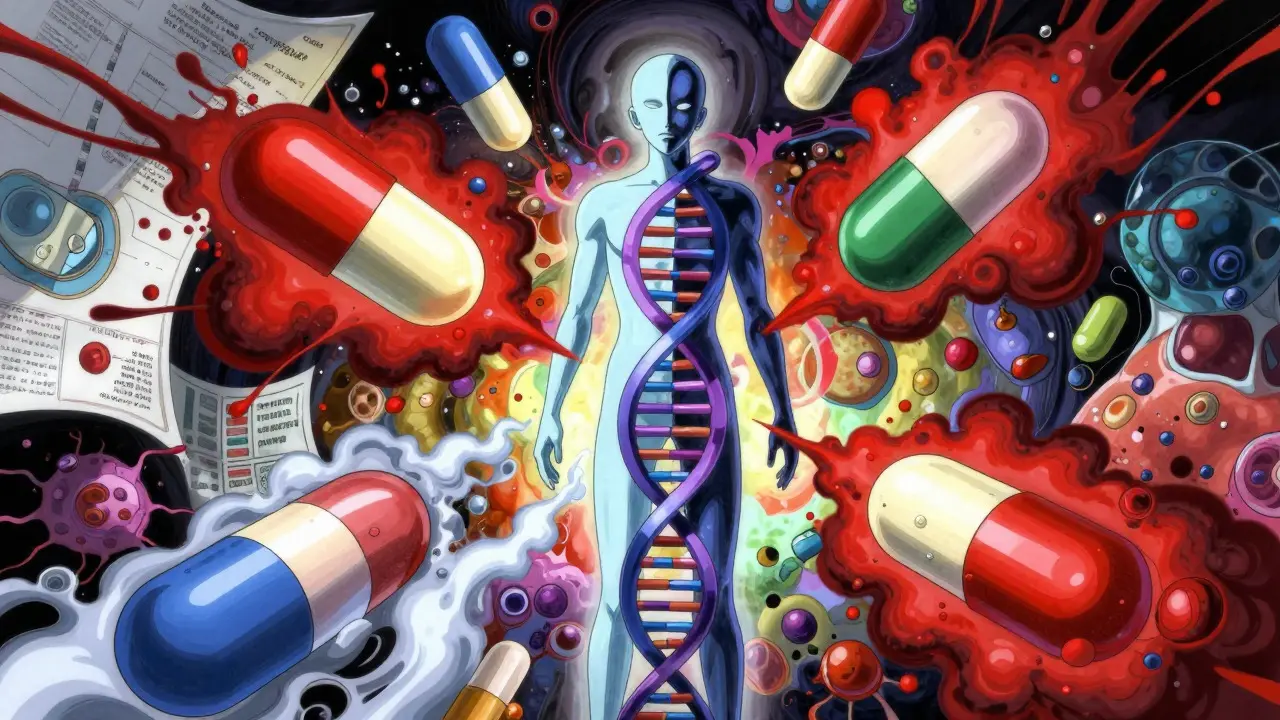
Imagine taking two medications that are perfectly safe on their own. Now imagine taking them together, and suddenly you’re in the hospital with a severe reaction. This isn’t just bad luck; it’s often biology. For decades, doctors treated everyone like they had the same metabolism. But we don’t. Pharmacogenomics is the study of how your unique genetic makeup changes how your body processes drugs. It turns out that your DNA doesn't just determine eye color or height-it dictates whether a standard dose of medication will work, do nothing, or cause harm. The problem gets worse when patients take multiple medications, a practice known as polypharmacy. According to the National Center for Health Statistics, 13% of U.S. adults take five or more prescriptions daily. When you mix multiple drugs with a specific genetic profile, the risk of dangerous interactions skyrockets. This article breaks down exactly how your genes influence these risks, why traditional interaction checkers might be missing the mark, and what this means for your health in 2026.
The Hidden Variable: Why Standard Doses Fail
Most drug labels give you a "one-size-fits-all" dosage recommendation. But studies show that genetics account for 20% to 95% of the variability in how people respond to medications. The FDA has added pharmacogenomic information to the labels of over 300 drugs as of 2023. This data reveals that two people can take the exact same pill at the exact same time, yet one person metabolizes it quickly while the other stores it in their system for days. When we talk about drug interactions, we usually think of Drug A canceling out Drug B. But with pharmacogenomics, we have to look at a three-way street: the gene, the first drug, and the second drug. This is called a Drug-Drug-Gene Interaction (DDGI). If your liver enzymes are genetically slow, adding a second drug that further slows those enzymes can push your blood levels into toxic territory. Conversely, if you are a fast metabolizer, a standard dose might never reach effective levels, leaving you untreated. Understanding this triad is the key to preventing adverse drug reactions (ADRs), which cost the U.S. healthcare system roughly $30 billion annually.
Three Ways Genes and Drugs Collide
To understand the risk, you need to know the mechanisms. Research published in Nature by Whirl-Carrillo et al. identifies three primary ways these interactions happen. Knowing which category your situation falls into helps clarify why certain combinations are risky.
- Inhibitory Interactions: This happens when a "perpetrator" drug blocks the enzyme responsible for breaking down a "victim" drug. If you are already a poor metabolizer due to your genetics, adding an inhibitor can stop the victim drug from clearing your system entirely. Think of it like a clogged drain. Your genetics made the drain narrow; the second drug put a plug in it.
- Induction Interactions: Here, a drug speeds up the enzyme activity. If you are a normal metabolizer, induction might lower the concentration of another drug below therapeutic levels. You’re essentially flushing the medication out before it can help you.
- Phenoconversion: This is the most complex scenario. It occurs when a drug temporarily changes your metabolic phenotype to match a different genetic profile. For example, if you have a genotype that makes you a rapid metabolizer, but you take a strong inhibitor, your body acts like a poor metabolizer for the duration of the treatment. This mismatch confuses standard dosing algorithms.
Approximately 60% of clinically significant pharmacogenomic interactions are pharmacokinetic (affecting how the body moves the drug), while the remaining 40% are pharmacodynamic (affecting how the drug impacts the body’s receptors). Both types carry serious risks if ignored.

Why Traditional Interaction Checkers Are Not Enough
If you’ve ever used an online drug interaction checker, you’ve likely seen warnings based on population averages. Tools like Lexicomp or Micromedex identify tens of thousands of potential interactions. However, a 2022 study in the American Journal of Managed Care revealed a critical gap: when genetic polymorphisms were considered, the estimated probability of any interaction impact increased by 90.7%. Traditional databases assume average metabolism. They miss the individual reality. In the same study, researchers found that including genetic data raised the probability of major impact interactions by 30.4%. The enzymes most commonly implicated in these missed risks are CYP2D6 and CYP2C19. These are part of the cytochrome P450 family, which handles the metabolism of many antidepressants, antipsychotics, and painkillers. Without knowing your status for these genes, you’re flying blind regarding half your prescription regimen.
| Feature | Traditional DDI Checker | Pharmacogenomic-Informed Assessment |
|---|---|---|
| Basis of Prediction | Population averages | Individual genetic profile + drug properties |
| Detection Rate | ~50,000 potential interactions identified broadly | Identifies specific high-risk scenarios for the patient |
| Major Impact Accuracy | Standard baseline | 30.4% higher detection of major impacts (AJMC 2022) |
| Key Enzymes Tracked | Limited focus on common inhibitors | Detailed analysis of CYP2D6, CYP2C19, TPMT, etc. |
| Clinical Utility | General warnings | Actionable dosing adjustments and alternative therapies |
High-Risk Scenarios: What to Watch For
Not all drugs are created equal when it comes to genetic sensitivity. Certain classes of medications have well-documented, high-stakes interactions with specific genes. Being aware of these can prompt you to ask your doctor about testing.
- Warfarin (Blood Thinner): This drug is heavily influenced by the CYP2C9 and VKORC1 genes. Dr. Alan H. Shuldiner from the NIH noted that PGx-guided dosing reduces major bleeding events by 31% compared to standard dosing. If you are a poor metabolizer of CYP2C9, standard doses can lead to dangerous internal bleeding.
- Azathioprine (Immunosuppressant): Patients with variations in the TPMT gene break down this drug very slowly. The FDA label states that poor metabolizers should receive 10% or less of the standard dosage to avoid myelosuppression, a condition where bone marrow stops producing enough blood cells.
- Carbamazepine (Anticonvulsant): Patients carrying the HLA-B*15:02 allele face a 50 to 100 times higher risk of Stevens-Johnson Syndrome, a life-threatening skin reaction, when taking this drug. Genetic screening is now standard practice before starting this medication in at-risk populations.
- SSRIs and Antidepressants: Many selective serotonin reuptake inhibitors are metabolized by CYP2D6. If you take an SSRI along with another CYP2D6 substrate, and you are a poor metabolizer, the risk of serotonin syndrome increases significantly.

The Reality of Implementation in 2026
The science is solid, but the rollout is uneven. As of 2023, only 15% of U.S. healthcare systems had fully integrated pharmacogenomic testing into their electronic health records. Academic medical centers like Mayo Clinic and Vanderbilt University Medical Center are leaders here. Vanderbilt’s PREDICT program has tested over 100,000 patients since 2011. At Mayo Clinic, preemptive testing showed that 89% of patients had at least one actionable variant, and clinical decision support alerts reduced inappropriate prescribing by 45%. However, for the average community pharmacy, barriers remain. A 2023 survey found that only 28% of pharmacists felt adequately trained to interpret these results. Furthermore, reimbursement is a hurdle. With only 19 specific CPT codes for PGx testing and average reimbursements between $250 and $400, many insurance plans still classify these tests as experimental or optional. Despite this, the market is growing rapidly, projected to reach $24.3 billion by 2030, driven by the undeniable evidence that personalized dosing works.
What You Can Do Today
You don’t need to wait for universal adoption to benefit from this knowledge. Here are practical steps to manage your drug interaction risk using pharmacogenomics:
- Ask About Testing: If you are prescribed warfarin, carbamazepine, azathioprine, or certain antidepressants, ask your doctor if pharmacogenomic testing is appropriate. The Clinical Pharmacogenetics Implementation Consortium (CPIC) provides guidelines for over 30 genes and 100+ drug-gene pairs.
- Review Your Med List Annually: Bring a complete list of all prescriptions, over-the-counter drugs, and supplements to your doctor. Highlight any new additions. Polypharmacy increases interaction risk exponentially.
- Look for Symptoms: If you start a new medication and experience unexpected side effects-such as extreme fatigue, dizziness, or gastrointestinal issues-it could be a sign that your body isn’t metabolizing the drug as expected. Don’t ignore these signals.
- Consider Direct-to-Consumer Options: Companies like 23andMe offer limited pharmacogenomic reports. While not a replacement for clinical-grade testing, they can provide initial insights into your CYP2D6 and CYP2C19 status, which you can then discuss with your healthcare provider.
The future of medicine is not just about finding the right drug for the disease; it’s about finding the right drug for you. By understanding how your genes influence drug interactions, you move from being a passive recipient of care to an active participant in your health safety.
What is pharmacogenomics?
Pharmacogenomics is the study of how a person's genetic makeup affects their response to drugs. It combines pharmacology (the study of drugs) and genomics (the study of genes and their functions) to develop effective, safe medications and doses tailored to a person's genetic profile.
How does pharmacogenomics reduce drug interaction risk?
It identifies genetic variants that affect drug-metabolizing enzymes. By knowing if you are a poor, intermediate, extensive, or ultrarapid metabolizer, doctors can avoid prescribing drugs that would accumulate to toxic levels or be cleared too quickly, thus preventing adverse drug reactions and ineffective therapy.
What is a DDGI?
DDGI stands for Drug-Drug-Gene Interaction. It refers to a scenario where the interaction between two drugs is modified by a patient's genetic makeup. For example, a drug may inhibit an enzyme, but the severity of that inhibition depends on whether the patient's genes already code for low enzyme activity.
Are pharmacogenomic tests covered by insurance?
Coverage varies widely. Some insurers cover specific tests for certain conditions (like cancer or cardiovascular disease) if deemed medically necessary. However, many plans still consider broader preemptive panels experimental. Average out-of-pocket costs range from $250 to $400 per test, though prices are decreasing as technology advances.
Which genes are most important for drug interactions?
The most clinically significant genes include CYP2D6 and CYP2C19 (which metabolize many psychiatric and pain medications), CYP2C9 and VKORC1 (critical for warfarin dosing), TPMT (for azathioprine and thioguanine), and HLA-B*15:02 (for carbamazepine hypersensitivity).
Can I get pharmacogenomic testing done at home?
Yes, several direct-to-consumer companies offer saliva-based kits. However, clinical-grade testing ordered through a healthcare provider is generally more comprehensive and includes professional interpretation, which is crucial for making safe medication changes.
What is phenoconversion?
Phenoconversion is when a drug temporarily alters a person's metabolic phenotype to mimic a different genetic status. For instance, a person who is genetically an extensive metabolizer might act like a poor metabolizer if they take a strong inhibitor drug, leading to unexpected drug accumulation.
How accurate are pharmacogenomic predictions?
Accuracy depends on the specific gene-drug pair. For some, like TPMT and azathioprine, the prediction is highly accurate and definitive. For others, like warfarin, genetics explain a significant portion of variability but must be combined with clinical factors like age, weight, and diet for optimal dosing. CPIC guidelines provide strength-of-evidence ratings for each pair.