
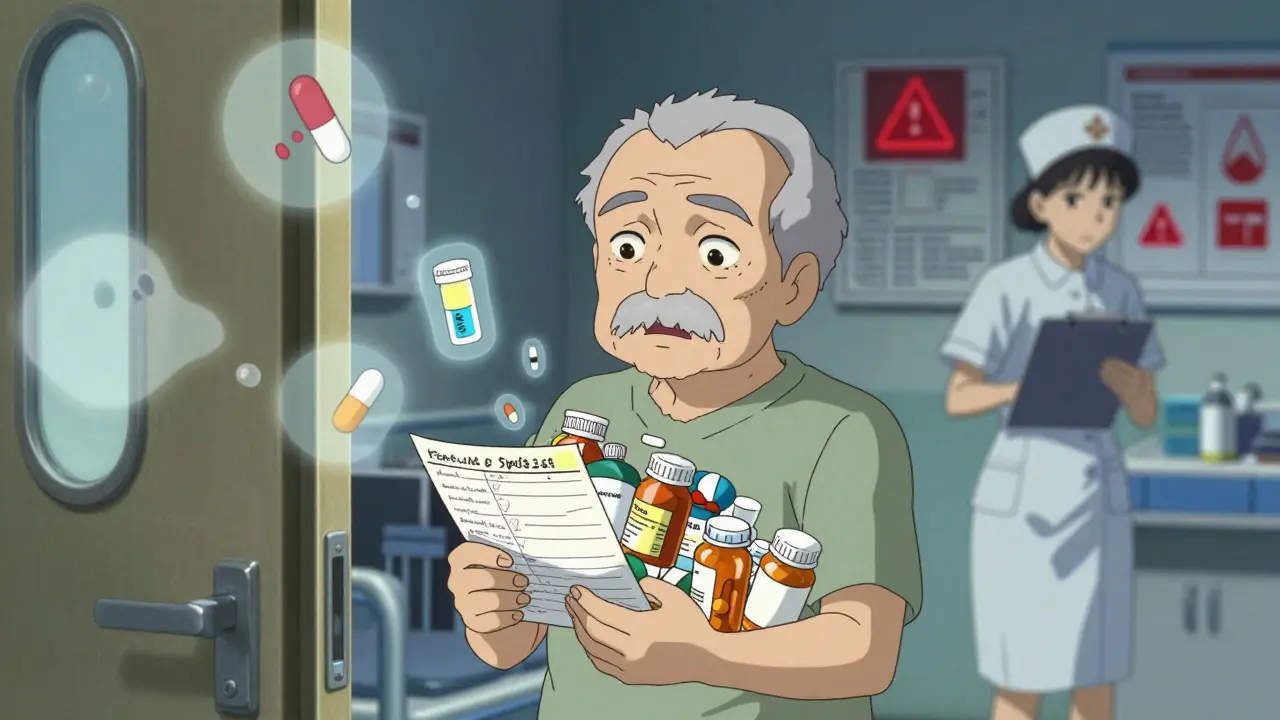
When you leave the hospital, your body is still healing. But the real danger often isn’t the illness you were treated for-it’s the medicines you’re sent home with. A 2022 study found that nearly 1 in 5 medication changes made during a hospital stay are never properly reviewed after discharge. That’s how dangerous gaps happen. One patient might be told to stop their blood thinner before surgery, but never told to restart it. Another might be given a new painkiller that clashes with their daily blood pressure pill. These aren’t rare mistakes. They’re common-and preventable.
Why Medication Reconciliation Matters
Medication reconciliation isn’t just a hospital formality. It’s a life-saving step that compares what you were taking before admission, what was changed while you were in the hospital, and what you’re supposed to take when you go home. The goal? To catch omissions, duplications, wrong doses, or dangerous interactions before they hurt you.The data speaks clearly. According to the Agency for Healthcare Research and Quality (AHRQ), proper reconciliation reduces adverse drug events by 30% to 50%. That means fewer ER visits, fewer readmissions, and fewer lives lost. In 2022, the National Quality Forum estimated that medication errors after discharge caused over 836,000 preventable adverse events in the U.S. alone. The cost? More than $2.1 billion in avoidable healthcare spending.
Yet, even though nearly all U.S. hospitals claim to have reconciliation processes, only about 65% actually complete them properly at discharge. Why? Time. Staff shortages. Poor communication. And too often, patients themselves don’t understand what’s changed.
What Happens at Discharge
At discharge, your medical team should do three things:- Compare your pre-hospital meds with what you received in the hospital.
- Decide which meds to continue, stop, or change.
- Give you a clear, written list of exactly what to take at home-including doses, timing, and why.
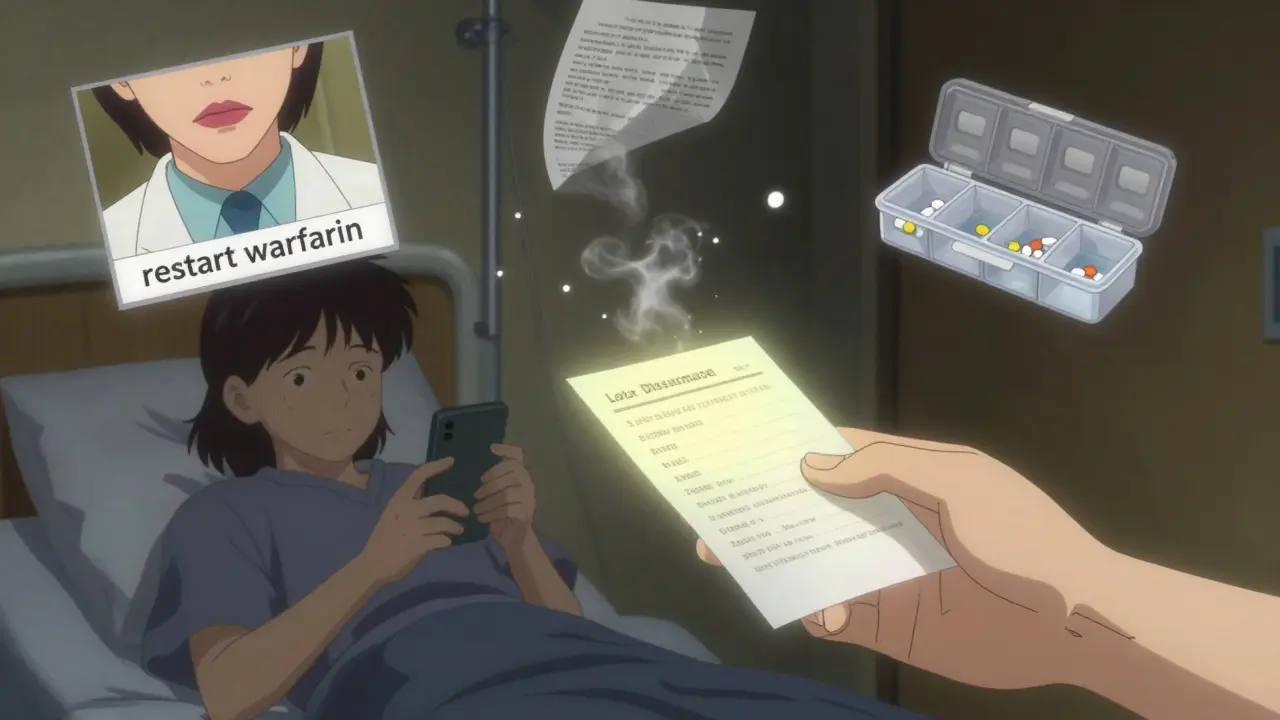
This list should be written in plain language. Not medical jargon. Not a printout from a computer system that only doctors understand. It should say: “Take 5 mg of warfarin every evening to prevent blood clots,” not “Continue anticoagulation therapy.”
The most reliable source for this list? The discharge summary-not your memory, not the pharmacy label, not the nurse’s verbal instructions. A 2021 study from Legacy Health found that discharge summaries had only a 17.3% error rate. Patient self-reports? That jumped to 42.1%. If you say you take “that little white pill” and your doctor says it was lisinopril, but you actually took hydrochlorothiazide, you’re at risk.
Common Mistakes That Lead to Interactions
Here are the most frequent errors that happen at discharge:- Omissions (42.7% of errors): A medication you were taking before admission-like your statin, diabetes pill, or thyroid medicine-is left off your discharge list. No one tells you to restart it.
- Unintended continuations (18.7%): A medication given for a short-term issue (like an antibiotic or steroid) is accidentally kept on your long-term list. This can cause side effects or interactions with your regular meds.
- Dosing errors (11.8%): You were on 10 mg of a drug before, but you’re sent home with 20 mg. Or worse-you’re told to take it twice a day when you only need it once.
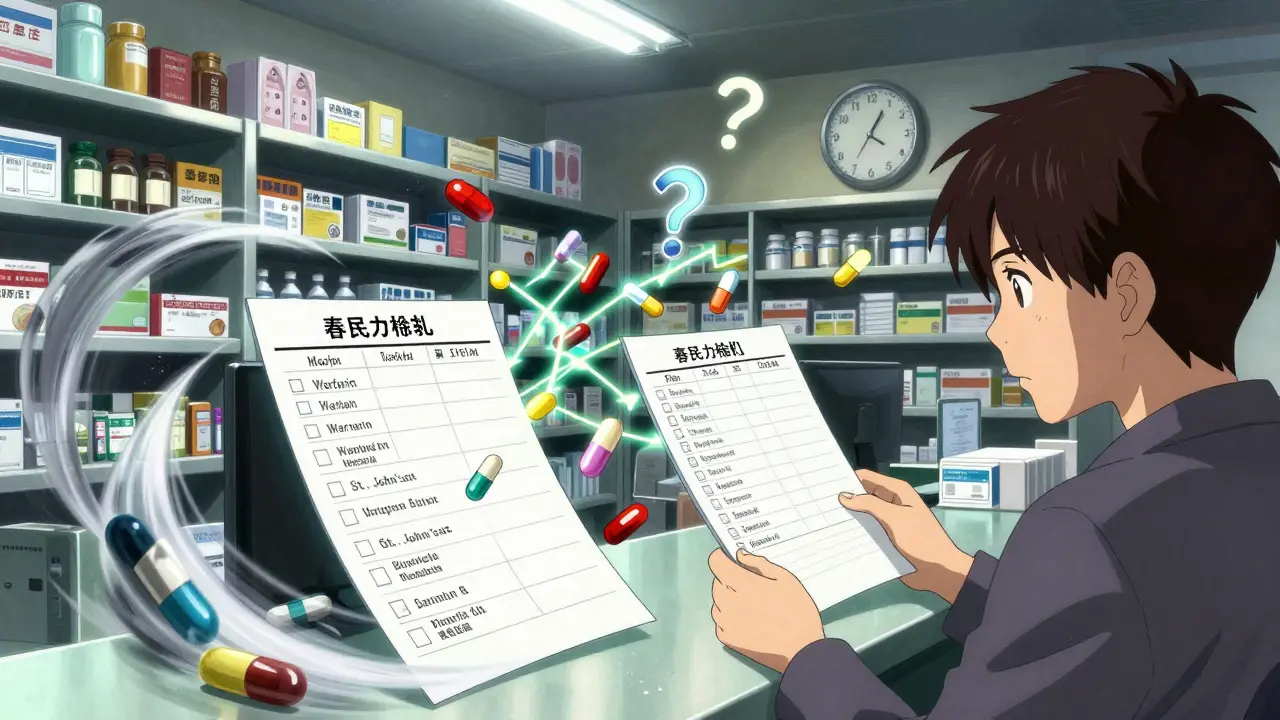
- Missing supplements: Herbal products, vitamins, or over-the-counter painkillers like ibuprofen or aspirin are often not included in hospital records. These can clash with prescription drugs. For example, St. John’s Wort can make blood thinners like warfarin ineffective.
Patients on five or more medications are at the highest risk. The CDC reports that 29% of U.S. adults take five or more drugs daily. That’s a lot of room for something to go wrong. A 2023 Medscape survey found that 41% of patients were confused about their meds after leaving the hospital-and 27% of those on five or more drugs had at least one potential interaction.
What You Can Do Before You Leave
You are your own best advocate. Don’t assume someone else is handling this. Here’s what to do before you walk out:- Bring a full list of everything you take at home-prescription, over-the-counter, vitamins, supplements, herbal remedies. Include dosages and how often you take them. Don’t rely on memory. Write it down.
- Ask for a written discharge med list before signing out. Make sure it’s clear, complete, and matches what you were taking before admission.
- Ask three key questions:
- “What’s new on this list?”
- “What did I stop taking?”
- “Why was this changed?”
- Get it in writing and ask if it’s been sent to your primary care doctor or pharmacy. If not, ask how to make sure it is.
If you’re discharged on a weekend or holiday, don’t wait. Call your doctor’s office the next day. Ask them to confirm the list. Many hospitals now offer discharge follow-up calls. Ask if that’s available.
What Happens After You Go Home
Your work doesn’t end at the hospital door. In fact, the first 30 days are the most dangerous. A 2023 study showed that 1 in 4 medication-related readmissions happen within two weeks of discharge.Here’s what to do next:
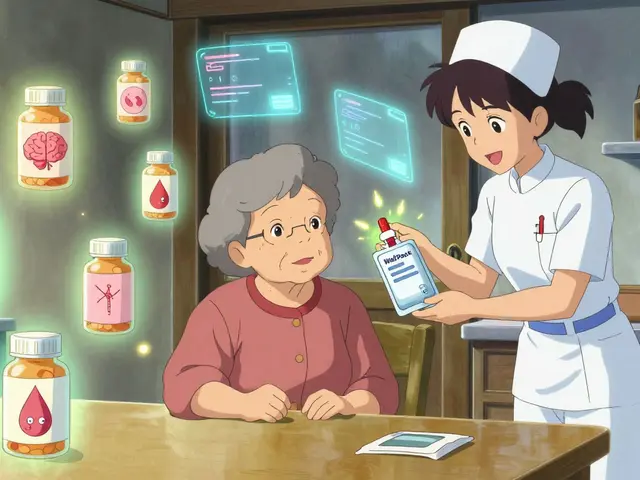
- Take your new med list to your pharmacy. Pharmacists are trained to spot interactions. Let them compare your old and new lists. They can catch things your doctor might miss.
- Set up reminders for new doses or schedules. Use a pill organizer, phone alerts, or a printed schedule. Don’t guess.
- Watch for side effects. Dizziness, nausea, unusual bruising, swelling, confusion, or fatigue can signal a bad interaction. Don’t ignore them.
- Schedule a follow-up with your primary care provider within 7-14 days. This isn’t optional. Medicare and private insurers now pay for Transitional Care Management visits (codes 99495/99496) specifically for this purpose. If your doctor doesn’t offer it, ask why.
And if you’re seeing multiple specialists? That’s a red flag. A 2022 MGMA report found that 38% of patients with multiple specialists had conflicting medication instructions. One doctor might restart your beta-blocker. Another might have stopped it. Make sure your primary care provider is coordinating everything.
The Role of Technology-and Its Limits
Hospitals are using software to help. Epic and Cerner systems now auto-generate discharge lists. Some use AI to scan discharge notes for missing meds. Mayo Clinic’s pilot system detects omissions with 94.3% accuracy. But here’s the catch: technology can’t replace conversation.Dr. David Bates from Harvard says, “A computer can flag a missing drug, but it can’t ask the patient if they actually took it for six months or stopped it because it made them sick.”
That’s why the best systems combine tech with human touch. PipelineRx, a telepharmacy service, uses trained pharmacists to call patients within 24 hours of discharge. In their pilot programs, they reduced 30-day readmissions by 14.7%. But it takes time. The average reconciliation process should take 15-20 minutes per patient. Most hospitals only allow 7.3 minutes.
What to Do If Something Feels Off
If you’re unsure about your meds after discharge:- Don’t stop or change anything on your own.
- Call your primary care doctor or pharmacist. Say: “I just got out of the hospital and I’m confused about my new meds. Can you help me compare what I was on before and what I’m on now?”
- If you’re having side effects, go to urgent care or call your doctor. Don’t wait for your next appointment.
- Keep a written log: What you took, when, and how you felt. This helps your doctor spot patterns.
One Reddit user shared how her father was discharged after heart surgery without his blood thinner. Two weeks later, he had a pulmonary embolism. He almost died. He didn’t know the drug had been stopped. No one told him to restart it.
Final Checklist Before You Leave the Hospital
Before you sign out, ask for this:- A printed, clear list of all medications you’re taking at home-including names, doses, and frequency.
- A list of what was stopped during your hospital stay.
- A list of what was newly started.
- Confirmation that this list was sent to your primary care doctor and pharmacy.
- Your doctor’s direct phone number or a contact for medication questions after hours.
- Explanation of why each change was made.
If they can’t give you all this, ask for a delay. Say: “I need to understand this before I go home.”
Medication reconciliation isn’t just a hospital procedure. It’s your right. And it’s your responsibility to make sure it’s done right.
What’s the difference between medication reconciliation and just getting a new prescription?
Medication reconciliation isn’t just about writing a new prescription. It’s about comparing your entire medication history before, during, and after hospitalization. A new prescription might only cover one drug. Reconciliation looks at all of them-prescription, over-the-counter, supplements-and checks for gaps, duplicates, and dangerous combinations. It’s a full audit, not a simple update.
Can I rely on my pharmacy to catch errors?
Pharmacists are trained to spot interactions, and they can catch many mistakes. But they only see what’s in your current prescription record. If your hospital didn’t send the updated list, your pharmacy won’t know you were on a different dose before. That’s why you need to bring your own list and ask them to compare it. Don’t assume they have all the info.
Why do hospitals stop some medications during a stay?
Some meds are stopped because they interfere with treatment. For example, blood thinners might be paused before surgery to reduce bleeding risk. Or diabetes drugs might be held if you’re not eating. But stopping them doesn’t mean you never need them again. The mistake happens when no one reviews whether to restart them after you’re stable. That’s why reconciliation is essential.
Is it okay to take supplements after discharge?
Some supplements are safe. Others can be dangerous. St. John’s Wort can make blood thinners, antidepressants, or birth control pills less effective. Garlic, ginkgo, or fish oil can increase bleeding risk. Always tell your doctor what you take-even if you think it’s “just a vitamin.” Many hospitals don’t record supplements unless you mention them.
What if I don’t have a primary care doctor?
If you don’t have a regular doctor, ask the hospital’s discharge planner to connect you with a community clinic or health center. Many hospitals have partnerships with local providers who can help with post-discharge care. You can also visit a community pharmacy with a medication therapy management (MTM) program. Pharmacists there can review your full list and help you stay safe.






Man, this post hit hard. I had my mom discharged after a stroke last year, and the meds list they gave us was a mess. Half the stuff she was on before was gone, and they didn’t even mention the blood thinner they’d taken off. She didn’t know to ask, and the nurse just said, ‘You’ll get a call from your doctor.’ No call. Two weeks later, she fell, had another mini-stroke. Turns out the warfarin was never restarted. I spent three days calling every department until I got someone to admit they messed up. It’s not just about the hospital - it’s about the whole system being broken. Patients aren’t trained to be medical detectives, but we have to be now.
And yeah, the discharge summary is the only thing that matters. I’ve seen pharmacy labels with wrong doses because the hospital didn’t update the system. Don’t trust the label. Don’t trust memory. Trust paper. And make them print it twice.
Also - supplements. My mom was taking turmeric for ‘inflammation.’ No one asked. Turns out it thins blood. She was on two blood thinners. That’s how you end up in the ER with a bleeding ulcer. Just say it all. Even if it’s ‘I chew garlic cloves every morning.’ Say it.
And if you’re discharged on a Friday? Don’t wait. Call your PCP Saturday morning. They’re probably at brunch, but they’ll answer. I did. They were shocked I called. That’s how bad the system is.
Bottom line: if you don’t have a written list with names, doses, and times - you don’t have a discharge. You have a gamble.
thank you for this. 🙏
in india, we don’t even get a printed list. sometimes, we don’t get a verbal explanation either. the doctor just says, ‘take these’ and hands over a plastic bag with unlabeled pills. no one asks what they are. we don’t know how to ask.
my uncle was discharged after a heart procedure. they gave him three pills. he took them for a month. then he got dizzy. went to a local clinic. the doctor said, ‘this is a blood pressure pill, you were never supposed to take it.’ turns out, it was meant to be temporary. no one told him. no one wrote it down.
we need simple, local-language instructions. not english medical jargon. not a computer printout. just: ‘take one white pill every night. stop after 10 days.’
hospitals don’t see us as people. they see us as numbers. but we’re not numbers. we’re someone’s son. someone’s mother. someone’s neighbor.
thank you for saying this out loud.
so let me get this straight - you’re telling me hospitals are too lazy to write down what meds you’re on? and now you want patients to be their own pharmacists? lol. i work in a hospital. we’re understaffed. we have 12 patients per nurse. no one has 20 minutes to explain warfarin to grandma who doesn’t remember her own birthday.
and don’t even get me started on ‘bring a full list.’ most people can’t tell you what their blood pressure med is called. they just say ‘that blue pill.’
this isn’t negligence. it’s systemic collapse. you want a solution? hire more pharmacists. pay them. don’t make the patient do the job of five people.
also - who the hell is gonna call their doctor on saturday? i work weekends. i don’t answer calls from strangers. and neither should you.
just… stop blaming patients. we’re drowning here too.
you know what this really is? a scam. hospitals make money when you come back. every readmission? they get paid again. so why would they actually fix this? they want you to forget your meds. they want you to have a ‘bad reaction.’ so you come back in 3 weeks and they bill insurance for another ‘complex case.’
they don’t care if you live or die. they care if you’re a revenue stream.
look at the numbers - 836k preventable events? that’s not a mistake. that’s a business model.
and don’t tell me about ‘technology.’ epic and cerner? those are owned by the same companies that own insurance. they don’t want you to get better. they want you to keep paying.
the only person who cares about your meds? you. and your family. no one else. so print it. double-check it. scream at them. because if you don’t, you’re signing your own death warrant.
they’re not trying to help you. they’re trying to profit from your confusion.
How quaint. A well-meaning but fundamentally naive piece of advocacy masquerading as public health guidance. Let’s be clear: the problem isn’t ‘poor communication’ or ‘staff shortages.’ The problem is that healthcare in the U.S. is a profit-driven, bureaucratic nightmare that has no intrinsic incentive to prioritize patient safety over billing codes.
And let’s not pretend that giving patients a ‘written list’ is a solution. That’s like handing a drowning man a life jacket made of tissue paper. The real issue? The entire system is designed to offload responsibility onto the most vulnerable. The elderly. The non-English speakers. The mentally unwell. The uninsured.
Meanwhile, the hospitals that ‘claim’ to have reconciliation protocols? They’re using AI to generate discharge summaries that are 94% accurate - then assigning a 23-year-old medical assistant to hand them to a patient who’s still sedated from morphine.
And yes - you want us to ‘call our doctor’? On a Saturday? After a 72-hour hospital stay? Please. The primary care physician who ‘coordinates care’ hasn’t seen the patient in three years and doesn’t even know they were hospitalized.
This isn’t about reconciliation. It’s about systemic abandonment. And until we stop treating healthcare as a commodity, this will keep happening. Again. And again. And again.
thank you for writing this.
my dad had a heart attack last year. they gave him a list. i read it. it said he was on lisinopril 20mg. he was on 10mg for 5 years. i asked. they said ‘we upped it.’ no one told him. no one explained why.
i took him to the pharmacy. the pharmacist said ‘this is wrong.’ she called the hospital. they fixed it.
you don’t need to be a doctor. you just need to be awake.
ask. write. double-check. don’t be polite. be persistent.
they’re not trying to hurt you. they’re just overwhelmed. but that’s not your problem. your job is to make sure you go home safe.
one less readmission starts with you.
Medication reconciliation is not a suggestion. It is a standard of care, as defined by The Joint Commission and mandated by CMS. Hospitals that fail to meet these standards risk accreditation loss and reimbursement penalties. The fact that only 65% complete it properly is a failure of leadership, not frontline staff.
Technology alone cannot resolve this. Human verification is non-negotiable. The 15–20 minute reconciliation window is not a luxury - it is a clinical necessity. Reducing it to 7.3 minutes is not efficiency - it is negligence.
Patients must be empowered, yes. But the onus for systemic reform lies with administrators, not with the elderly woman who doesn’t know her own medication list.
This is not a patient problem. It is an institutional failure.
As a clinical pharmacist with 18 years of experience in both U.S. and Indian healthcare systems, I can confirm that the root cause of post-discharge medication errors lies not in patient non-adherence, but in fragmented information systems and lack of standardized handoff protocols.
While patients are advised to bring a complete list, this is often impractical - especially for those with polypharmacy, cognitive impairment, or limited health literacy. The burden of reconciliation must be borne by the healthcare team, not the patient.
Successful models exist: Integrated discharge teams comprising pharmacists, nurses, and care coordinators reduce adverse events by up to 60%. The UK’s NHS uses structured discharge summaries with barcode scanning and direct pharmacy integration. Canada mandates pharmacist-led medication reviews within 72 hours of discharge.
Here in India, we have piloted community health worker follow-ups using voice-based reminders in regional languages. Results: 41% reduction in readmissions. The solution is not more paperwork - it is systemic redesign.
Until hospitals invest in interoperable systems and dedicated reconciliation personnel, patient advocacy will remain a stopgap - not a solution.