
CBD Medication Interaction Checker
This tool helps identify potential interactions between your prescription medications and CBD oil based on CYP450 enzyme inhibition. Note: This is for informational purposes only and should not replace medical advice.
Check Your Medications
When you take CBD oil alongside your prescription meds, something quiet but powerful is happening inside your liver. Your body’s main drug-processing system-called the CYP450 enzyme family-is being slowed down. This isn’t just a minor concern. It’s the reason some people feel dangerously sleepy after starting CBD, or why their blood thinners suddenly become too strong. The science behind this isn’t new, but the number of people affected is growing fast.
How CBD Slows Down Your Medications
The CYP450 system is made up of more than 50 enzymes, but just six of them handle about 90% of all prescription drugs. CBD doesn’t just touch one or two-it hits CYP3A4, CYP2C9, CYP2C19, CYP2D6, and CYP2B6 hard. These are the same enzymes that break down warfarin, clobazam, antidepressants, statins, and even some painkillers. When CBD blocks them, your meds don’t get cleared out the way they should. They build up. And when they build up, side effects get worse.
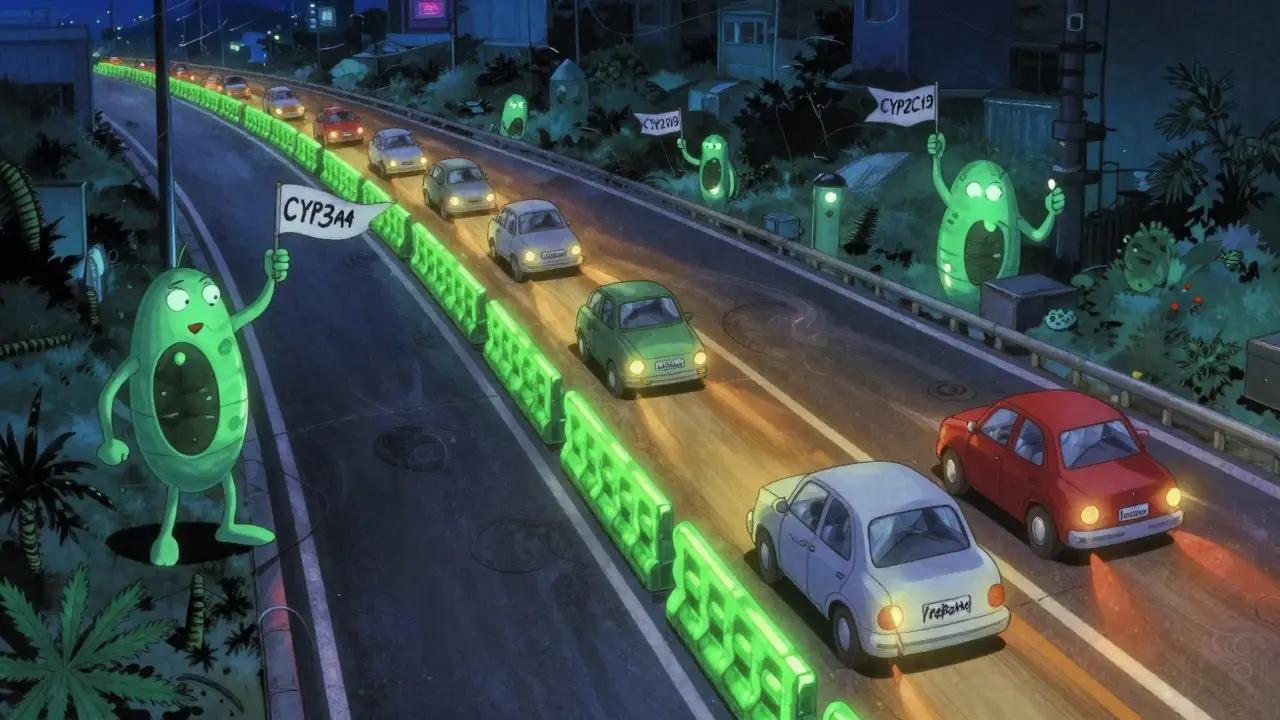
Think of it like traffic. Normally, your liver is a busy highway where drugs zip through and get broken down. CBD slams on the brakes. Cars (your medications) pile up. Some of them, like clobazam, are especially sensitive. In one study, when people took Epidiolex (a purified CBD drug) with clobazam, the active part of clobazam in their blood jumped by 60%. That’s not a small change-it’s enough to make someone feel like they’re drugged all day.
Real People, Real Consequences
It’s not just theory. Real patients are reporting the effects.
One person with epilepsy started taking CBD oil and noticed they couldn’t stay awake. Their clobazam levels went from 600 ng/mL to over 1,000 ng/mL in two weeks. Their neurologist had to cut their dose in half just to get them back to normal.
Another patient on warfarin saw their INR-how thick their blood is-spike from 2.5 to 5.8 after adding CBD. That’s a level that puts you at risk for internal bleeding. They needed emergency treatment with vitamin K.
These aren’t rare cases. A 2023 survey of 217 medical cannabis users found that 34% felt unusually sleepy when combining CBD with their meds. Among those taking drugs processed by CYP2C19-like clobazam, diazepam, or proton-pump inhibitors-the number jumped to 58%.
And it’s not always bad news. Some patients have used this interaction intentionally. One chronic pain patient worked with their doctor to reduce their fentanyl dose by 40% after starting CBD. Because CBD slowed down how fast their body cleared fentanyl, the same amount lasted longer. But this only works under strict medical supervision. Trying it on your own is dangerous.
Which Medications Are Most at Risk?
Not all drugs are equally affected. The ones you need to watch out for fall into three categories:
- Narrow therapeutic index drugs-These have a tiny window between being effective and being toxic. Even a small increase in blood levels can be deadly. Examples: warfarin (blood thinner), clobazam (anti-seizure), phenytoin (anti-seizure), cyclosporine (immunosuppressant), and theophylline (asthma).
- Central nervous system depressants-Drugs that make you sleepy. CBD adds to that effect. Examples: benzodiazepines (like lorazepam), opioids (like oxycodone or fentanyl), sleep aids (like zolpidem), and even some antidepressants (like trazodone).
- Drugs metabolized by CYP2C19 or CYP3A4-These are the two enzymes CBD hits hardest. If your drug label says it’s processed by these enzymes, assume CBD will interfere.
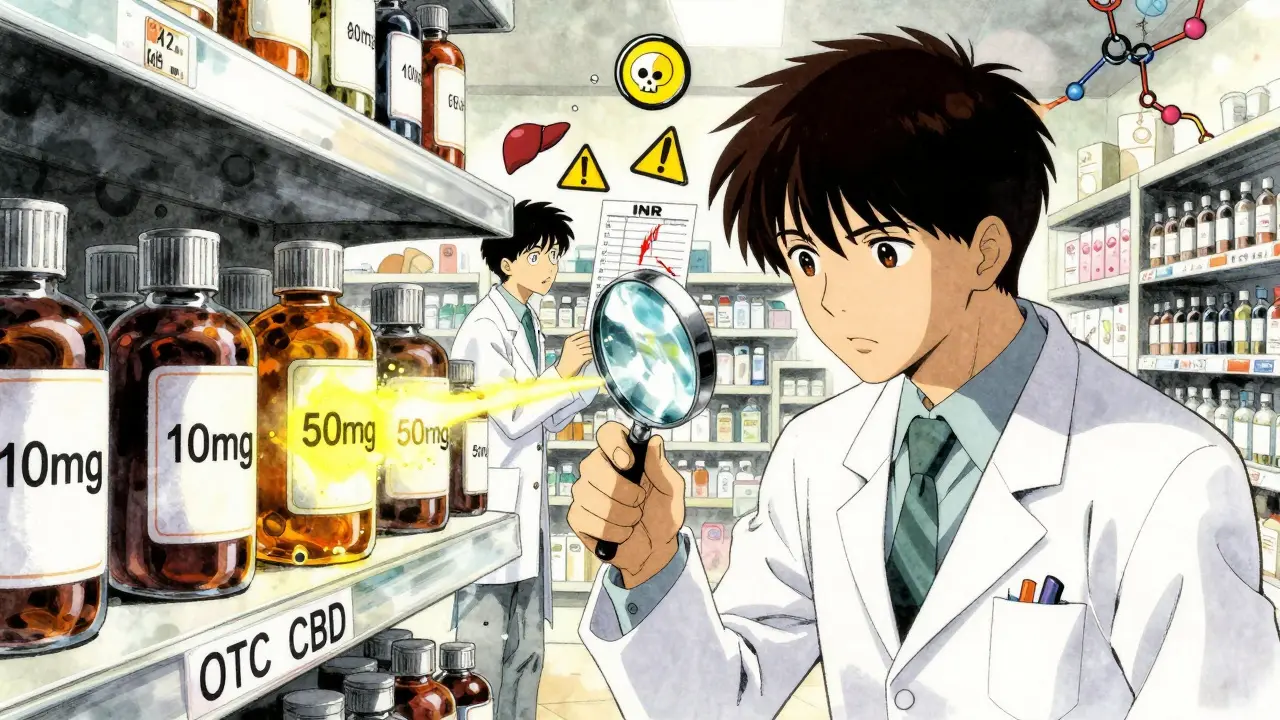
The FDA’s Epidiolex label warns about interactions with clobazam and valproate. But here’s the problem: most CBD products sold online aren’t Epidiolex. They’re unregulated. One 2022 study found that 42% to 121% of the CBD listed on the label was actually in the bottle. You could be taking twice as much as you think-and that doubles your risk.
Why Sedation Happens (And Why It’s Not Just ‘CBD Making You Chill’)
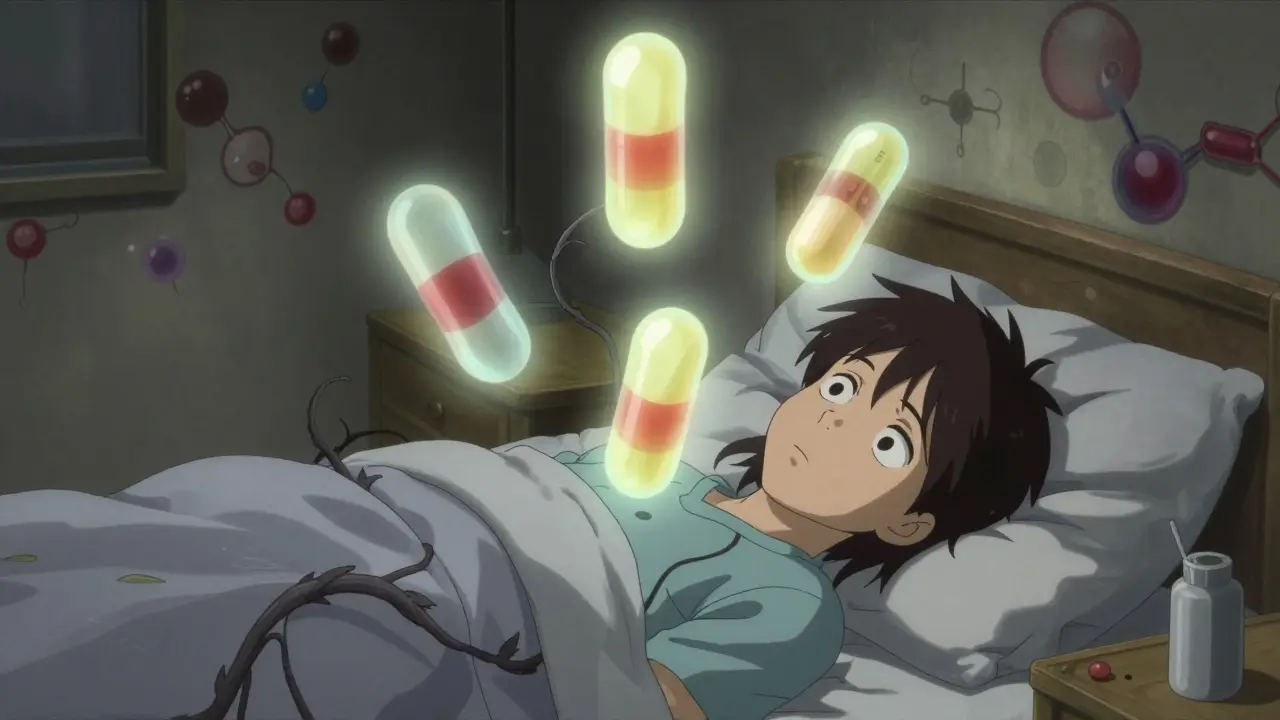
Many people think feeling sleepy after taking CBD is just part of the “relaxing” effect. But that’s not always true. Sometimes, it’s your other meds piling up.
Take a person on sertraline (Zoloft) for anxiety. Sertraline is broken down by CYP2C19 and CYP3A4. Add CBD, and suddenly, sertraline levels rise. That means more drowsiness, dizziness, even confusion. The person doesn’t realize it’s not the CBD-it’s the combo.
Same with clonazepam (Klonopin). It’s a benzodiazepine. CBD doesn’t just add to its sedative effect-it prevents your liver from clearing it. The result? You’re not just tired-you’re foggy, uncoordinated, maybe even at risk for falls or car accidents.
The sedation isn’t a feature. It’s a warning sign.
What You Can Do (And What You Shouldn’t)
If you’re on prescription meds and thinking about trying CBD, here’s what actually works:
- Talk to your doctor or pharmacist first. Don’t assume they know about CBD interactions. Bring up the name of your meds and ask: ‘Could CBD affect how these are processed?’
- Get a blood test before and after starting CBD. For drugs like warfarin, clobazam, or phenytoin, a simple blood test can show if levels are rising. Do it 3-5 days after you start CBD.
- Start low and go slow. If your doctor says it’s okay, begin with 5-10 mg of CBD per day. Wait a week. Check in with your provider. Don’t jump to 50 mg or 100 mg right away.
- Don’t mix CBD with alcohol or other sedatives. The combined effect can be unpredictable-and potentially life-threatening.
- Watch for new side effects. If you start feeling unusually drowsy, dizzy, confused, or nauseous after adding CBD, stop and call your doctor.
What doesn’t work:
- Staggering doses by a few hours. This doesn’t help. CBD sticks around in your system for hours. It doesn’t matter if you take your pill at 8 a.m. and CBD at 8 p.m.-your liver is still blocked.
- Buying “CBD-only” products that claim to be “THC-free.” Even pure CBD inhibits CYP450 enzymes. THC isn’t the problem here.
- Assuming natural = safe. Just because it comes from a plant doesn’t mean it won’t interfere with your meds.
What’s Being Done to Fix This?
The problem is growing-and so is the response.
In 2024, the European Medicines Agency made it mandatory for all cannabinoid-based medicines to include CYP450 interaction warnings on their labels. The FDA has issued warning letters to 15 CBD companies for failing to mention drug interactions on their packaging.
Pharmacists are now required to complete 3 hours of continuing education on cannabinoid-drug interactions. In 2023, over 1,200 clinicians took a specialized course on managing these interactions.
Researchers are also working on solutions. One company is testing a nanoparticle form of CBD that might avoid liver metabolism altogether. Another is building a free online tool called the “Cannabis-Drug Interaction Checker” to help doctors quickly see if a patient’s meds and CBD could clash.
But for now, the best tool you have is information-and honesty with your care team.
Bottom Line: CBD Isn’t Harmless
CBD isn’t magic. It’s a powerful biochemical agent that changes how your body handles other drugs. The fact that it’s sold in gas stations and online doesn’t make it safe to mix with your prescriptions.
If you’re taking any medication that has a narrow therapeutic window, or that makes you drowsy, CBD could push you into danger. Sedation isn’t a bonus-it’s a red flag. And that spike in your INR? That’s not just a number. It’s your body screaming for help.
There’s no reason to avoid CBD if it helps you. But there’s every reason to use it carefully. Talk to your doctor. Get tested. Don’t guess. Your liver is working hard to keep you alive. Don’t make it work harder than it has to.
Can I take CBD with my blood thinner like warfarin?
No, not without close medical supervision. CBD strongly inhibits CYP2C9, the enzyme that breaks down warfarin. This can cause your INR to rise dangerously high, increasing your risk of internal bleeding. If you must use both, your doctor needs to monitor your INR closely-within 3-5 days of starting CBD-and adjust your warfarin dose accordingly.
Does CBD make you sleepy because of the CBD itself?
Sometimes, but often it’s not the CBD alone. CBD can cause mild drowsiness, but when combined with other sedating medications-like antidepressants, anti-anxiety drugs, or opioids-it can cause extreme sedation because it slows how fast your body clears those drugs. The sleepiness you feel may be from the combo, not just the CBD.
Are over-the-counter CBD products safe to use with prescriptions?
No. Most OTC CBD products are unregulated and often contain more or less CBD than labeled. A 2022 study found CBD content varied from 42% to 121% of what was stated on the bottle. You can’t know how much you’re actually taking, so you can’t predict how it will interact with your meds. Prescription-grade CBD like Epidiolex is dosed and tested-OTC products are not.
Can I just take CBD at a different time than my meds to avoid interactions?
No. CBD stays in your system for hours and continues to inhibit liver enzymes even if you take your medication later. Spacing doses apart doesn’t prevent the interaction. The enzyme inhibition lasts longer than the CBD’s presence in your bloodstream.
Is CBD safer than THC for drug interactions?
Not necessarily. While THC also inhibits CYP enzymes, CBD has a broader and more potent effect on key enzymes like CYP2C19 and CYP3A4. In fact, CBD is the primary concern in clinical cases involving drug interactions. Even CBD-only products pose a significant risk.
What should I ask my pharmacist about CBD and my meds?
Ask: ‘Which of my medications are processed by CYP2C9, CYP2C19, CYP3A4, or CYP2D6?’ Then ask: ‘Could CBD raise the levels of these drugs in my blood?’ Pharmacists are trained to check for these interactions. Don’t assume they’ll bring it up-ask directly.
For more information, refer to the FDA’s Epidiolex prescribing information, the American Society of Health-System Pharmacists (ASHP) guidelines on cannabinoid interactions (2022), and the 2023 study in Frontiers in Pharmacology on sedation in medical cannabis users.





Man, I started CBD for my back pain and didn’t think twice about my blood pressure med. Turned out I was almost passing out by noon. Got my doctor to check my levels - turns out my amlodipine spiked. Never again. Always ask first.
Oh wow, another ‘CBD is dangerous’ panic piece. Let me guess - you also think sunlight causes cancer because UV rays exist? CBD inhibits CYP450? So does grapefruit. So does turmeric. So does green tea. You’re telling me we should ban all of them? The real problem is lazy doctors who don’t educate patients. Not the plant.
Also, 34% felt sleepy? That’s like 1 in 3. So 2 out of 3 didn’t. Maybe the issue isn’t CBD - it’s people taking 200mg of it while on 5 different meds and then blaming the herb. Grow up.
Thanks for laying this out so clearly. I’ve been nervous about trying CBD for my anxiety since I’m on sertraline, but this made me realize I need to talk to my pharmacist - not just Google it. I’m gonna book an appointment this week. Really appreciate the practical steps too.
As a nurse practitioner, I see this every single week. Patients come in saying, ‘I just started CBD, now I’m dizzy all day.’ We run labs - and sure enough, their phenytoin or clobazam levels are through the roof. It’s not ‘CBD making them sleepy’ - it’s a pharmacokinetic train wreck. Please, if you’re on meds, don’t self-experiment. Talk to someone who knows the science. Your liver will thank you.
THEY WANT YOU TO THINK CBD IS DANGEROUS SO YOU’LL KEEP BUYING PRESCRIPTIONS!! THE FDA IS IN BED WITH BIG PHARMA!! WHY DO YOU THINK THEY ONLY WARN ABOUT EPIDIOLEX AND NOT THE OTHER 1000 BRANDS?? THEY’RE SCARING YOU TO KEEP YOU DEPENDENT!! I TOOK CBD WITH MY WARFARIN AND MY INR WENT DOWN!! THEY LIED!!
Why do people even take CBD? Like, what’s the point? If you’re sick, take your medicine. If you’re not, why are you putting weird oil in your mouth? I don’t get it. And now you’re telling me it messes with my pills? Cool. So don’t do it. Problem solved. Stop overcomplicating everything
You’re all missing the real issue. CBD doesn’t even need to inhibit CYP450 to cause problems. The real danger is the unregulated market. I tested 7 brands from Amazon. 5 had heavy metals. 3 had synthetic cannabinoids. 1 had actual THC. You think your ‘pure CBD’ is safe? It’s a Russian roulette pill with a hemp label. Stop trusting labels. Test your stuff or don’t touch it.
OMG I just realized I’ve been taking CBD with my Xanax 😱 I thought it was helping me chill but now I’m scared I’m gonna pass out in my car 😭 I’m calling my doctor tomorrow and stopping it immediately 💔🙏
I appreciate the depth here. I’ve been using CBD for neuropathy and was worried about my statin. I reached out to my pharmacist - she pulled up my med list and flagged that simvastatin is metabolized by CYP3A4. We adjusted my dose and I’m now on a low 10mg CBD daily with monthly bloodwork. It’s working. The key isn’t fear - it’s communication. Thanks for pushing that message.