
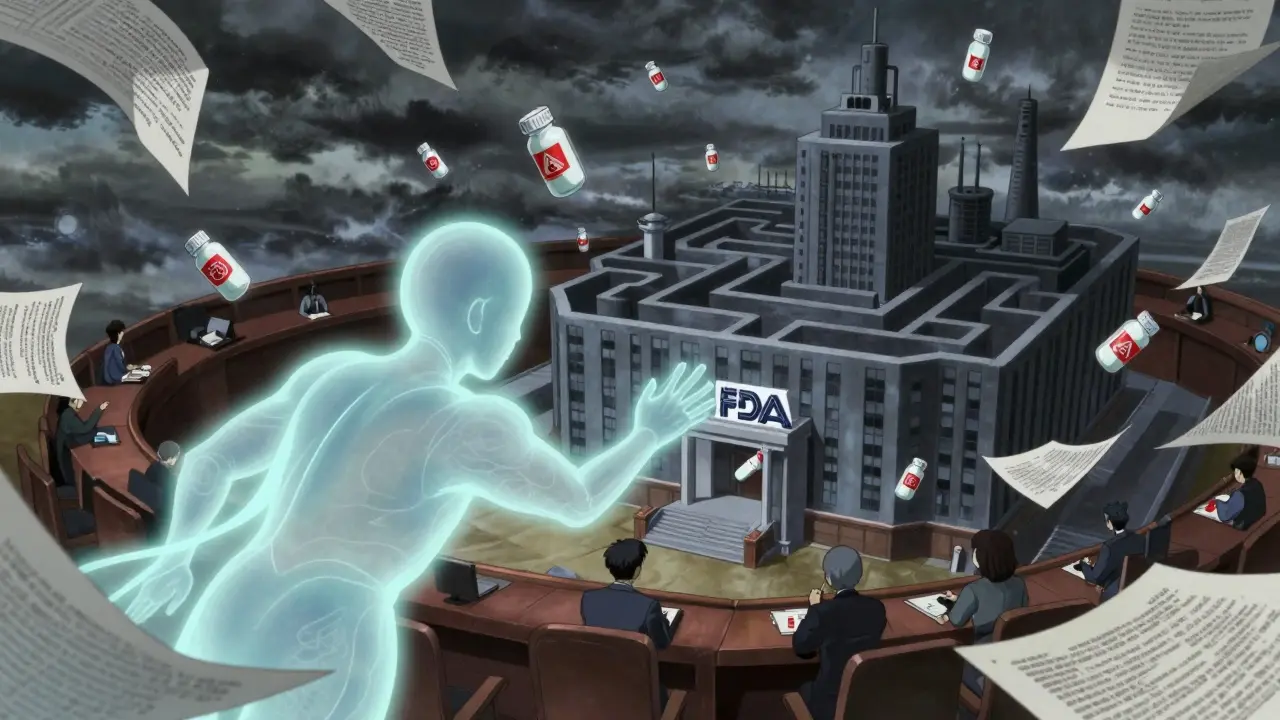
When a medication turns out to be dangerous, people assume the FDA just pulls it off the shelves. That’s not how it works. The FDA doesn’t have the power to force a drug company to recall a medicine. Instead, it asks. And in almost every case, the company agrees.
How the FDA Actually Removes Unsafe Drugs
The FDA’s authority to remove unsafe drugs comes from the Federal Food, Drug, and Cosmetic Act (FD&C Act) of 1938. But here’s the catch: that law never gave the agency the right to order a recall. It can only request one. This isn’t a loophole-it’s the law. If a drug maker refuses to recall a product, the FDA can’t simply shut it down. It has to go to court.
That means the real power lies with the manufacturer. The FDA can issue a public warning, shut down production, or get a federal judge to stop distribution. But the actual removal of the drug from pharmacies, hospitals, and shelves? That’s done by the company. In 99.7% of cases, companies comply within 10 days after the FDA raises a red flag. Why? Because the alternative-facing a lawsuit, bad press, or losing their license-is far worse.
Why the FDA Can’t Just Order Recalls
It’s not about laziness or bureaucracy. It’s about how the law was written. When the FD&C Act was passed, drug companies were mostly small, and the market was simpler. Mandatory recalls weren’t seen as necessary. Today, with global supply chains and complex biologics, that system is strained.
Compare that to medical devices. Under 21 CFR 810, the FDA can legally order a mandatory recall if a device poses a serious health risk. Why the difference? Because in 1976, Congress gave the FDA stronger tools for devices after a series of dangerous implant failures. Drugs? Still stuck with the 1938 rules.
Experts like Dr. Sidney Wolfe from Public Citizen have called this a dangerous gap. In 2018, when contaminated blood pressure meds (valsartan) were found to contain a cancer-causing chemical, it took six months for all affected lots to be pulled. Why? Because some manufacturers, especially overseas ones, dragged their feet. The FDA could only nudge them.
The Three Levels of Drug Recalls
Not all recalls are the same. The FDA classifies them into three categories based on risk:
- Class I: Highest risk. Use of the drug could cause serious injury or death. These make up just 2.1% of all recalls but demand immediate action. Think contaminated injectables or pills with deadly dosing errors.
- Class II: Moderate risk. The drug might cause temporary or reversible harm. This is the most common type-about 68.7% of recalls. Examples include mislabeled pills or packaging that doesn’t list all ingredients.
- Class III: Lowest risk. The product won’t harm you, but it violates labeling or manufacturing rules. These are often about incorrect expiration dates or minor labeling mistakes. They make up nearly 29% of recalls.
The classification determines how fast and how far the recall goes. A Class I recall might require hospitals to notify every patient who got the drug. A Class III might just need a notice to distributors.
How a Recall Starts
Recalls don’t usually start with a patient complaint. Most begin with the manufacturer itself. Companies are required to run annual stability tests on their drugs. If they spot contamination, degradation, or inconsistent potency, they must report it to the FDA and initiate a recall.
But the FDA also finds problems on its own. Its MedWatch system collected over 1.2 million adverse event reports in 2022. That’s doctors, pharmacists, and even patients reporting side effects that weren’t seen in clinical trials. When patterns emerge-like a spike in liver damage linked to a specific batch-the FDA investigates.
Once the FDA confirms a risk, it contacts the manufacturer. The company then develops a recall strategy: how far back to trace the product, how to notify pharmacies, whether to issue public alerts, and how to collect returned drugs. The FDA reviews and approves that plan.
What Happens When a Company Says No
It’s rare, but it happens. In the last decade, only 3 out of 15,241 drug recalls required FDA enforcement action. Still, when it does, the agency has to go to court. Under Section 304 of the FD&C Act, the FDA can ask a federal judge to issue an injunction. That stops the company from shipping any more of the drug. It can also seize existing stock.
But here’s the problem: court cases take time. While the legal wheels turn, patients might still be getting the unsafe drug. That’s why the FDA’s main tool is pressure-not power. Public alerts, media outreach, and coordination with state health departments make it too costly for companies to resist.
Why Hospitals Struggle With Recalls
Even when the system works, it’s messy on the ground. A 2022 survey by the American Society of Health-System Pharmacists (ASHP) found that 68% of hospital pharmacies had trouble identifying which specific lots of a drug were affected. Why? Because manufacturers use inconsistent lot numbering systems. One company uses a 10-digit code. Another uses letters and numbers mixed with dates. No standard.
And 42% of pharmacy directors said communication delays during Class I recalls caused patient notifications to be late-by an average of 3.7 days. That’s dangerous. If a drug causes seizures or heart problems, every hour counts.
Hospitals now spend millions on recall tracking software. Companies like Recall Masters and Recall Index help hospitals monitor alerts, match lot numbers, and automate notifications. The U.S. recall management industry is now worth $287 million-a sign of how broken the system has become.
The Push for Change
There’s been a push to fix this. The FD&C Modernization Act of 2022 included a provision-Section 604-that would have given the FDA mandatory recall authority for drugs. It was removed during committee review. Industry lobbyists, especially from PhRMA, spent $8.2 million in Q2 2023 fighting the change. They argue that voluntary recalls work: 99.98% effectiveness over 10 years.
But critics point out: 99.98% isn’t 100%. And when a drug causes death, that 0.02% matters. The proposed PREVENT Pandemics Act (S.2871) now includes a section that would give the FDA power to order recalls of drugs and biologics during public health emergencies. But it’s still stuck in Congress.
Meanwhile, the FDA has tightened its own rules. As of September 2023, manufacturers must act within 24 hours of a Class I recall notice-not 72 hours as before. That’s progress. But it’s still a request, not a command.
What Patients and Providers Should Do
If you’re on a medication, don’t wait for a recall notice. Check the FDA’s recall page regularly. Pharmacies are required to notify you if your drug is recalled, but they don’t always do it well. If your pill looks different, or you hear about contamination in the news, call your pharmacist.
Hospitals and clinics must have written recall protocols. They need someone assigned to monitor FDA alerts, a system to track lot numbers, and training for staff. Without that, even a well-designed recall can fail.
The system isn’t broken-it’s outdated. The FDA is doing its best with limited tools. But when lives are on the line, asking nicely shouldn’t be the only option.





so the fda can't just yank a drug off the shelf? lol. we pay taxes for this? i had a relative die from a contaminated generic blood pressure med. they waited six months because the manufacturer was 'reviewing data.' six months. that's not a system, that's a death sentence with a side of bureaucracy.
this is wild but also kinda makes sense? like, imagine if the gov just seized your company's product overnight-you’d fight back hard too. still, 99.7% compliance is impressive. maybe we just need better incentives instead of forcing it? 🤔
class i recalls should be automatic. no excuses.
oh my gosh, i had no idea the system was this… medieval? 😅 like, we have self-driving cars but still rely on companies to voluntarily recall pills that might kill people? the fact that hospitals are spending $287 million just to track lot numbers is both hilarious and terrifying. imagine if your Netflix password expired and you had to call 12 different people to figure out why you couldn’t watch the new season-except this time, someone could die. we need a barcode system. like, scannable. like, QR codes on the blister packs. why isn’t this a thing yet??
so the FDA's got a 'please' button and a 'sue you later' button? and they use the please button 99.98% of the time? wow. real leadership. meanwhile, my dog gets more oversight when he takes a pill. 'please take your heartworm med, sir.' 'no.' 'ok, here's a treat.' 'no.' 'ok, we'll put you on a leash.' ...wait, that's not how it works. but it should be.
the fact that this isn't national news is insane. i'm a nurse and we get recall alerts via email-sometimes 3 days late. if someone gets a bad batch and has a seizure? we're scrambling. hospitals aren't equipped for this. someone needs to make this mandatory. like, now. not in 2030 when Congress finally gets around to it.
interesting. i come from india where recalls are even messier. sometimes the drug just disappears from shelves without warning. no public notice. no tracking. i guess the system here is better than nothing, but still… it feels like playing russian roulette with your meds.
The current regulatory framework governing pharmaceutical recalls is predicated upon a voluntary compliance model rooted in the Federal Food, Drug, and Cosmetic Act of 1938. This model, while historically pragmatic, is demonstrably inadequate in the context of contemporary pharmacovigilance needs, particularly given the scale and complexity of modern drug supply chains. The absence of mandatory recall authority constitutes a structural vulnerability in public health infrastructure.
i just read this whole thing and i’m crying a little. not because i’m sad-because i’m angry. we’ve had decades of warnings. Dr. Wolfe said it in 2018. hospitals are spending millions on software just to keep up. and congress still won’t give the FDA the power to act? it’s not about lobbying money-it’s about who gets heard. the people who die from bad drugs don’t show up to committee hearings. the CEOs do. and that’s the problem. we need to stop treating drug safety like a favor, not a right.
oh wow. america’s so soft. in the uk, if a drug’s dangerous, we just ban it. no begging. no waiting. no 'industry collaboration.' we just say no. and guess what? people don’t die. maybe we should just import our meds from europe instead of trusting your 'please and thank you' system.
the fda is a puppet. big pharma owns them. this whole 'voluntary recall' thing? it's a scam. the real reason they don't have power is because the FDA director gets a private jet from Merck every year. you think that's a coincidence? i don't. and the 'class i' recalls? they're all covered up. they just say 'manufacturing error' and move on. the truth? they knew. they always knew.
The epistemological dissonance between the legal architecture of pharmaceutical governance and the empirical reality of pharmacological risk is profound. The 1938 Act, a product of its time, reflects a pre-industrial conception of market accountability. To maintain this framework in an era of globalized biologics and algorithmic pharmacovigilance is not merely an oversight-it is an ethical failure. The absence of mandatory recall authority constitutes a structural negation of the state's fiduciary duty to protect life.
so you're telling me the fda can't stop a drug that causes cancer? lol. i bet they're in cahoots with the drug companies. and those lot numbers? they're hiding something. i heard the fda puts microchips in pills to track us. this recall thing? it's all a distraction. the real danger is in the water. check your tap. they're putting fluoride in it to make you docile. and the fda won't say anything because they're scared of the illuminati.
funny how everyone says 'just give the fda power' but no one mentions the real problem: the manufacturers don't even test their own drugs properly. i work in pharma QA. half the time, they skip stability tests because it's 'too expensive.' so the fda finds the problem? yeah, because the company didn't. the fix isn't more power-it's more accountability. make them pay millions if they skip a test. then watch how fast they fix it.