

Tacrolimus-Azole Interaction Calculator
Calculate Safe Dose Adjustment
Recommended Adjustment
Adjusted Tacrolimus Dose: mg/day
Expected Tacrolimus Levels:
Normal therapeutic range: 5-10 ng/mL
When someone gets a kidney, liver, or lung transplant, they’re given tacrolimus to stop their body from rejecting the new organ. It works. But it’s dangerous if not managed right. Now add an antifungal like voriconazole or posaconazole - common after transplant to fight fungal infections - and things get risky fast. The two drugs don’t just coexist; they collide. Tacrolimus levels can jump 200% to 500% overnight. That spike doesn’t just show up on a lab report - it can shut down a transplanted kidney in days.
Why Azoles and Tacrolimus Don’t Mix
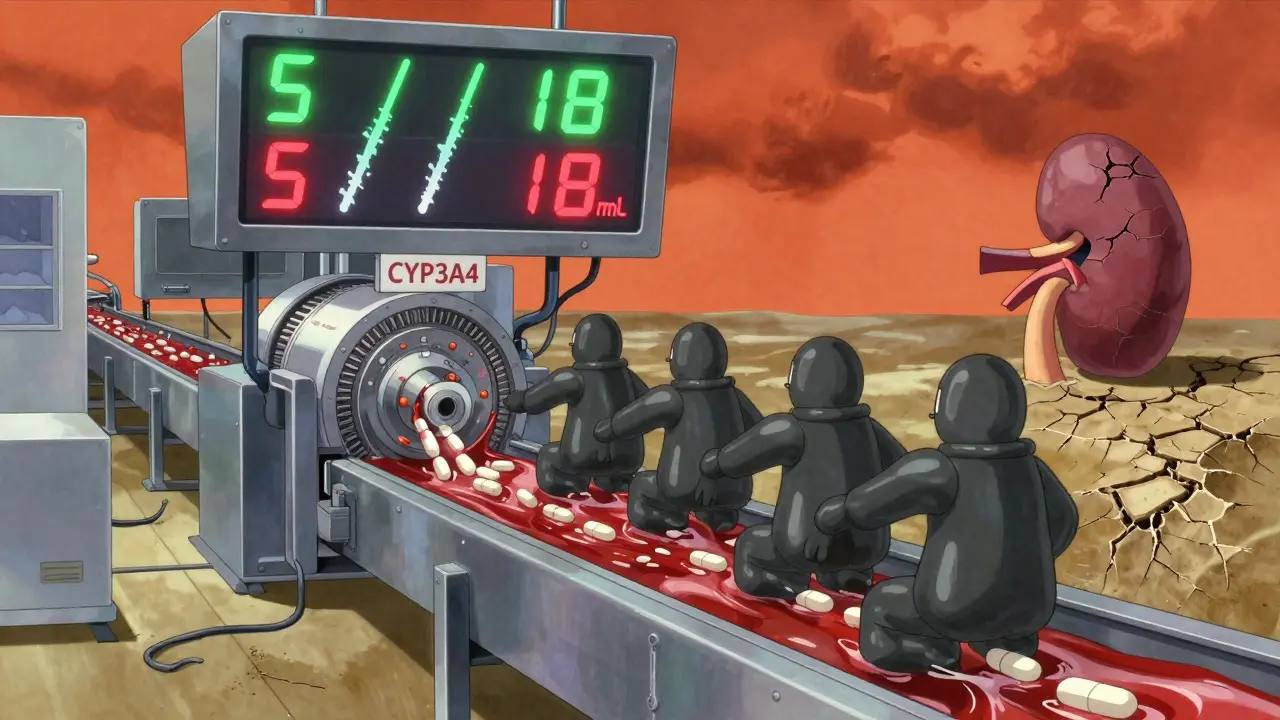
Tacrolimus is broken down by one enzyme system: CYP3A4. It’s the body’s main cleanup crew for this drug. Azole antifungals - ketoconazole, itraconazole, voriconazole, posaconazole - are powerful inhibitors of that same enzyme. They don’t just slow it down. They clog it. Think of it like a factory line. Tacrolimus is the product moving through. Azoles are workers who sit on the conveyor belt. Nothing gets processed. The drug piles up. Blood levels climb. And when they climb too high, the kidneys pay the price.Here’s what the numbers look like. Ketoconazole, the strongest of the bunch, can make tacrolimus levels jump 300-500%. Voriconazole? That’s 100-300%. Even posaconazole, often thought of as "safer," still pushes levels up 80-150%. These aren’t theoretical risks. These are real, documented spikes seen in hospitals every week. A 2022 survey of 127 transplant pharmacists found 89% considered this the most common dangerous interaction they manage. One pharmacist put it bluntly: "We see this weekly. A patient starts posaconazole. Three days later, their tacrolimus level is 18 ng/mL. Normal is 5-10. They’re in acute kidney injury. Again."
The Kidney Takes the Hit
Tacrolimus doesn’t just sit in the blood. It goes straight to the kidneys. There, it narrows blood vessels. It reduces blood flow. It damages the tiny filtering units called tubules. This isn’t a side effect - it’s a direct, dose-dependent toxicity. The higher the level, the worse the damage. Studies show that peak concentrations matter more than average levels. A sudden spike from 7 to 18 ng/mL? That’s enough to cause acute kidney injury in a transplant patient who was stable for months.One patient story from a transplant forum says it all: "My creatinine doubled in 48 hours. I was hospitalized. My kidney biopsy showed acute tubular necrosis - classic tacrolimus toxicity. The only thing that changed? I started voriconazole." This isn’t rare. Research from Johns Hopkins shows azole-tacrolimus interactions account for 15-20% of all tacrolimus-related kidney damage in transplant centers. And the damage isn’t always reversible. Some patients lose graft function permanently.
Not All Azoles Are the Same
You can’t treat all azoles the same. The difference between voriconazole and isavuconazole is night and day. Isavuconazole, approved in 2015, inhibits CYP3A4 much less. Studies show it raises tacrolimus levels by only 30-50%. That’s manageable. But here’s the catch: insurance often won’t cover isavuconazole as first-line. It’s more expensive. So doctors are forced to use voriconazole - the one that spikes levels - even when the safer option exists.Amphotericin B and echinocandins like caspofungin are alternatives. They don’t touch CYP3A4. But they have their own problems. Amphotericin B is toxic to kidneys too. Echinocandins are IV-only. So for outpatient prophylaxis - say, after a lung transplant - azoles are still the go-to. That’s why this interaction persists. It’s not ignorance. It’s trade-offs.
How to Manage It - And When to Avoid It
The American Society of Transplantation says this interaction is "high-risk." They don’t mince words. Their 2022 guidelines say: avoid ketoconazole completely. For voriconazole and itraconazole, cut the tacrolimus dose by 50-75% before starting the azole. For posaconazole, a 25-50% reduction is usually enough. And never, ever start the azole without adjusting the dose first.Monitoring isn’t optional. Daily trough levels for the first 3-5 days. Then 2-3 times a week until stable. Some centers now use concentration-to-dose ratios (C/D) instead of just troughs. Why? Because it accounts for how fast the patient metabolizes the drug. A 2023 study showed using C/D ratios cut nephrotoxicity by 22% compared to standard monitoring.
Electronic alerts in the EHR help - but only if they’re set up right. A 2022 study from UPMC found 35% of severe toxicity cases happened because the system didn’t flag the interaction. Standardized order sets fixed that. Now, when a doctor orders voriconazole, the system auto-suggests a 60% tacrolimus dose reduction and schedules daily labs. Simple. Effective.
What’s Changing in 2026
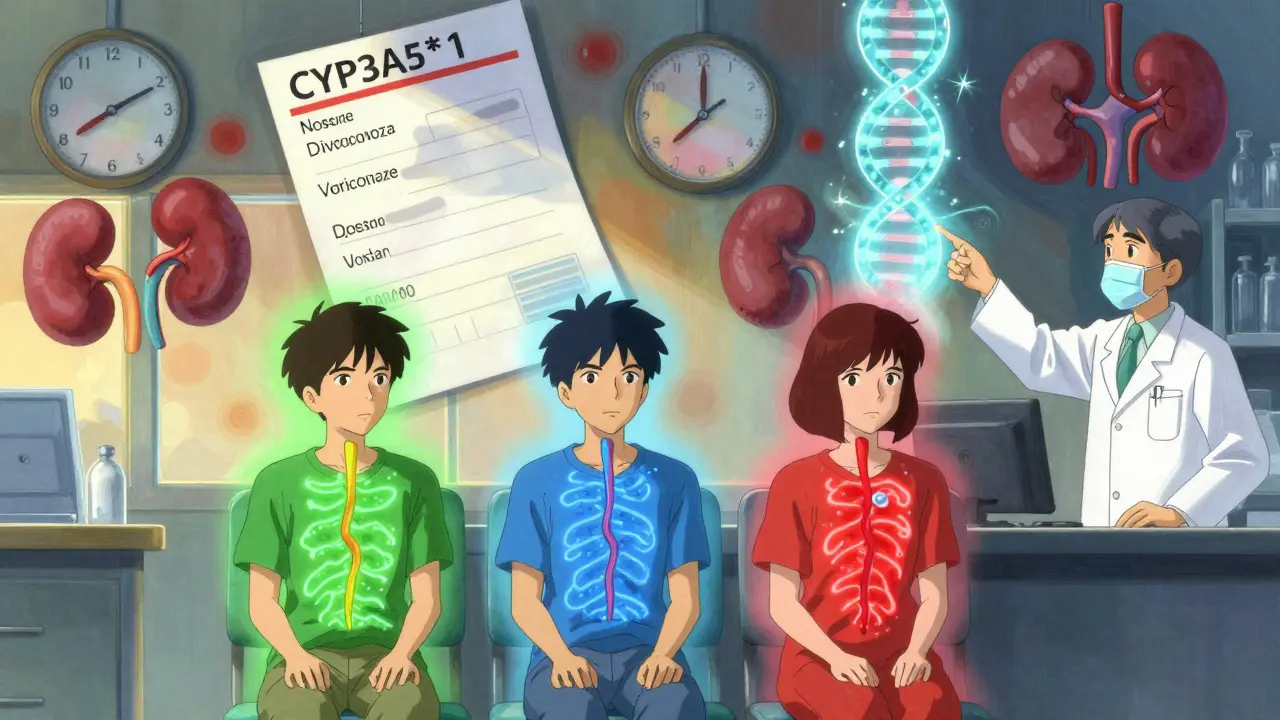
New tools are emerging. The FDA approved a new extended-release form of tacrolimus in 2023. It smooths out the peaks and valleys in blood levels. That means even if an azole pushes levels up, the spikes are less violent. Less stress on the kidneys.Even bigger: genetics. About 10-15% of Caucasians and 50-60% of African ancestry patients have a gene variant called CYP3A5*1. They metabolize tacrolimus faster. That means they need higher doses. But when you add an azole? Their levels still rise - but not as dramatically. In 2024, new guidelines will start recommending genotype testing before starting azoles in high-risk patients. It’s not standard yet. But it’s coming.
Meanwhile, some centers are moving away from tacrolimus entirely. Belatacept, a non-CNI immunosuppressant, doesn’t rely on CYP3A4. It’s used in 15-20% of kidney transplants now. But it’s not for everyone. It’s more expensive. Requires more infusions. And it doesn’t work as well in liver or lung transplants. So for now, tacrolimus stays. And so does the risk.
The Bottom Line
This interaction isn’t a footnote. It’s a leading cause of transplant failure. Every transplant team sees it. Every pharmacist manages it. Every patient on both drugs lives with the fear of a sudden kidney crash. The solution isn’t magic. It’s discipline: know the drugs, reduce the dose before combining, monitor like your patient’s life depends on it - because it does. And push for better options when insurance blocks them. Because isavuconazole isn’t just a drug. It’s a lifeline.Can I take fluconazole with tacrolimus?
Fluconazole is a weaker CYP3A4 inhibitor than voriconazole or itraconazole. It typically raises tacrolimus levels by 20-40%. That’s still significant. Most transplant centers reduce tacrolimus by 25-50% when starting fluconazole, especially if given daily or long-term. Weekly fluconazole for thrush is usually fine without adjustment. But always check levels.
How soon after starting an azole do tacrolimus levels rise?
Levels can start climbing within 24-48 hours. Peak increases usually happen between days 3 and 7. That’s why daily monitoring is critical in the first week. Waiting until day 5 to check levels is too late - the damage may already be done.
Can I stop tacrolimus if my levels spike?
Never stop tacrolimus on your own. Stopping suddenly can trigger acute rejection - which is often worse than toxicity. If levels spike, reduce the dose, not stop it. Work with your transplant team. They’ll adjust the dose, monitor levels, and may temporarily hold the azole if toxicity is severe. The goal is balance: enough immunosuppression to protect the graft, and low enough levels to protect the kidney.
Are there any natural remedies or supplements that make this worse?
Yes. St. John’s Wort induces CYP3A4 and lowers tacrolimus levels - dangerous for rejection. Grapefruit juice, on the other hand, inhibits CYP3A4 just like azoles. Even a single glass can push levels up. Garlic supplements and curcumin may also interfere. Always tell your transplant team about every supplement, herb, or OTC product you take.
Why do some patients have worse reactions than others?
It’s not random. Genetics play a big role. People with the CYP3A5*1 gene variant break down tacrolimus faster, so they need higher doses. But when you add an azole, their levels still rise - just not as high as someone without that gene. Age, liver function, kidney health, and even diet can change how the body handles the interaction. That’s why one-size-fits-all dosing fails.







I’ve seen this play out in my ICU rotation - one patient on voriconazole, next thing you know, their tacrolimus level hits 22. They were stable for 8 months. Then poof. AKI. We had to dialyze them. And the kicker? The pharmacy alert didn’t trigger because the system was set to flag only >300% increases. But 150% is enough to wreck a graft. We need better alerts. And better training. This isn’t rocket science - it’s basic pharmacokinetics.
The part about isavuconazole being cheaper to use long-term but insurance blocking it? That’s the real tragedy. I work in transplant pharmacy. We’ve had patients lose grafts because they couldn’t afford the ‘premium’ antifungal. The system is rigged. We’re treating people based on their insurance tier, not their clinical need. It’s not medical - it’s capitalism.
The assertion that ‘azoles clog the conveyor belt’ is an oversimplification. CYP3A4 inhibition is not mechanical obstruction; it is competitive, reversible, and concentration-dependent. Furthermore, the term ‘kidney damage’ is imprecise. The histopathological correlate is acute tubular necrosis, not interstitial fibrosis or glomerulosclerosis. Precision matters. This post, while clinically relevant, lacks scholarly rigor.
This is why people die. Not because they’re sick. Because someone didn’t check a drug interaction. Because insurance won’t pay for the safe option. Because doctors are too busy to read the damn guidelines. I’m so sick of this. Stop pretending it’s complicated. It’s not. It’s negligence.
You know what’s worse than azole-tacrolimus interactions? People who don’t tell their doctors they’re taking St. John’s Wort because they ‘heard it helps anxiety’ or chugging grapefruit juice because it’s ‘healthy.’ I had a patient who came in with a tacrolimus level of 38. Turns out he was on voriconazole, took grapefruit juice every morning, and was on turmeric capsules ‘for inflammation.’ He didn’t think any of it mattered. I had to explain to him that his kidney biopsy looked like a roadkill raccoon. He cried. I didn’t. I was too tired.
I’m a transplant nurse. I’ve seen this a hundred times. The thing nobody talks about? The emotional toll on patients. They’re not just worried about their kidney. They’re terrified of every new med, every supplement, every ‘natural remedy’ their cousin swears by. We need more compassion in the guidelines. Not just numbers. Real talk. Real support.
The C/D ratio monitoring approach is brilliant. It accounts for inter-individual variability in metabolism far better than trough levels alone. I’ve implemented this at our center over the past year. We’ve seen a 28% reduction in acute kidney injury episodes. The key is consistency. Daily levels aren’t just a suggestion - they’re a lifeline. And yes, we’ve had to fight pharmacy to get the labs ordered proactively. But it’s worth it.
I’ve been thinking… what if this interaction is intentional? Who benefits from patients needing more dialysis? Who profits from repeat transplants? Who controls the patents on isavuconazole? I’ve looked into the pharmaceutical supply chain. There’s a pattern. The FDA approves the toxic drug first. Then the ‘safer’ one. But the ‘safer’ one costs 5x more. Coincidence? I think not. We’re being manipulated. And the transplant community is too busy to notice. 😈
I just want to say thank you for writing this. I’m a kidney transplant recipient, and I’m on tacrolimus. I started fluconazole last month for oral thrush. My team reduced my dose by 40% and checked my levels daily. I didn’t know how dangerous this was. I thought it was just ‘a fungus pill.’ Now I know. And I’m telling everyone I know. You saved me from a nightmare.
Let me tell you something about CYP3A4 - it’s not just about inhibition. It’s about epigenetic modulation, polymorphic expression, and gut microbiome modulation. You think voriconazole is the problem? It’s the synergy with your low vitamin D, your high-fat diet, and your sedentary lifestyle. The real issue is systemic neglect. We’ve reduced complex human physiology to a single enzyme pathway because it’s easier to sell a drug than to fix a society. I’ve read the 2024 guidelines. They’re still infantile. We need gene-editing interventions. CRISPR-edited CYP3A5. That’s the future. Not dose reductions. Not monitoring. Evolution.
Bro, this whole thing is just a distraction. Tacrolimus? Azoles? Who cares? The real problem is that we’re still using 1980s immunosuppression in a 2020s world. Why are we even using tacrolimus? Why not just use stem cells? Or gene therapy? Or… I don’t know… a goddamn AI that predicts rejection before it happens? We’re arguing over milligrams while the future is being built in labs in Boston and Berlin. You’re all just rearranging deck chairs on the Titanic. The real answer? Stop transplanting. Start regenerating.