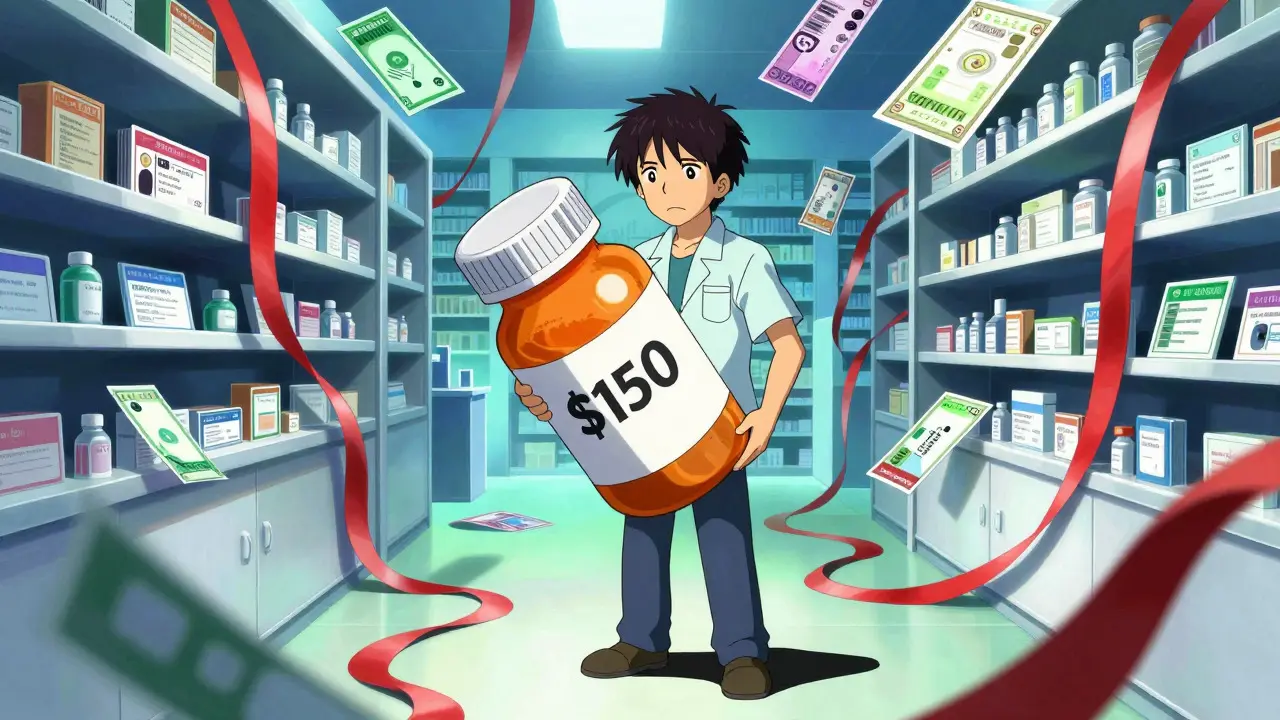
Picture this: you’re staring at a $150 bill for a generic blood pressure medication. Your insurance says your copay is $35, but the pharmacy counter shows a different number entirely. Meanwhile, an email from a direct-to-consumer (DTC) pharmacy promises that same pill for $18 if you pay cash. Do you use your insurance? Do you switch to the online DTC option? Or do you keep digging?
This isn’t just a hypothetical headache. It’s the daily reality for millions of people navigating a broken system where "insurance" doesn’t always mean "cheapest." Direct-to-consumer generic pharmacies have exploded onto the scene since 2020, promising transparency and lower prices by cutting out the middlemen. But here’s the catch: they aren’t a magic bullet. Sometimes they save you hundreds. Other times, they cost you more than your insurance would.
The Core Problem: Why Insurance Prices Are So Confusing
To understand why DTC pharmacies exist, you first have to look at what they’re fighting against: Pharmacy Benefit Managers (PBMs). PBMs are the intermediaries between drug manufacturers, insurance companies, and pharmacies. They negotiate rebates and discounts behind closed doors.
Here is how it usually works:
- List Price: The sticker price on the bottle. This is often absurdly high.
- PBM Rebate: A secret discount the PBM gets from the manufacturer.
- Your Copay: What you actually pay at the counter.
The problem? Your copay might be based on the list price before the rebate, or it might be a flat fee. If you have a deductible, you might pay the full list price until you hit that threshold. This creates a situation where paying cash at a transparent DTC pharmacy can sometimes be cheaper than using your insurance, especially if your insurance has high deductibles or narrow networks.
DTC pharmacies like Mark Cuban Cost Plus Drug Company, founded in 2020 by entrepreneur Mark Cuban and physician Dr. Alex Oshmyansky, operate on a simple model: cost plus a fixed markup. For example, they add a 15% markup to the wholesale acquisition cost of the drug, plus a flat dispensing fee. No secrets. No complex rebate structures.
Who Wins? The Data on Savings
Do these pharmacies actually save money? Yes, but with major caveats. A comprehensive cross-sectional analysis published in the Journal of General Internal Medicine in 2024 looked at 88 expensive generic drugs across five major DTC platforms: Amazon Pharmacy, Mark Cuban Cost Plus Drug Company, Health Warehouse, Costco, and Walmart.
The findings were striking:
- Expensive Generics: Median savings were $231 compared to retail prices without coupons (like GoodRx). That’s a 76% reduction.
- Common Generics: Median savings were $19, representing a 75% drop from retail cash prices.
However, "savings" depends on who you compare it to. If your insurance copay is $5 for a common statin, saving $19 off a $25 cash price doesn’t help you. You still lose because $18 (DTC price) > $5 (Insurance copay).
The study also revealed that no single DTC pharmacy is the cheapest for everything. For expensive generics, Amazon Pharmacy had the lowest price for 47% of the drugs studied. Mark Cuban Cost Plus Drug Company won on 26%. For common generics, Costco was the winner for 31%, followed by Amazon at 27%.
| Pharmacy Platform | Best For Expensive Generics | Best For Common Generics |
|---|---|---|
| Amazon Pharmacy | 47% of cases | 27% of cases |
| Mark Cuban Cost Plus | 26% of cases | 10% of cases |
| Costco Online | 13% of cases | 31% of cases |
| Health Warehouse | 14% of cases | 12% of cases |
| Walmart | Not top tier | 20% of cases |
The Hidden Trap: Availability and Specialty Drugs
If DTC pharmacies are so cheap, why don’t everyone use them? Two words: availability and complexity.
The same 2024 study found that one-fifth (20%) of the most costly generic drugs were not available through any national DTC pharmacy. If you need a specific niche medication, you might find yourself locked out of the DTC market entirely.
Then there’s the issue of specialty medications. Research commissioned by CVS Health and published on JAMA Network in 2023 analyzed 79 generic neurological medications. The conclusion was stark: if all commercial prescriptions for these neurologics were filled at DTC pharmacies, aggregate out-of-pocket expenditures would increase by $82 million.
Why? Because Mark Cuban Cost Plus Drug Company only stocked 33 of those 79 drugs. Of those 33, only two were cheaper than what insured patients paid through traditional PBM arrangements. For complex conditions requiring specialized generics, insurance networks often negotiate better bulk rates than a standalone DTC site can offer.
How to Decide: A Practical Strategy for 2026
You cannot rely on a single rule of thumb. The right choice depends on your specific drug, your insurance plan, and your willingness to shop around. Here is a decision framework to help you navigate this landscape.
- Check Your Insurance First: Look up your drug on your insurer’s portal or call the member services number. Find out your exact copay or coinsurance. Is it a flat $10? Or is it 20% of the cost after a $1,500 deductible?
- Identify the Drug Type: Is it a common generic (like metformin or lisinopril) or an expensive/specialty generic (like certain neurologics or rare disease treatments)?
- Shop the DTC Leaders:
- For common generics: Check Costco (if you have a membership), Amazon, and Walmart. These three consistently offer the lowest prices for everyday meds.
- For expensive generics: Compare Amazon Pharmacy, Mark Cuban Cost Plus, and Health Warehouse. Prices vary wildly here.
- Calculate the Total Out-of-Pocket: Don’t forget shipping fees. Some DTC pharmacies offer free shipping over $20; others charge flat rates. Add this to the drug cost.
- Consider Convenience vs. Savings: Saving $15 is great, but is it worth creating a new account, uploading prescriptions, and waiting for mail delivery? If you need the drug today, your local pharmacy + insurance coupon (like GoodRx) might be faster, even if slightly more expensive.
The Time Tax: Is Shopping Around Worth It?
Dr. Hatim Lalani, lead author of the Journal of General Internal Medicine study, pointed out a critical friction point: "This variation in the availability and cost of generics at DTC pharmacies requires patients and prescribers to shop around to find the best deal, which is a time-consuming process with financial tradeoffs."
There are currently no simple, real-time tools that scan every DTC pharmacy, every retail chain, and your specific insurance plan to give you one definitive "lowest price" button. You have to do the legwork.
Chloe Bakst from Advisory Board noted in March 2024 that DTC pharmacies serve a valuable function for consumers "who invest the time to price shop." If you are managing multiple chronic conditions with five different prescriptions, spending an hour each month comparing prices across Amazon, Costco, and Mark Cuban’s site could save you hundreds. If you take one inexpensive allergy pill a year, the hassle likely outweighs the $5 savings.
Future Outlook: Will DTC Replace Insurance?
Unlikely. The market is evolving toward hybrid models rather than total replacement. The USC Schaeffer Center noted in 2022 that direct out-of-pocket payments by insured consumers for generics declined by about 50% as DTC options grew, suggesting they complement rather than replace insurance.
We are seeing signs of integration. Some employers and health plans are beginning to partner with DTC pharmacies for specific formularies. Additionally, technology is catching up. New apps and browser extensions are emerging to automate price comparisons, reducing the "time tax" mentioned earlier.
However, the fundamental tension remains: PBMs hold power through volume and network exclusivity, while DTC pharmacies win on transparency and low overhead. For now, the smartest patient is the one who treats their prescription budget like a shopping list-checking multiple stores, reading the fine print, and never assuming "insurance" means "best price."
Are DTC pharmacies safe and legitimate?
Yes, major DTC pharmacies like Amazon Pharmacy, Mark Cuban Cost Plus, and Costco are fully licensed and accredited. They require valid prescriptions from licensed healthcare providers, just like traditional brick-and-mortar pharmacies. Always verify that a website displays its licensing information and requires a prescription before purchasing controlled or non-controlled substances.
Can I use my insurance card at a DTC pharmacy?
Generally, no. Most pure-play DTC pharmacies operate on a cash-pay model specifically to bypass insurance networks and PBM fees. However, some large retailers like Amazon and Walmart may offer hybrid options where you can choose to pay with insurance or cash depending on the specific service tier. Always check the checkout page for payment options.
Which DTC pharmacy is the cheapest overall?
There is no single cheapest pharmacy for all drugs. According to 2024 data, Amazon Pharmacy offers the lowest prices for nearly half of expensive generics, while Costco is often the cheapest for common generics. You must compare prices for your specific medication across at least two or three platforms to find the true lowest cost.
Do DTC pharmacies cover specialty medications?
Availability is limited. Studies show that 20% of the most costly generic drugs are not available through national DTC pharmacies. Furthermore, for specialized categories like neurology, DTC prices are often higher than insurance copays due to limited formulary breadth. For specialty drugs, insurance coverage is usually the more cost-effective route.
Is it worth switching to DTC if I have good insurance?
If your insurance has low copays (e.g., $5-$10 per script) and covers your medications broadly, DTC pharmacies may not save you money. They shine when you have high deductibles, uncovered generics, or medications with high list prices where your coinsurance results in a large bill. Calculate your exact out-of-pocket cost with insurance first before switching.