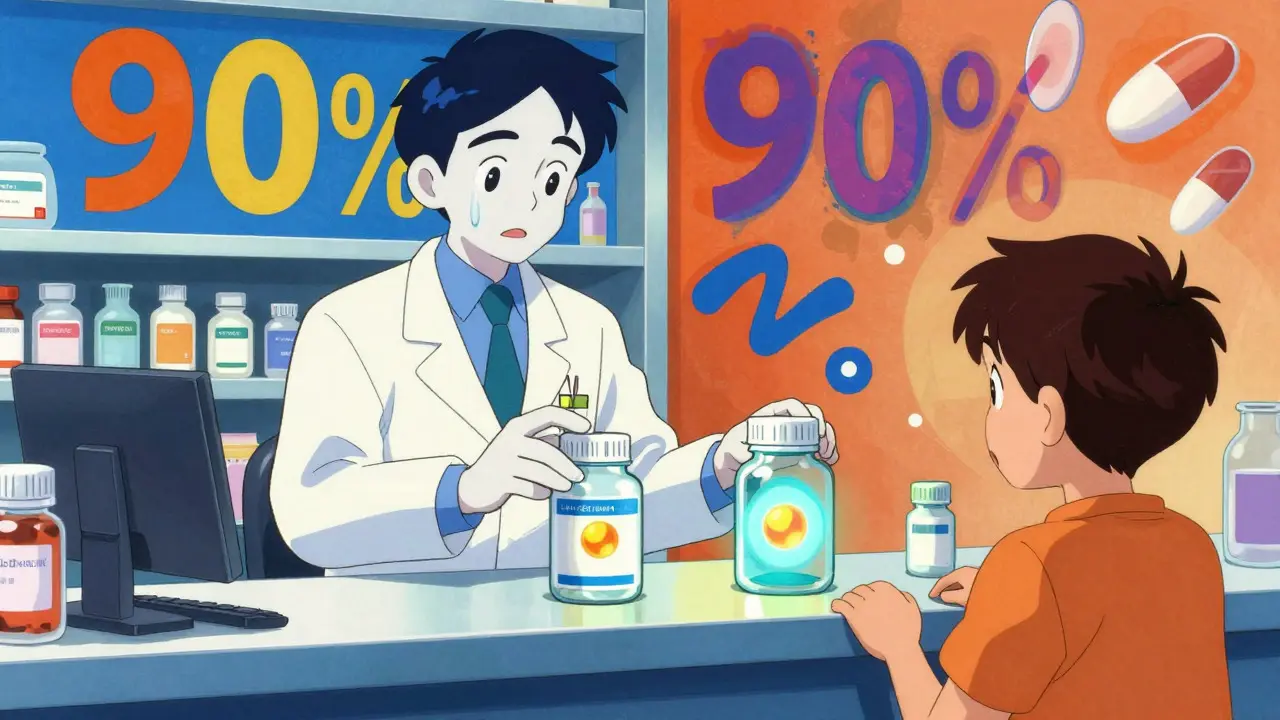
When you pick up a prescription at the pharmacy, there is a high chance it is a generic version of the original brand-name medication. In fact, as of 2023, more than 90 percent of prescriptions filled in the United States are generics. This shift has saved the U.S. healthcare system an estimated $37 billion annually. But have you ever wondered if that cheaper pill is truly just as safe and effective as the expensive brand-name counterpart? The short answer is yes, but only because of a rigorous, non-negotiable set of rules enforced by the Food and Drug Administration (FDA).
The system governing these drugs was established by the Hatch-Waxman Act of 1984. This legislation created a pathway for affordable competition while protecting patent rights for innovator companies. It led to the creation of the FDA’s Office of Generic Drugs (OGD), which now oversees a framework ensuring that every generic dose meets strict standards of safety, purity, and potency. If you are taking a generic medication, understanding what happens behind the scenes can help put your mind at ease.
Pharmaceutical Equivalence: What Must Be Identical
To earn the FDA seal of approval, a generic drug must first meet the criteria for pharmaceutical equivalence. This means the generic product must be identical to the reference listed drug (RLD)-the brand-name version-in several critical ways. There is no room for approximation here.
The active ingredient, which is the part of the drug that produces the therapeutic effect, must be exactly the same. For example, if the brand-name drug contains 500 mg of amoxicillin, the generic must also contain exactly 500 mg of amoxicillin. Beyond the chemical identity, the strength, dosage form (such as a tablet, capsule, or liquid), and the route of administration (oral, topical, injectable) must match perfectly. Even the conditions of use, including labeling instructions for indications and warnings, are required to be consistent.
However, not everything has to be a carbon copy. You might notice differences in color, shape, size, or taste. These variations come from inactive ingredients, such as fillers, binders, or dyes. The FDA allows these minor differences as long as they do not affect how the drug works in the body. For instance, a different dye might make a pill blue instead of white, but it does not change the amount of medicine inside. Storage requirements may also vary slightly depending on the stability of these inactive components.
| Attribute | Requirement | Allowed Differences? |
|---|---|---|
| Active Ingredient | Identical | No |
| Strength/Dosage | Identical | No |
| Dosage Form (e.g., Tablet) | Identical | No |
| Route of Administration | Identical | No |
| Inactive Ingredients (Fillers/Dyes) | Must not affect efficacy | Yes |
| Color/Shape/Taste | N/A | Yes |
Bioequivalence: Proving It Works the Same Way
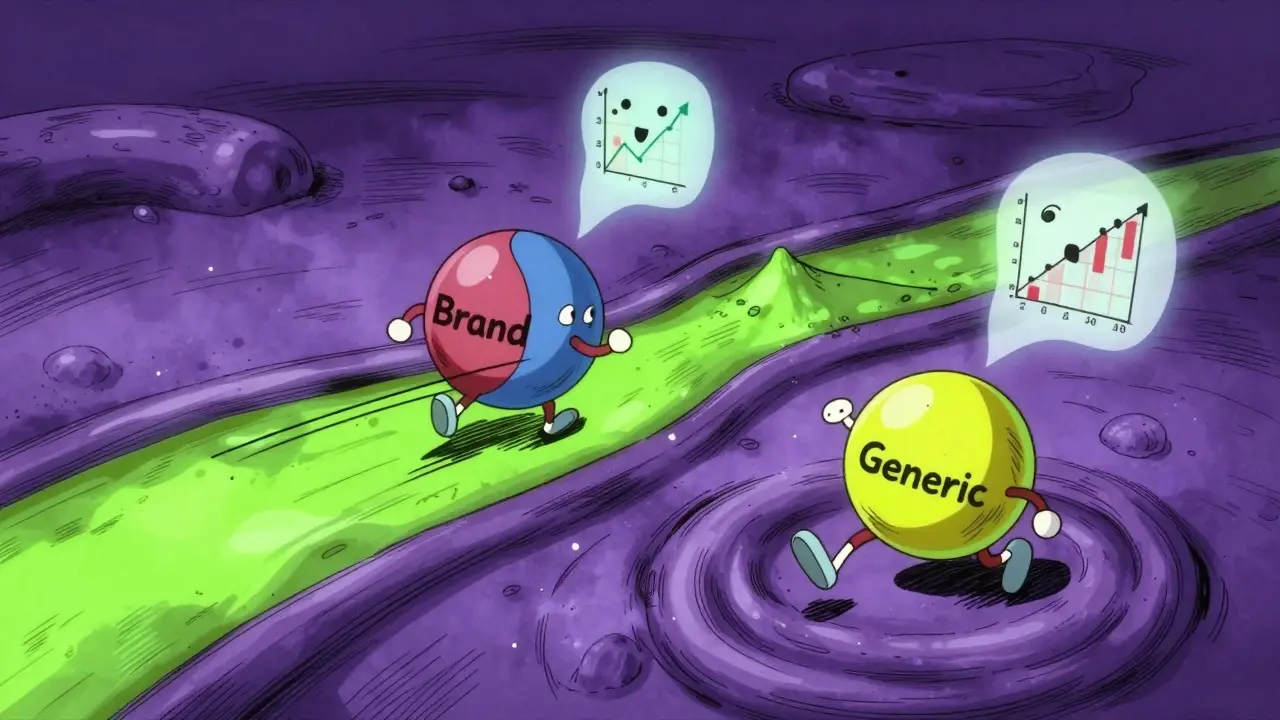
Having the same ingredients is only half the battle. The drug must also behave the same way once it enters your body. This is where bioequivalence comes in. Bioequivalence ensures that there is no significant difference in the rate and extent to which the active ingredient becomes available at the site of action.
The FDA uses specific statistical metrics to prove this. Manufacturers must conduct clinical studies, typically involving 24 to 36 healthy volunteers. They measure two key pharmacokinetic parameters: Cmax (the maximum concentration of the drug in the blood) and AUC (the area under the curve, representing total exposure over time). The 90% confidence interval for the ratio of the geometric means of these values for the generic versus the brand-name drug must fall within a narrow acceptance range of 80% to 125%. If the data falls outside this window, the generic is rejected.
This standard applies to most small-molecule drugs. However, complex drug products-such as inhalers, long-acting injectables, or topical creams-pose unique challenges. For these, simple blood level measurements might not tell the whole story. As of May 2023, the FDA had developed 2,143 product-specific guidances across 1,528 unique drug products to address these complexities. These guidelines may require additional physicochemical tests to demonstrate 'Q3 sameness,' ensuring the structural integrity and delivery mechanism of the generic matches the reference drug.
Manufacturing Standards: Current Good Manufacturing Practices
Quality control doesn’t stop after the formula is approved. Every single batch of generic medication must be manufactured under Current Good Manufacturing Practices (cGMP), codified in 21 CFR Parts 210 & 211. These regulations apply equally to generic and brand-name manufacturers, ensuring that the facility itself is up to par.
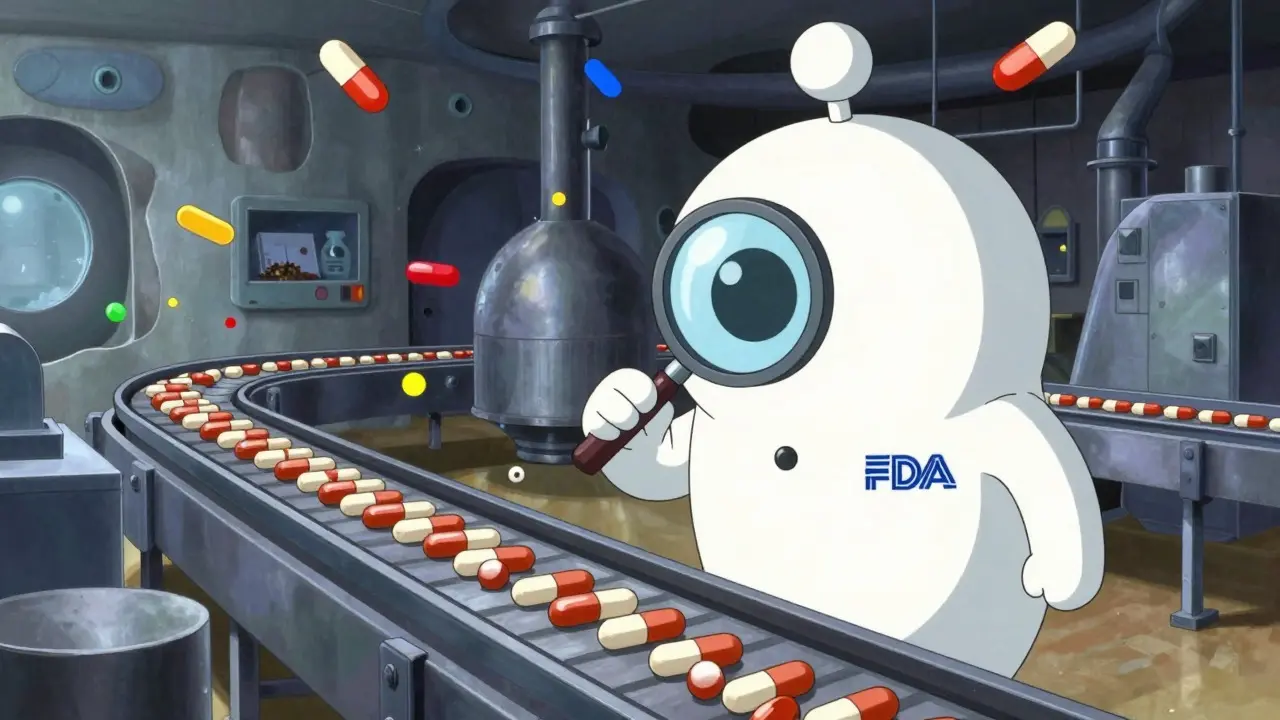
cGMP requires strict oversight of materials from the moment they arrive at the factory until the final product is shipped. Manufacturers must have clear written procedures for production, monitor critical parameters during manufacturing, and perform rigorous quality control testing using validated methods. Every production lot undergoes batch testing to confirm identity, strength, purity, and quality before it leaves the facility.
The FDA enforces these standards through inspections. The agency conducts approximately 3,500 inspections annually across manufacturing facilities globally. Interestingly, many brand-name pharmaceutical companies also manufacture generic drugs. In fact, an estimated 50 percent of generic drugs are made by the same companies that produce the branded versions, often in the same facilities. This overlap reinforces the consistency of quality standards across the industry.
The Approval Process: ANDA and Stability Testing
Bringing a generic drug to market involves submitting an Abbreviated New Drug Application (ANDA) to the FDA. Unlike new drugs, generics don’t need to repeat large-scale clinical trials for safety and efficacy because that data already exists for the brand-name drug. Instead, the ANDA focuses on chemistry, manufacturing, and controls (CMC) data, along with bioequivalence results.
A crucial component of the ANDA is stability testing. Manufacturers must provide data demonstrating that the product retains its integrity and quality over its proposed shelf life. This typically includes accelerated stability studies conducted at 40°C and 75% relative humidity for six months, followed by long-term studies at recommended storage conditions for 12 to 24 months. This ensures that the medication won’t degrade prematurely in your medicine cabinet.
The review process is streamlined thanks to the Generic Drug User Fee Amendments (GDUFA). First implemented in 2012 and reauthorized in 2017 and 2022, GDUFA has improved review timelines significantly. The standard review goal for complete ANDAs is now 10 months. In fiscal year 2022 alone, the FDA approved 892 original ANDAs, adding to the more than 20,000 generic drug products currently on the market.
Complex Generics and Patient Confidence
While the vast majority of generic drugs perform identically to their brand-name counterparts, some patients report issues, particularly with narrow therapeutic index (NTI) drugs. NTI drugs, such as levothyroxine for thyroid conditions or certain seizure medications, have a very small margin between a therapeutic dose and a toxic one. A 2021 study in JAMA Internal Medicine found that 12.3% of patients who switched between different generic versions of levothyroxine experienced thyroid level fluctuations requiring dose adjustments.
For these cases, the FDA has taken steps to enhance scrutiny. The agency’s 2023-2027 strategic plan prioritizes developing novel methodologies for demonstrating equivalence of complex drug products, allocating $15.7 million specifically for research and development in this area. Additionally, the Complex Generic Drugs Scientific Exchange has hosted 18 public workshops since 2017 to address scientific challenges with industry and academic stakeholders.
Despite these isolated concerns, patient satisfaction remains high. A 2022 Consumer Reports survey of 1,200 U.S. adults found that 89% were satisfied with generic medications, and 62% actively chose them to save money. Dr. Janet Woodcock, former Director of CDER, stated in 2022 that FDA-approved generic drugs have the same high quality, strength, purity, and stability as brand-name drugs. The American Medical Association has consistently supported this view since its 2010 policy statement.
Are generic drugs really as good as brand-name drugs?
Yes. FDA-approved generic drugs must meet stringent standards of pharmaceutical equivalence and bioequivalence. They contain the same active ingredients, strength, and dosage form as brand-name drugs and work the same way in the body. The main differences are usually in inactive ingredients like colors or flavors, which do not affect efficacy.
What is bioequivalence in generic drugs?
Bioequivalence means that the generic drug is absorbed into your bloodstream at a similar rate and extent as the brand-name drug. The FDA requires that the 90% confidence interval for the ratio of key metrics (Cmax and AUC) falls within 80% to 125% of the brand-name drug's values.
Why do some people feel different effects from generic drugs?
While rare, some individuals may react differently to inactive ingredients in generic formulations. Additionally, for narrow therapeutic index drugs (like certain thyroid or seizure medications), slight variations between different generic manufacturers can sometimes require dose adjustments. However, for the vast majority of drugs, no difference is felt.
How does the FDA ensure generic drug quality?
The FDA ensures quality through rigorous pre-market review of Abbreviated New Drug Applications (ANDAs), which include bioequivalence data and stability testing. Post-market, the FDA enforces Current Good Manufacturing Practices (cGMP) through annual inspections of manufacturing facilities, conducting about 3,500 inspections globally each year.
Can I switch between different generic manufacturers?
Generally, yes. Pharmacists often substitute one generic manufacturer for another based on availability and cost. For most drugs, this causes no issue. However, if you are taking a narrow therapeutic index drug, you should discuss with your doctor whether staying with a specific manufacturer is advisable to maintain consistent blood levels.
What is the Hatch-Waxman Act?
Passed in 1984, the Hatch-Waxman Act (Drug Price Competition and Patent Term Restoration Act) created the legal framework for generic drug approval in the U.S. It balanced patent protections for innovator drugs with a streamlined pathway for generic competitors, leading to the current system where generics account for over 90% of prescriptions.
Do brand-name companies make generic drugs?
Yes. Approximately 50% of generic drugs are manufactured by the same companies that produce the brand-name versions. They often use the same facilities and quality control processes, which helps ensure consistency in manufacturing standards.