
Polypharmacy Risk Calculator
This tool calculates your risk of adverse drug events based on the number of medications you or a loved one is taking. According to research, each additional medication increases the risk of falls by 8%.
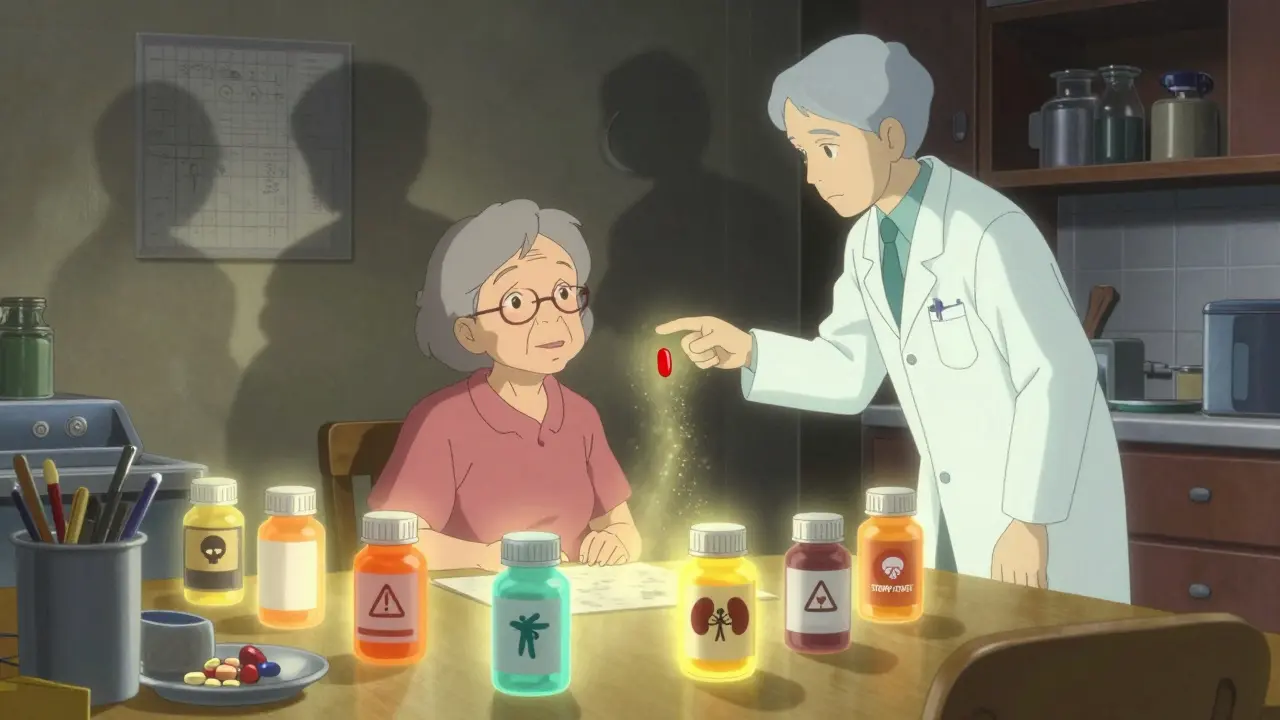
When an older adult takes five or more medications, they’re not just managing health-they’re navigating a minefield. Polypharmacy, defined as the routine use of five or more drugs, affects 41% of adults aged 65 and older in the U.S., and nearly 19% take ten or more. The problem isn’t the number of pills alone-it’s the hidden dangers. Each extra medication increases the risk of a fall by 8%, and medication-related hospitalizations account for nearly 28% of all hospital admissions in this age group. The good news? We know how to fix it.
Why Polypharmacy Is Dangerous for Older Adults
Older adults aren’t just taking more pills because they’re sicker. They’re taking more because different doctors prescribe for different conditions, and no one steps back to ask: Is this still necessary? A patient might be on a blood thinner for atrial fibrillation, a statin for cholesterol, a diuretic for heart failure, an antacid for reflux, and a sleep aid-all prescribed by different providers. No one checks if the sleep aid is making the antacid less effective, or if the diuretic is worsening kidney function. That’s where harm happens. Research from the Journal of the American Geriatrics Society shows that patients on four or more medications have a 30-50% higher risk of injurious falls. The risk doesn’t stop there. Drug interactions can cause confusion, dizziness, low blood pressure, or even kidney failure. And here’s the twist: while some medications are unnecessary, others are missing. Nearly 39% of older adults aren’t getting drugs they actually need-like vaccines, blood pressure meds, or bone-strengthening agents. This isn’t just overmedication-it’s undertreatment too.The Three Levels of Medication Review-Only One Works
Not all medication reviews are created equal. There are three types, and only one makes a real difference.- Type I: Just reviewing the list of meds. No conversation. No clinical context. This does nothing.
- Type II: Adds a check on whether the patient is taking the meds as prescribed. Still doesn’t address whether they should be taking them.
- Type III: Face-to-face or video consultation with a pharmacist or clinician who looks at the full picture: symptoms, lab results, life goals, and functional status. This is the only type proven to cut hospital readmissions by 18.3%.
The Tools That Actually Work
There are dozens of guidelines for when to stop or start a drug. But only a few have been tested in real-world trials and shown to reduce harm.- Beers Criteria (2023 update): Lists drugs to avoid in older adults. Useful, but doesn’t tell you when to restart something.
- STOPP/START v3 (2021): Stops inappropriate prescriptions (STOPP) and starts needed ones (START). Proven in RCTs to reduce hospitalizations.
- FORTA List: Classifies drugs as “Fit,” “Optimal,” “Reasonable,” or “Avoid” based on evidence and frailty. Only one tool that links drug choice to functional status.
Who Does the Best Job? Pharmacists, Not Just Doctors
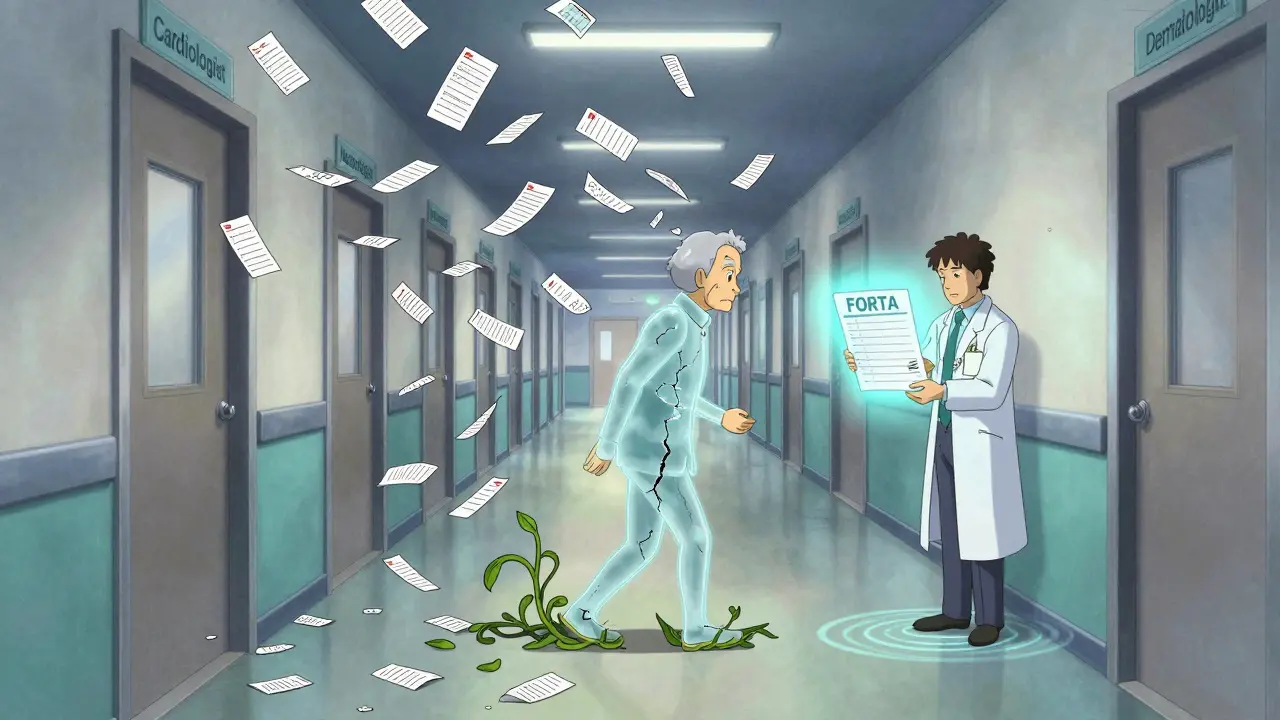
You wouldn’t ask a mechanic to fix your plumbing. Why do we expect doctors to manage every drug interaction? Pharmacists trained in geriatrics are the unsung heroes here. A 2025 study showed that under Collaborative Practice Agreements (CPAs), pharmacists deprescribe at a rate 37.6% higher than physicians working alone. Why? They have the time. They have the training. And they’re not juggling 20 patients an hour. But here’s the catch: only 72 U.S. states allow CPAs for pharmacists. In 28 states, pharmacists can’t legally adjust prescriptions-even if they spot a dangerous interaction. That’s not a clinical issue. It’s a policy failure. Even in states where CPAs exist, reimbursement is a nightmare. Only 15% of Medicare Advantage plans pay for comprehensive medication reviews. Most clinics can’t afford to spend 45-60 minutes per patient unless they’re funded by grants or government programs like the VA.What Works in Real Clinics
The Veterans Health Administration (VHA) has been doing this right for years. Their Geriatric Research, Education and Clinical Centers (GRECCs) embedded pharmacists directly into geriatric teams. Result? A 26.8% drop in potentially inappropriate medications. How? They didn’t just remove pills. They rebuilt the whole process. Their method:- Get an accurate medication list-no guesswork. Use pill bottles, pharmacy records, and family input.
- Run the list through STOPP/START and FORTA.
- Have a conversation with the patient: “What are your goals? Do you want to live longer, or feel better now?”
- Taper slowly. Don’t yank meds. Especially not benzodiazepines or antipsychotics.
- Follow up in 2 weeks. Watch for withdrawal symptoms.
The Hidden Barriers
Even when clinics want to help, they hit walls.- Fragmented care: 78% of older adults see five or more providers a year. No one has the full picture.
- Poor documentation: Only 33% of electronic health records track whether patients actually take their meds.
- Patient fear: 68% of older adults are terrified of stopping a medication-even if it’s harmful. “My doctor told me to take this. What if I get worse?”
What’s Next? The Future Is Here
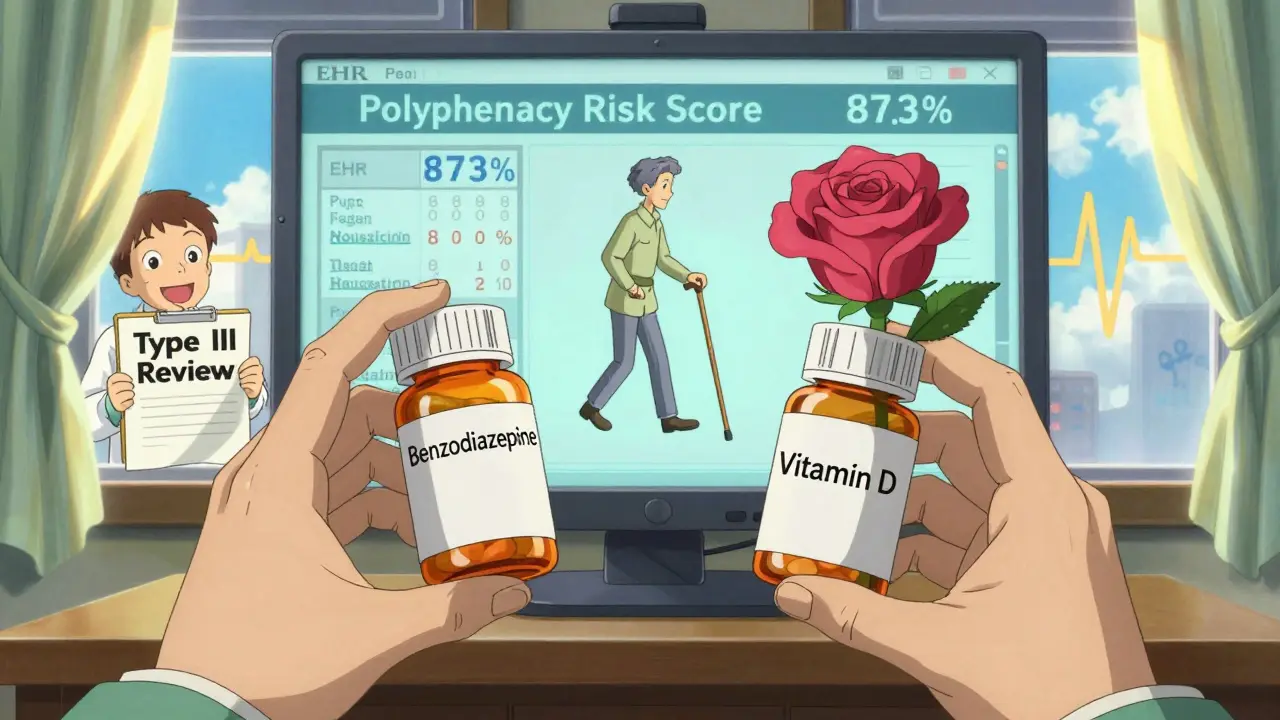
The American Geriatrics Society is finalizing Beers Criteria v2026, with a new focus: deprescribing algorithms tailored to life expectancy and cognitive status. The National Institute on Aging is funding trials on genomic-based risk calculators-imagine knowing a patient’s DNA tells them to metabolize certain drugs dangerously fast. Medicare is already changing. Starting in 2024, the Merit-Based Incentive Payment System (MIPS) penalizes providers if 30% or more of their Medicare patients are on ten or more medications. That’s not a suggestion. It’s a financial consequence. And the numbers are clear: clinics that have fully adopted these interventions report 19.3% higher patient satisfaction and 27.6% lower total cost of care. That’s not just better health. It’s better economics.What You Can Do Right Now
If you’re caring for an older adult:- Ask: “Is this medication still helping? Is it causing more harm than good?”
- Bring every pill bottle to every appointment-even the ones they haven’t opened in months.
- Ask for a pharmacist consult. Say: “Can we get a comprehensive medication review?”
- Don’t rush deprescribing. Taper slowly. Monitor for rebound symptoms.
- Use STOPP/START or FORTA as a checklist. They’re free and online.
- Stop doing Type I and II reviews. They’re a waste of time.
- Partner with a clinical pharmacist. Even one hour a week changes outcomes.
- Use EHR alerts for high-risk combinations-like NSAIDs with blood thinners.
- Document goals of care: “Patient wants to avoid hospitalizations, prioritize mobility.”





It's wild how we treat elderly patients like they're just a list of symptoms to be managed. The real issue isn't the number of pills-it's that no one's sitting down with them to ask what they actually want out of life. If someone's 82 and just wants to walk their dog without dizziness, maybe that statin isn't worth the risk. We need more of this kind of thinking, not less.
While the data presented here is compelling, I must emphasize the importance of clinical judgment. Not every patient fits neatly into algorithmic categories. Deprescribing must be individualized, and while pharmacists play a vital role, physicians remain ultimately responsible for therapeutic outcomes. A balanced, multidisciplinary approach is non-negotiable.
I love how this article doesn't just point out the problem-it gives real solutions. STOPP/START and FORTA? YES. And pharmacists being able to act? LONG OVERDUE. I've seen my grandma go from 12 meds to 5 and suddenly she's laughing again, not nodding off at the table. It's not magic-it's just good care. Why do we make it so hard?
In India we see this too-elders on 8-10 meds because each specialist writes their own script. No one talks. No one coordinates. But we also have family who notice the changes-the confusion, the falls. Maybe the real fix is not just systems but culture. Teach families to ask: 'Why this pill? What does it do?' And then listen. The answer might surprise you.
So let me get this straight-we're supposed to trust pharmacists more than doctors? And we're going to cut meds based on some checklist while ignoring that these people have lived through decades of medical advice? This feels like someone who's never held an elderly person's hand while they're scared to stop a pill that's kept them alive for 15 years. Stop pretending this is simple.
Oh honey, we're not just overmedicating-we're medicating the ghost of a 1998 health guideline into a 2025 body. It's like forcing a Ford Model T to run on hydrogen. The Beers Criteria? Cute. But STOPP/START? Now you're talking. And FORTA? That's the Tesla of geriatric prescribing. Let’s stop playing nice with outdated protocols and start engineering care for humans, not checkboxes.
And yet... the system still resists. The same hospitals that brag about their 'patient-centered care' refuse to pay for a 45-minute pharmacist consult. The same administrators who demand 'value-based outcomes' won't fund the very tools that deliver them. It's not incompetence-it's institutional cowardice. We have the science. We have the evidence. We have the tools. But we lack the moral courage to change the way we pay for care. And that, my friends, is the true epidemic.
As someone from Chennai, I see this daily. Grandparents on 10 meds because each doctor says 'take this' without knowing what the other did. But here’s the twist-we have strong family networks. My aunt’s daughter sits with her every Sunday, sorting pills, calling clinics. Maybe the real innovation isn’t tech-it’s reweaving care into family life. We don’t need more apps. We need more presence.
This is one of the clearest summaries of geriatric polypharmacy I’ve read in years. The emphasis on Type III reviews is spot-on. Too often, we mistake activity for impact-checking a box on an EHR doesn’t equal care. The VHA model proves that embedding pharmacists into teams isn’t a luxury-it’s a necessity. Let’s stop talking about innovation and start funding what already works.
...I just cried reading this. My mom was on 11 meds. We tapered her off 5 over 6 months. She didn’t die. She started gardening again. I wish someone had told us this 3 years ago. The system failed her. But the people who care? They didn’t. 💛