

Forgetting to take your pills isn’t just a minor annoyance-it can land you in the hospital. Around 50% of people with chronic conditions miss doses at least once a week, and for seniors taking four or more medications daily, the risk skyrockets. The solution isn’t more sticky notes or phone alarms. It’s technology designed to work with human behavior, not against it. Smart pill caps and dispensers don’t just remind you-they track, alert, and even notify caregivers when something goes wrong.
Why Forgetfulness Is a Silent Health Crisis
Think about your own routine. You’re rushing out the door, your phone dies, your glasses are on the kitchen counter, and suddenly, it’s 3 p.m. and you realize you never took your blood pressure pill. Now multiply that by five or six pills a day, every day. That’s the reality for millions of older adults. According to Hero Health, over half of seniors over 65 take more than four prescriptions. That’s not just a lot of pills-it’s a cognitive overload. The brain isn’t built to track complex, timed routines for years on end. And when you forget, it’s not just a missed dose. It’s higher risk of falls, uncontrolled diabetes, heart failure, and emergency room visits.How Smart Pill Caps Work (Without an App)
Not all smart pill systems require you to download an app, log in, or tap a screen. Take Tenovi’s Cellular Pillbox. It’s a simple plastic box with compartments for morning, noon, evening, and bedtime. Inside, sensors detect when you open a compartment. When it’s time for your pill, a red LED glows. When you open it, the light turns green. No phone. No setup. No passwords. The device uses built-in cellular connectivity to send a signal to a gateway that logs your adherence. If you miss a dose, your caregiver gets a text-no app needed. This is the kind of design that works for someone with early dementia or shaky hands. It doesn’t ask you to learn something new. It just fits into your life.Smart Pill Caps That Turn Your Bottle Into a Tracker
What if you don’t want to switch from your current pill bottles? AdhereTech’s Aidia Smart Bottle lets you keep them. You just screw the smart cap onto your existing prescription bottle. The cap uses weight sensors to detect when you open it and how much medicine you take. It knows if you took your 10 mg dose or just the 5 mg. It also knows if you opened it at 8 a.m. or 8 p.m. If you miss a dose, the cap flashes red and sends a text or call to your family. But here’s what makes it different: it asks you why. After a missed dose, you get a prompt: “Why didn’t you take your pill?” Options: side effects, too many pills, didn’t feel sick, forgot. That data goes to your doctor-not just a log of missed doses, but the real reason behind them. That’s how you fix the problem, not just track it.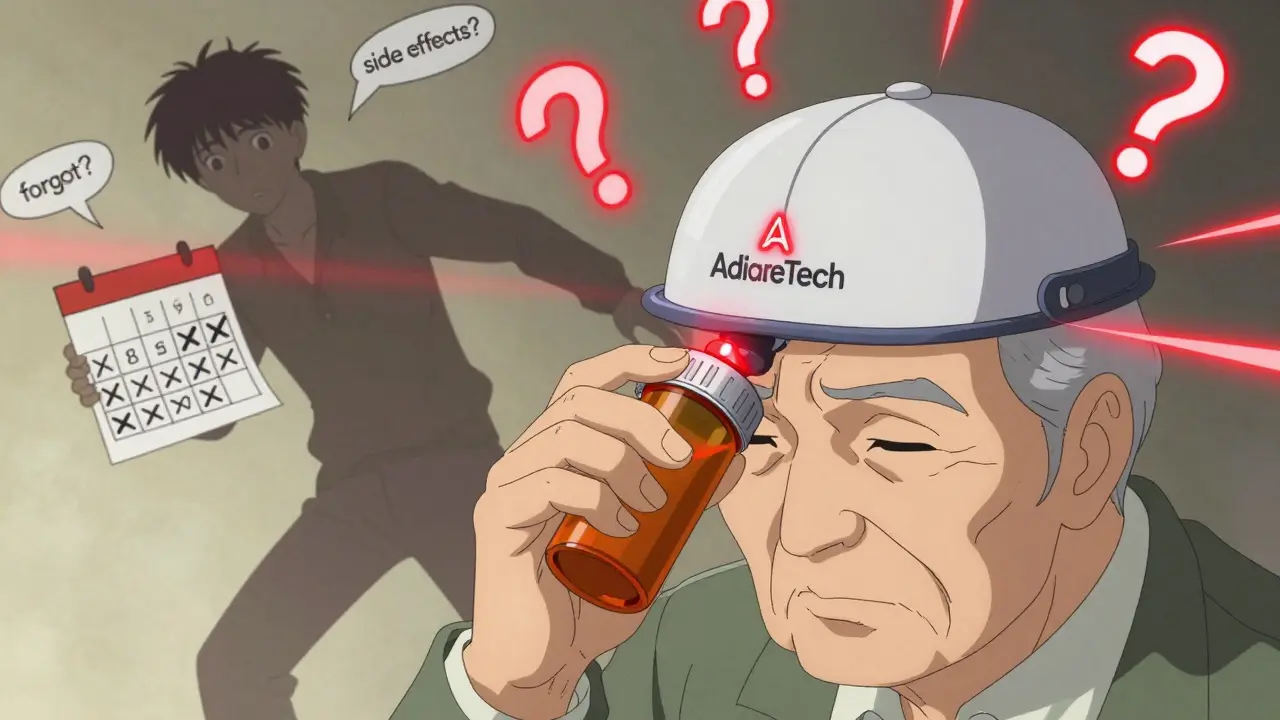
Automatic Dispensers That Give You the Pill
Some people need more than reminders-they need the pill handed to them. Hero Health’s automatic dispenser does exactly that. It holds up to 28 doses. At the right time, it beeps, flashes, and then slides open a compartment to release your pills. If you don’t take them within 30 minutes, it beeps again. And again. And again. Every half hour, until you open it. This isn’t a gentle nudge. It’s a persistent, in-your-face system designed for people who truly can’t remember. It even calls your caregiver if you miss three doses in a row. And it works even if you’re in another room. The sound is loud enough to cut through TV noise or hearing loss. It’s not elegant, but it’s effective. One user on Reddit said it literally saved her mother’s life during a urinary tract infection-because the system forced her to take her antibiotics on time.The Problem With Alarms That Don’t Work
Not every device lives up to the hype. The MedQ Electronic Programmable Pill Dispenser, for example, repeats alarms every 30 minutes. Sounds good, right? But users report the alarm is too quiet. One verified buyer on Amazon wrote, “I have to be right next to it to hear it.” For someone with hearing loss, that’s useless. Other budget devices lack backup power. If the electricity goes out, the device resets. No alarms. No tracking. Just silence. And then there’s the issue of “gaming the system.” On Reddit, one user admitted to opening their AARDEX Pill Connect cap without taking the pill-just to make the light turn green. The device recorded adherence. But the person didn’t take the medicine. No technology can force ingestion. That’s why the best systems combine reminders with human support.Cost, Subscriptions, and the Hidden Barrier
Here’s the hard truth: the most effective devices come with monthly fees. AARDEX’s Pill Connect costs $299 upfront, plus $49 a month for software. Tenovi’s system is $199 with $29 monthly service. AdhereTech’s cap is $149 with $39/month. Hero Health’s dispenser is $499. For many seniors on fixed incomes, these aren’t just expenses-they’re dealbreakers. A CMS survey found that 63% of people who didn’t adopt smart devices said the subscription fees were too high. And here’s the kicker: many Medicare Advantage plans now cover these devices, but only if your doctor prescribes them and proves you’re at risk for hospitalization. That means you need a doctor who knows about these tools-and the patience to fight for coverage.
What Works Best for Different Needs
- For mild forgetfulness: AdhereTech’s smart cap. It’s simple, fits your bottles, and gives you real insight into why you miss doses.
- For dementia or severe memory loss: Hero Health’s automatic dispenser. The repeated alarms and physical dispensing make skipping nearly impossible.
- For caregivers who want remote monitoring: Tenovi’s Cellular Pillbox. No app, no confusion, and texts go straight to your phone.
- For clinical use or research: AARDEX’s Pill Connect. Used in hospitals and trials, with advanced analytics that predict adherence patterns.
- For budget users: Look for devices with no monthly fee-but check battery life, alarm volume, and backup power. Avoid anything that resets during a power outage.
The Future: Ingestion Sensors and AI Predictions
The next wave isn’t just about reminding you-it’s about knowing you took it. MIT’s AgeLab is testing edible sensors that send a signal to your phone once the pill dissolves in your stomach. That’s not science fiction-it’s coming in 2025. Meanwhile, AARDEX’s new version of Pill Connect uses AI to predict when you’re likely to miss a dose, based on your past behavior, weather, and even your activity levels. It doesn’t just alert you-it warns your doctor before you miss anything. That’s the future: not just tracking, but preventing.What to Do Next
Start by talking to your doctor. Ask: “Am I at risk for hospitalization because of missed doses?” If the answer is yes, they can prescribe a device and help you get it covered by insurance. If not, look at your routine. Do you forget because you’re overwhelmed? Try a pill organizer with a simple alarm. Do you forget because you don’t feel sick? Then you need a system that asks why-and connects you to support. Don’t settle for a device that just glows. Choose one that listens, learns, and helps you stay healthy.Do smart pill dispensers really work?
Yes-when they’re matched to the user’s needs. Studies show adherence rates jump from 67% to over 92% with systems like AdhereTech’s smart cap. But success depends on the right fit. A device that requires an app won’t help someone with dementia. A loud, repeating alarm won’t help if the sound is too quiet. Effectiveness comes from matching the technology to the person’s cognitive abilities, lifestyle, and support system.
Are smart pill dispensers covered by Medicare?
Traditional Medicare (Part A/B) doesn’t cover them. But many Medicare Advantage plans do-if your doctor documents that you’re at risk for hospitalization due to non-adherence. In 2024, CMS expanded coverage rules to include devices that reduce hospitalizations by 15% or more. That means more plans will start paying for them. Ask your doctor to submit a letter of medical necessity.
Can I use a smart pill dispenser if I have poor eyesight or hearing?
Yes, but choose wisely. Hero Health’s dispenser has customizable alarms-bright flashing lights, loud tones, and even vibrating alerts. Tenovi’s system uses simple color lights (red/green), which are easy to see. Avoid devices that rely only on small screen notifications or quiet beeps. Look for products rated highly on accessibility by SeniorTechReview.com or similar organizations.
What’s the difference between a smart pill cap and a dispenser?
A smart pill cap fits onto your existing medicine bottle and tracks when you open it. It reminds you, but doesn’t give you the pill. A dispenser holds your pills and automatically releases them at the right time. Dispensers are better for people who need help remembering to take the pill at all. Caps are better for people who just need a reminder and can open the bottle themselves.
What if I miss a dose and the system doesn’t notify anyone?
That’s a risk with any system. No device can guarantee you’ll take your medicine. The best systems combine technology with human backup. If you’re using a smart cap or dispenser, make sure a family member or caregiver is set up to receive alerts. If you live alone, consider a medical alert system that can call for help if you don’t respond to the device’s prompts. Technology helps-but it’s not a replacement for human connection.






so u know what i saw last week? some old guy at the store tryna use one of them smart caps n he just kept openin the bottle like 10 times just to make the light turn green. lol. tech dont fix stupid.
One must, with due diligence, consider the epistemological underpinnings of technological intervention in personal health management. The proliferation of these devices, while ostensibly benevolent, subtly externalizes cognitive responsibility-replacing metacognitive discipline with algorithmic surveillance. Moreover, the subscription-based business model is not merely inconvenient-it is ethically indefensible, especially when targeting the elderly, who are already burdened by systemic healthcare inequities.
I appreciate the effort put into outlining these solutions. It’s easy to overlook how complex medication adherence truly is-especially for those with limited mobility, vision, or memory. I’ve seen family members struggle with alarms they can’t hear or apps they can’t navigate. The fact that some devices work without smartphones is a huge step forward. Still, we need more affordable options-and better insurance coverage. This isn’t luxury tech; it’s medical necessity.
Let’s be clear: these devices are a Band-Aid on a bullet wound. The real problem is that our healthcare system doesn’t prioritize prevention-it profits from crises. You think a $499 dispenser is expensive? Try paying for a hospital stay caused by a missed dose. And don’t get me started on the fact that Medicare Advantage plans only cover these if your doctor jumps through 17 hoops. This isn’t innovation-it’s corporate exploitation dressed up as compassion. The real solution? Universal healthcare with mandatory adherence support built in. Not another gadget.
Why are we letting tech companies profit off our grandparents’ forgetfulness? This is America-shouldn’t the government be providing these for free? My aunt’s in Florida, and she pays $1,200 a year just for her pills. Now they want her to pay $30/month for a box that beeps? This is why I’m done with this country. We let corporations turn medicine into a subscription service. Shameful.
my grandma use one of these box. she say it make her feel safe. no more worry. i am happy for her. simple is good.
From a clinical perspective, the adherence data generated by devices like AdhereTech and AARDEX are goldmines for pharmacovigilance. The real-time behavioral analytics enable dynamic intervention protocols-far superior to static reminders. The 'why' prompt is particularly elegant; it transforms passive tracking into active behavioral feedback loops. However, the Achilles’ heel remains the digital divide: low-literacy seniors, non-tech-savvy caregivers, and rural populations with spotty cellular coverage. Hybrid models-combining IoT with human check-ins via telehealth-are the future. Also, FYI: the MIT ingestible sensor trial uses a magnesium-based signal emitter-FDA-cleared for GI tract transit detection. No, it doesn’t glow. But yes, it’s real.
Wow. So now we’re giving people gadgets to babysit themselves? Next they’ll put a tracker in our toothbrushes. This isn’t progress-it’s surveillance capitalism wrapped in a medical blanket. And don’t even get me started on the fact that these companies sell your adherence data to insurers. You think your doctor’s helping you? Nah. They’re just the middleman for the algorithm. I’d rather just forget my pills and deal with the consequences. At least I’m not a data point.
i just got one of those tenovi boxes for my dad. no app, no fuss. he calls it 'the beepy box.' it works. that’s all i need.