

Imagine walking into a doctor's office or pharmacy with a single sheet of paper that holds the key to your health. It’s not just a list of pills; it is a roadmap for your treatment. This document is called a Medication Action Plan, often referred to as an MAP or MAP template. For millions of patients, especially those managing chronic conditions, this tool bridges the gap between complex medical advice and daily reality. Without it, miscommunication happens. Doses get missed, interactions are overlooked, and hospital visits increase. With it, you take control.
You might have received one during a Comprehensive Medication Review (CMR) through Medicare Part D, or perhaps your pharmacist handed it to you after noticing a potential issue with your prescriptions. But getting the paper is only half the battle. The real value comes from how you use it during every healthcare visit. If you treat it like a static form filed away in a drawer, you miss out on its power to prevent errors and improve adherence. Let’s look at exactly how to make this template work for you, step by step.
Understanding the Core Components of Your Map
To use the plan effectively, you first need to know what you are looking at. While designs vary slightly depending on whether it comes from CMS, a specific pharmacy chain, or an international standard like Germany’s E-Health law, the core structure remains consistent. Think of these sections as distinct tools for different parts of your conversation with providers.
| Section Name | Purpose | Who Fills It Out? |
|---|---|---|
| What We Talked About | Documents clinical discussions and decisions made during the visit. | Provider (Pharmacist or Doctor) |
| What I Need to Do | Lists specific actions: new meds, stopped meds, or lifestyle changes. | Provider (with patient confirmation) |
| What I Did and When | Tracks adherence and helps identify patterns in missed doses. | Patient |
| My Follow-Up Plan | Schedules next reviews and lists questions for future visits. | Patient and Provider jointly |
The "What I Need to Do" section is critical. Research shows that plans containing specific, measurable actions-like "Take metformin 500mg with breakfast starting tomorrow"-lead to significantly higher adherence than vague instructions like "Take as directed." When you see this section, ensure it is written in plain language. If it isn’t, ask for clarification before you leave the room.
Preparation Before the Visit
Your work starts before you even walk through the clinic doors. Bringing an outdated or empty plan defeats the purpose. According to CDC guidelines, accuracy improves dramatically when you bring not just the paper plan, but all your current medication containers. Why? Because memory is fallible. Studies indicate that relying on patient recall alone leads to significant discrepancies, whereas verifying against physical bottles increases accuracy by over 37%.
- Update Your List: Cross out any medications you have stopped taking. Write the date and the reason if you know it. If you don’t know why you stopped, write "Reason unknown" so your provider can investigate.
- Note Side Effects: In the tracking section, note any new symptoms. Did you feel dizzy after starting that new blood pressure med? Did you experience heartburn with your antibiotics? These details help providers adjust therapy safely.
- Prepare Questions: Use the "Questions I Want to Ask" box. Jot down concerns about costs, side effects, or confusion about timing. Having these written down ensures you don’t forget them in the moment.
This preparation turns a passive appointment into an active collaboration. You are no longer just receiving orders; you are providing data that shapes your care.
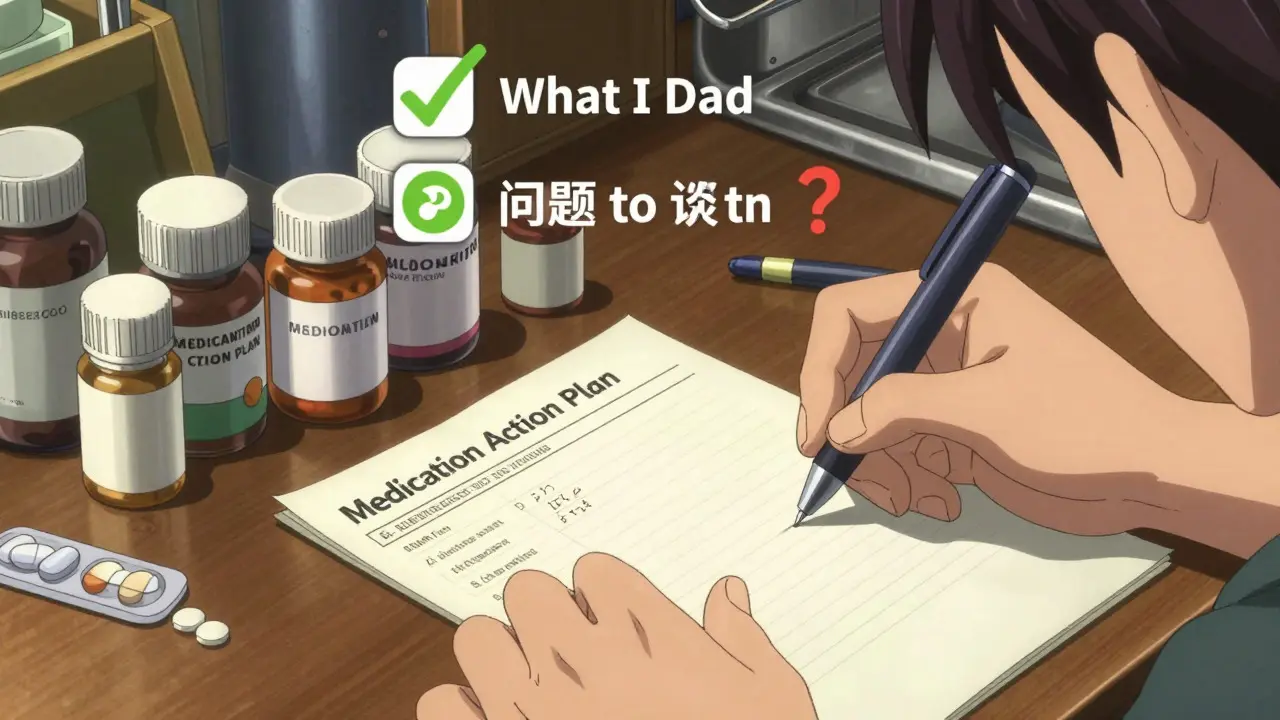
Navigating the Visit: Real-Time Collaboration
Once you are in the exam room or consultation area, hand your Medication Action Plan to the provider immediately. Don’t wait for them to ask. State clearly, "This is my current medication action plan. Please update it today." This simple phrase signals that you value continuity and safety.
During the discussion, watch how they fill out the "What We Talked About" and "What I Need to Do" sections. Are they writing specific dates? Are they crossing out old drugs with clear stop dates? The Institute for Safe Medication Practices (ISMP) has noted that failing to document exact discontinuation dates is a leading cause of reconciliation errors. If the provider writes "Stop Lisinopril," ask, "Do we stop it today, or next week?" Get that date on the paper.
If you are seeing a specialist, remind them that this plan also covers your primary care medications. Specialists often focus narrowly on their area of expertise. By showing them the full picture, you help them avoid prescribing drugs that interact with what your general practitioner already prescribed. This is known as reducing duplicate therapies, a major safety goal highlighted by the NIH.
Post-Visit Actions and Maintenance
The visit ends, but the plan’s job continues. Immediately after leaving, review the changes. Do you understand every instruction? If not, call the office while the interaction is fresh in their minds. Then, share the updated plan. Give a copy to your family members or caregivers who help manage your health. Keep a digital photo of it on your phone for emergencies.
Between visits, use the "What I Did" section honestly. If you missed a dose, mark it. Providers aren’t judging you; they are troubleshooting. A pattern of missed morning doses might mean the medication causes nausea, prompting a switch to evening dosing. This feedback loop is what makes the MAP a living document rather than a bureaucratic checkbox.
For older adults, keeping track of paper documents can be challenging. Some pharmacists recommend laminated wallet-sized versions that contain the most critical information: emergency contacts, allergies, and current high-risk medications. This ensures that even if the full binder is at home, essential data travels with you.

Common Pitfalls to Avoid
Even well-intentioned users can undermine the effectiveness of their Medication Action Plan. Here are three common mistakes:
- Treating it as Annual Only: Many patients think the MAP is only for the yearly MTM review. It should be updated at every encounter where medications change. The American College of Clinical Pharmacy emphasizes that it must be a dynamic record.
- Vague Documentation: Accepting generic advice like "take less painkillers" without specifics. Push for clarity: "Take maximum two tablets per day."
- Hiding Problems: Patients often hide non-adherence due to embarrassment. Remember, the provider needs the truth to fix the regimen. Hiding missed doses leads to ineffective treatments and wasted money.
Why This Matters for Your Health
The stakes are high. Data from the Agency for Healthcare Research and Quality (AHRQ) suggests that proper medication reconciliation can decrease adverse drug events by up to 23%. For individuals, this means fewer trips to the ER, less time spent feeling unwell, and more confidence in managing health conditions. Whether you are covered by Medicare Part D, private insurance, or national health services like Germany’s statutory insurance, the principle remains the same: clear communication saves lives.
By mastering the use of your Medication Action Plan, you transform from a passive recipient of care into an active partner. You hold the map. Now, you know how to read it.
What is a Medication Action Plan (MAP)?
A Medication Action Plan is a structured document used in Medication Therapy Management (MTM) programs. It outlines your current medications, identifies problems, and lists specific steps you need to take to manage your health. It serves as a communication tool between you and your healthcare providers to reduce errors and improve adherence.
Who creates the Medication Action Plan?
The plan is typically created collaboratively. A qualified healthcare provider, such as a pharmacist conducting a Comprehensive Medication Review or a physician, drafts the initial plan based on clinical assessment. However, the patient must review, agree to, and sign the plan, making it a joint responsibility.
How often should I update my MAP?
You should update your MAP at every healthcare visit where medications are discussed or changed. It is a living document. If you start a new prescription, stop one, or experience side effects, the plan should reflect these changes immediately to ensure accurate records across all providers.
Is the MAP required for Medicare beneficiaries?
Yes, for eligible Medicare Part D beneficiaries, a Medication Action Plan is a required component of the Comprehensive Medication Review (CMR). CMS mandates this standardized format to ensure consistent communication and safety for patients with multiple chronic conditions and expensive drug regimens.
What should I do if I lose my MAP?
Contact your pharmacist or primary care provider immediately. They can recreate the plan based on your current records. To prevent this, keep a backup copy at home and consider taking a photo of the updated plan after each visit. Some pharmacies also offer digital access to your medication history.
Can I use the MAP with specialists?
Absolutely. Bringing your MAP to specialist appointments is highly recommended. It provides a complete view of your medication regimen, helping specialists avoid prescribing drugs that may interact negatively with medications managed by your primary care provider.