
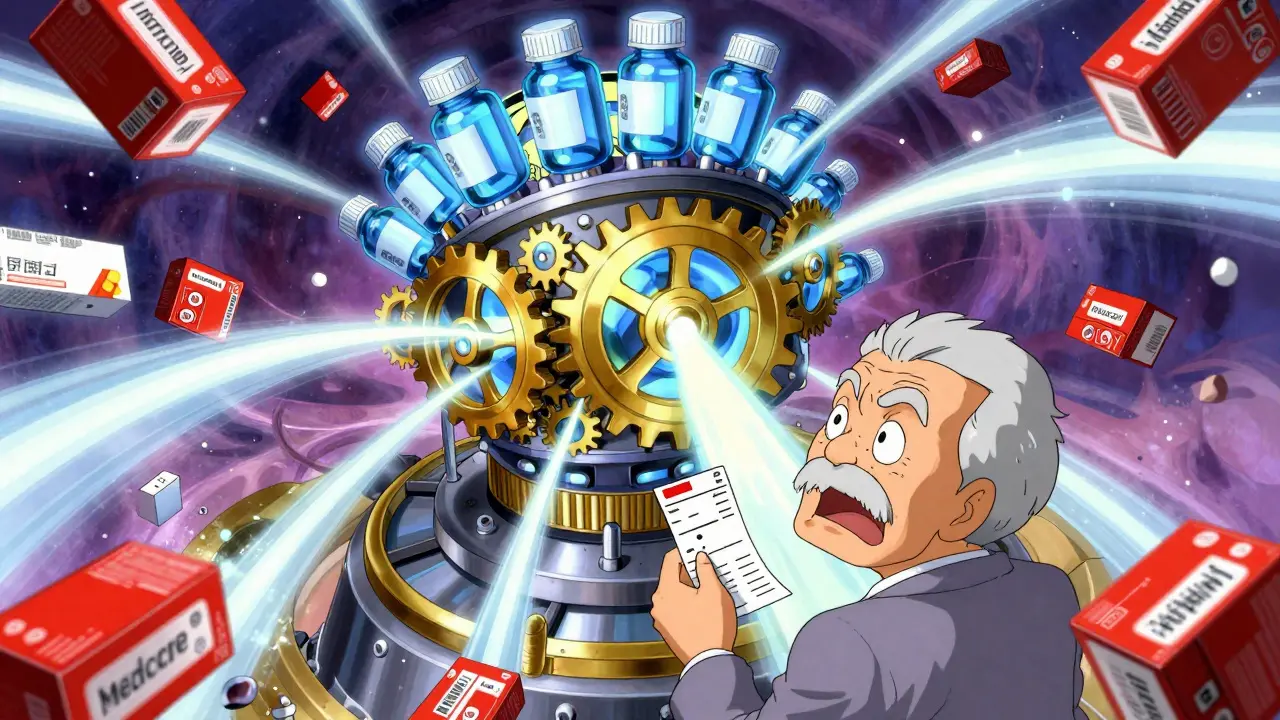
You pay for your prescription drugs, but you don't actually choose the price. In Medicare Part D, the cost of your medication is dictated by a complex economic engine designed to keep the program solvent while managing billions in federal spending. At the heart of this system are generic drugs. They aren't just cheaper alternatives; they are the primary lever private insurance plans use to control costs and manage their risk.
If you've ever wondered why your pharmacist suggests a generic version of a brand-name drug, or why switching plans can suddenly make your medication more expensive, the answer lies in how Part D programs structure their formularies. Understanding this dynamic is no longer optional-it's essential for protecting your wallet and ensuring you get the care you need without financial shock.
The Economic Backbone: Why Generics Matter More Than Ever
To understand the economics of Medicare Part D, you have to look at the sheer volume of prescriptions filled. Since the program launched in 2006 under the Medicare Prescription Drug, Improvement, and Modernization Act (MMA), it has grown to cover over 51 million beneficiaries. The numbers tell a stark story about efficiency. According to data from the Centers for Medicare & Medicaid Services (CMS), generic drugs account for approximately 87.3% of all Part D prescriptions filled. Yet, they represent only about 24.1% of total drug spending.
Compare that to brand-name drugs. They make up just 12.7% of prescriptions but consume roughly 75.9% of the program's budget. This disparity is intentional. Dr. Richard Frank, a former Assistant Secretary for Planning and Evaluation at HHS, noted that the systematic placement of generics in lower-cost tiers has reduced program costs by an estimated $1.37 trillion cumulatively since 2006. For the federal government, which subsidizes these plans, generics are the single most effective tool for fiscal sustainability.
Why do Medicare Part D plans prefer generic drugs?
Plans prefer generics because they offer significant cost savings. While generics make up nearly 87% of prescriptions, they account for only about 24% of total spending. Brand-name drugs, conversely, account for less than 13% of prescriptions but nearly 76% of spending. This allows plans to manage budgets more effectively and offer lower premiums to beneficiaries.
How Formulary Tiers Drive Your Behavior
Insurance companies don't just list drugs; they rank them. This ranking system is called a formulary, and it is structured into tiers. Each tier corresponds to a different level of out-of-pocket cost for you. The economic strategy here is simple: place the cheapest options at the bottom and the most expensive at the top.
In 2024, Humana’s analysis showed that 98.7% of Medicare Part D plans used a five-tier structure. Here is how it typically works:
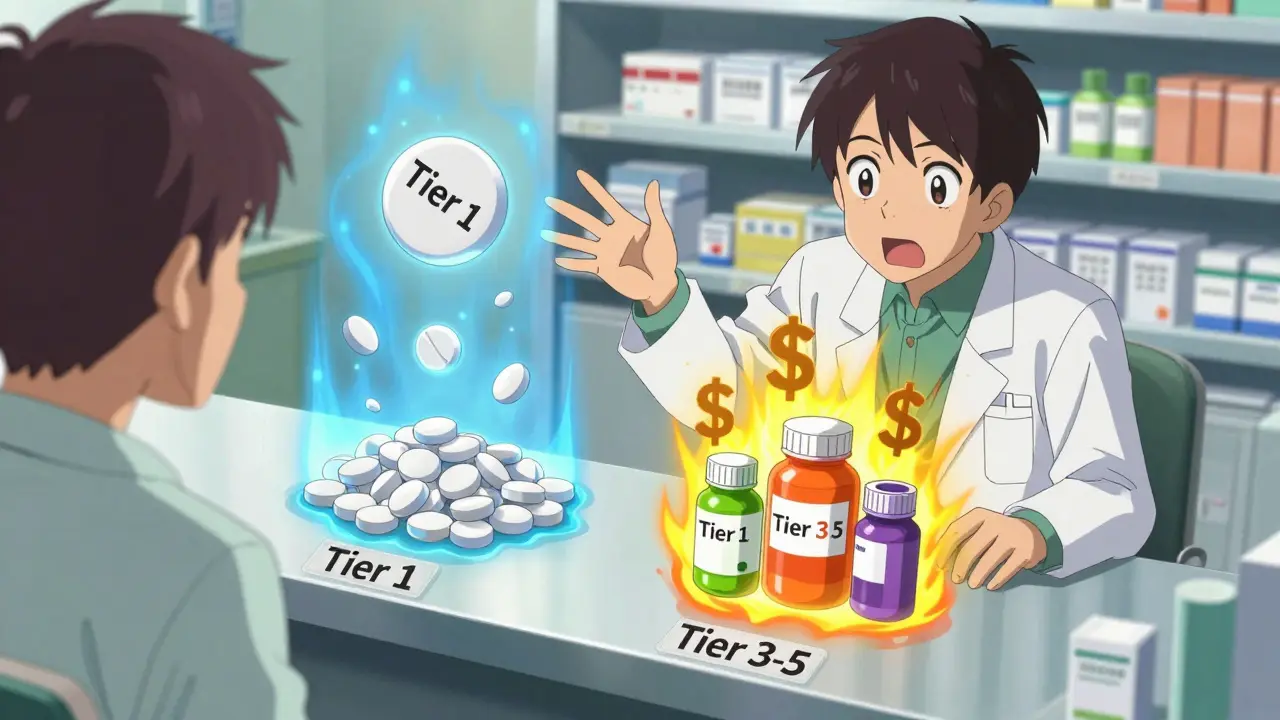
- Tier 1 (Preferred Generics): These are the most heavily utilized drugs. You might pay $0 to $10 for a 30-day supply at preferred pharmacies. Plans negotiate deep discounts with manufacturers like Teva, Mylan, and Sandoz-who control over 63% of the Part D generic market-to keep these prices rock-bottom.
- Tier 2 (Standard Generics): If a generic isn't on the "preferred" list, it lands here. Copayments average around $15.25. It's still cheap compared to brands, but slightly higher to nudge you toward Tier 1 options when possible.
- Tier 3 (Non-Preferred Brands): Brand-name drugs start appearing here. Copays jump significantly, often ranging from $45 to $75 for a month's supply.
- Tier 4 & 5 (Specialty Drugs): High-cost injectables and specialty medications live here. Costs can be thousands of dollars per month, usually requiring prior authorization.
This structure creates a powerful financial incentive. If you take a blood pressure medication like amlodipine, the generic version might cost you nothing. The brand name, Norvasc, could cost $45 a month. Over a year, that’s a difference of $540. Most people will choose the generic not because they distrust the brand, but because the math forces their hand.
The Hidden Complexity: Protected Classes and Exceptions
You might assume that if a generic exists, you must take it. That’s not entirely true. CMS requires Part D plans to include "substantially all" drugs in six protected classes. These include anti-cancer, anti-psychotic, anti-convulsant, anti-depressant, immunosuppressant, and anti-retroviral medications.
Why are these protected? Because switching patients off these drugs can have severe health consequences. A patient stabilized on a specific brand-name anti-psychotic may experience adverse reactions if switched to a generic with slightly different inactive ingredients. Therefore, plans cannot use tiering to aggressively push generics in these categories as they do with common drugs like statins or acid reducers. This is a crucial exception to the general economic rule of "generics first."
However, outside these protected classes, plans have wide latitude. A 2023 CMS Office of Inspector General report found that 63.2% of beneficiaries would face higher out-of-pocket costs if they switched plans without carefully reviewing formulary differences. This variability is where many people get burned. A generic drug covered at $0 in one plan might be placed in a higher tier-or even excluded-in another.
2025-2026 Changes: Caps, Discounts, and New Rules
The economics of Part D are shifting rapidly due to recent legislation. The Inflation Reduction Act of 2022 introduced changes that are now hitting beneficiaries in full force. Two major developments affect how generics fit into your budget starting in 2025 and 2026.
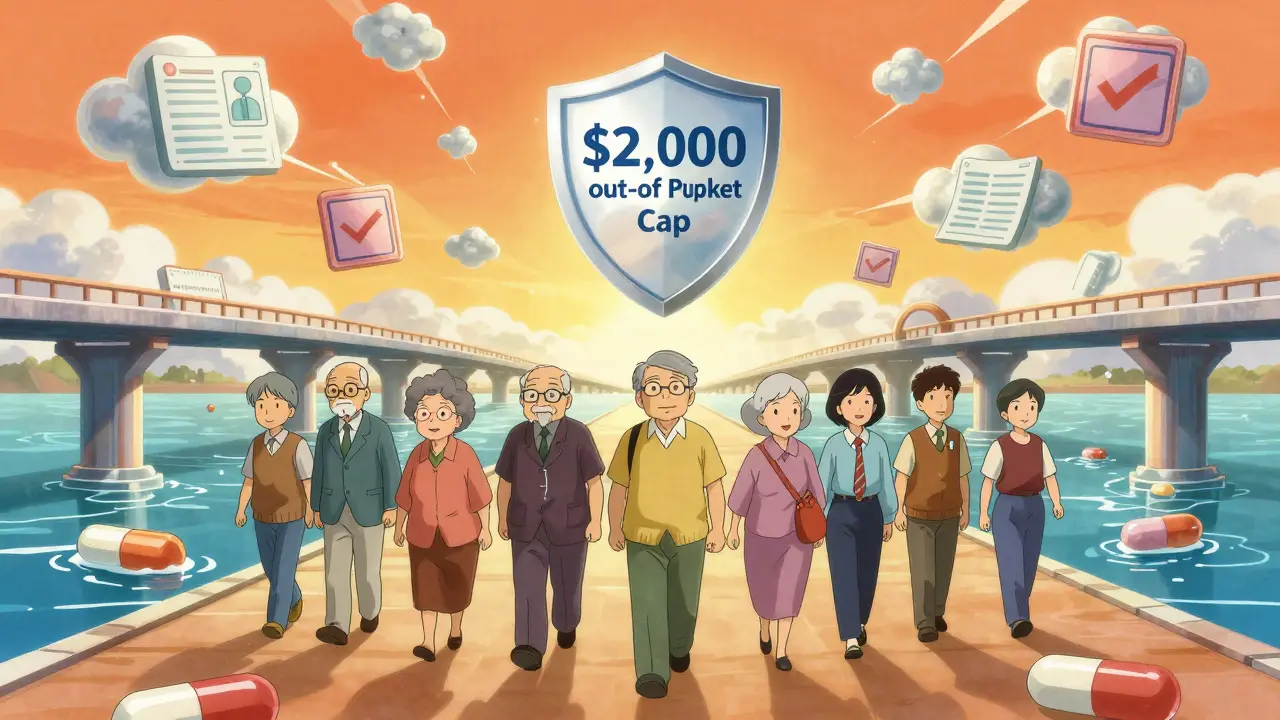
- The $2,000 Out-of-Pocket Cap: Starting in 2025, there is a hard cap on annual out-of-pocket spending for covered drugs. Once you spend $2,000 (rising to $2,100 in 2026), you enter catastrophic coverage. In this phase, you pay either 5% coinsurance or a nominal copay ($4.15 for generics in 2024, adjusted annually). This cap protects you from ruinous costs, but it also changes the incentive structure. Before, high deductibles made some people skip doses. Now, the safety net is tighter.
- Manufacturer Discount Program: Effective January 1, 2025, manufacturers must provide additional discounts on applicable drugs during both the initial coverage and catastrophic phases. The Congressional Budget Office (CBO) projects this will increase generic utilization by another 3.2 percentage points by 2026. Essentially, the government is squeezing more value out of the supply chain.
These changes mean that while generics remain the backbone of the program, the financial penalty for using brand-name drugs is becoming even steeper relative to the capped costs of generics.
| Factor | Generic Drugs | Brand-Name Drugs |
|---|---|---|
| Average Cost to Plan (2023) | $18.75 per prescription | $156.42 per prescription |
| Share of Total Prescriptions | 87.3% | 12.7% |
| Share of Total Spending | 24.1% | 75.9% |
| Typical Tier Placement | Tier 1 or 2 (Lowest Cost) | Tier 3, 4, or 5 (Higher Cost) |
| Copay Example (30-day supply) | $0 - $15 | $45 - $75+ |
Strategies for Beneficiaries: Navigating the System
Knowing how the economics work is useless unless you apply it. Here is how you can leverage this knowledge to save money and ensure access to your medications.
1. Review Formularies During Open Enrollment
Don't just pick the plan with the lowest premium. Look at the formulary. Specifically, check if your current medications are listed as Tier 1 or Tier 2 generics. The Medicare Rights Center recommends spending 3-5 hours researching during the Annual Enrollment Period (October 15-December 7). Studies show that beneficiaries who use the Medicare.gov Plan Finder tool save an average of $427 annually compared to those who don't.
2. Watch for Mid-Year Changes
Plans can change their formularies mid-year. A drug that was generic and cheap in January might move to a higher tier in July. Check your Explanation of Benefits (EOB) regularly. If a drug moves up, contact your doctor immediately. Sometimes, a simple switch to a different generic alternative keeps you in the lower tier.
3. Request Coverage Determinations When Necessary
If a generic causes side effects or doesn't work for you, you aren't stuck. You can request a "coverage determination" for the brand-name drug. CMS data shows a 78.4% approval rate for these requests when medically necessary. Don't suffer through adverse reactions just to save $10 a month. File the appeal.
4. Understand the "Donut Hole" Myth
The "coverage gap" is largely closed. Thanks to the Bipartisan Budget Act of 2018, you now pay only 25% of the negotiated price for both generics and brands in the gap. However, because generics are so much cheaper, your 25% payment is still far lower than it would be for a brand-name drug. Stick to generics to stay out of the gap longer.
The Future of Part D and Generic Utilization
The trajectory is clear. The Medicare Trustees Report projects that generic utilization will reach 91.5% by 2030. This growth is essential for the program's long-term viability. The trust fund is projected to remain solvent through 2093, but only if generic usage continues to rise at its current rate of 1.2 percentage points annually.
For beneficiaries, this means the push toward generics will only intensify. Prior authorization requirements are expanding, and therapeutic interchange programs-where pharmacists automatically substitute generics-are affecting nearly 59% of generic fills. The system is designed to make the generic choice the easiest, cheapest, and most automatic path.
Your role is to stay informed. By understanding that generics are the economic engine of Medicare Part D, you can navigate the system with confidence. You know why the tiers exist, how the caps protect you, and what steps to take when the system tries to steer you away from your preferred treatment. Use that knowledge to advocate for your health and your wallet.
What is the difference between Tier 1 and Tier 2 generics?
Tier 1 generics are "preferred" drugs that have the lowest copayments, often $0-$10. Tier 2 generics are standard non-preferred generics with slightly higher copays, averaging around $15. Both are chemically identical to brand names, but insurers negotiate better rates for Tier 1 drugs to encourage their use.
Can I refuse a generic substitution in Medicare Part D?
Yes, but it may cost you more. If you prefer a brand-name drug, your doctor must specify "dispense as written" on the prescription. However, you will likely face higher copays or coinsurance. If the generic causes medical issues, you can file a coverage determination request to get the brand covered at a lower cost.
How does the $2,000 out-of-pocket cap affect generic drug costs?
The cap limits your total annual spending on covered drugs. Once you hit $2,000 (in 2025), you enter catastrophic coverage. In this phase, you pay a small copay (e.g., $4.15 for generics) or 5% coinsurance, whichever is greater. Using generics helps you reach this cap faster due to lower upfront costs, but the cap protects you regardless of whether you use generics or brands.
Are all generic drugs equally effective?
FDA-approved generics must have the same active ingredient, strength, dosage form, and route of administration as the brand-name drug. They are bioequivalent, meaning they work the same way in the body. However, inactive ingredients (fillers, dyes) can differ, which rarely causes sensitivity issues in some patients.
Why do some plans exclude certain generic drugs?
Plans design formularies based on negotiations with manufacturers and clinical guidelines. Some generics may be excluded if there are multiple alternatives in the same class, or if the plan wants to steer patients toward specific preferred agents. Always check the formulary before enrolling to ensure your specific medication is covered.





Oh wow, another article explaining how the insurance companies are basically playing chess with our kidneys while we're just trying to keep our blood pressure down. Truly groundbreaking journalism here. 🙄
Hey everyone, I know this stuff feels like a maze, but breaking it down actually helps. The key takeaway is that generic drugs aren't just 'cheaper options'-they are the main lever insurers use to stay profitable. If you see your pharmacist suggesting a switch, they aren't being pushy; they are following the formulary tiers designed to save you money.
For instance, if your brand-name drug is on Tier 3 or 4, switching to a Tier 1 generic can save you hundreds per year. It's not about distrust in the brand, it's about the math forcing your hand. Check your plan's formulary during open enrollment because a drug covered at $0 in one plan might be excluded in another. Don't let the complexity scare you off from asking questions.
:) They want you to think it's about 'efficiency' and 'solvency' but really it's just the big pharma and insurance cartels squeezing every last drop of value out of the supply chain before they collapse the whole system. The FDA approved generics? Sure, if you believe the official narrative. Inactive ingredients differ, and guess what? That's where the real control lies. Wake up sheeple. :)
It is fascinating how economics dictates health outcomes. We often forget that behind every pill is a complex web of incentives and disincentives. 🌿💊 Perhaps we should view this not as a burden, but as a call to mindfulness in our consumption habits. The protected classes for mental health medications show that there is still some recognition of human fragility amidst the cold calculus. Let us remain open-minded and advocate for systems that balance fiscal responsibility with compassionate care. ✨🕊️
The author fails to adequately address the moral imperative of ensuring access to necessary medications regardless of cost. While the economic arguments for generic utilization are sound, they must not overshadow the ethical obligation to protect vulnerable populations. It is disingenuous to suggest that beneficiaries simply need to 'navigate the system' when the system itself is designed to create barriers. A truly robust healthcare framework would prioritize patient welfare over actuarial savings. One must question whether the current tiered structure constitutes a violation of basic rights to health. The data presented is accurate, yet the interpretation lacks the necessary philosophical depth to grasp the gravity of the situation.
i mean its kinda obvious right?? why do u think they make the brand name so expensive lol. its a scam. my mom had to switch her heart meds and now she has headaches but who cares its cheaper. :/
Dont give up guys! You got this! Its super important to check your formularies during open enrollment. I spent 3 hours looking at the plan finder tool and saved like $400! Just remember to ask your doctor if a generic works for you. Most of the time it does! Stay positive and keep fighting for your health! 💪✨
so you're telling me i have to do homework to get my pills? thats ridiculous. why cant the insurance company just figure it out for me? i dont have time to read all this. its their job to take care of me not mine to navigate their mess. stop blaming the victim for their own financial ruin.
I find it incredibly frustrating that mid-year formulary changes are allowed without much notice. How am I supposed to budget if my Tier 1 drug suddenly becomes Tier 3 in July? This lack of stability forces people into difficult medical decisions based on arbitrary corporate shifts rather than clinical needs.
Look, I'm always rooting for folks to save money, but let's be real-the system is rigged. However, knowing the rules is half the battle. If you can file a coverage determination and win 78% of the time, why wouldn't you? It's free money essentially. Just don't expect the insurance reps to tell you this voluntarily. 😉
This is typical American inefficiency. Other countries just fix prices. Here we have 'tiers' and 'formularies' and 'open enrollment'. It's a joke. Only the elite understand how to game this system. The rest of you are just pawns. 🇺🇸📉
Chill out everyone. The new $2000 cap starting in 2025 is actually a good thing. It stops the bleeding once you hit catastrophic coverage. Just stick to generics and you'll be fine. No need to panic.