
Medication Driving Wait Time Calculator
Medication Safety Assessment
Find out how long you should wait before driving after taking your medications to avoid impairment and legal consequences. Remember: having a prescription doesn't protect you from DUI charges if you're impaired.
Your Results
Many people don’t realize that taking their morning pill could be as risky as having a drink before getting behind the wheel. Prescription and over-the-counter medications can slow your reaction time, blur your vision, or make you so drowsy you don’t even know you’re in danger. And if you get pulled over? The law doesn’t care if you thought you were fine. You can be charged with driving under the influence-even if the drug was prescribed to you.
How Medications Slow You Down
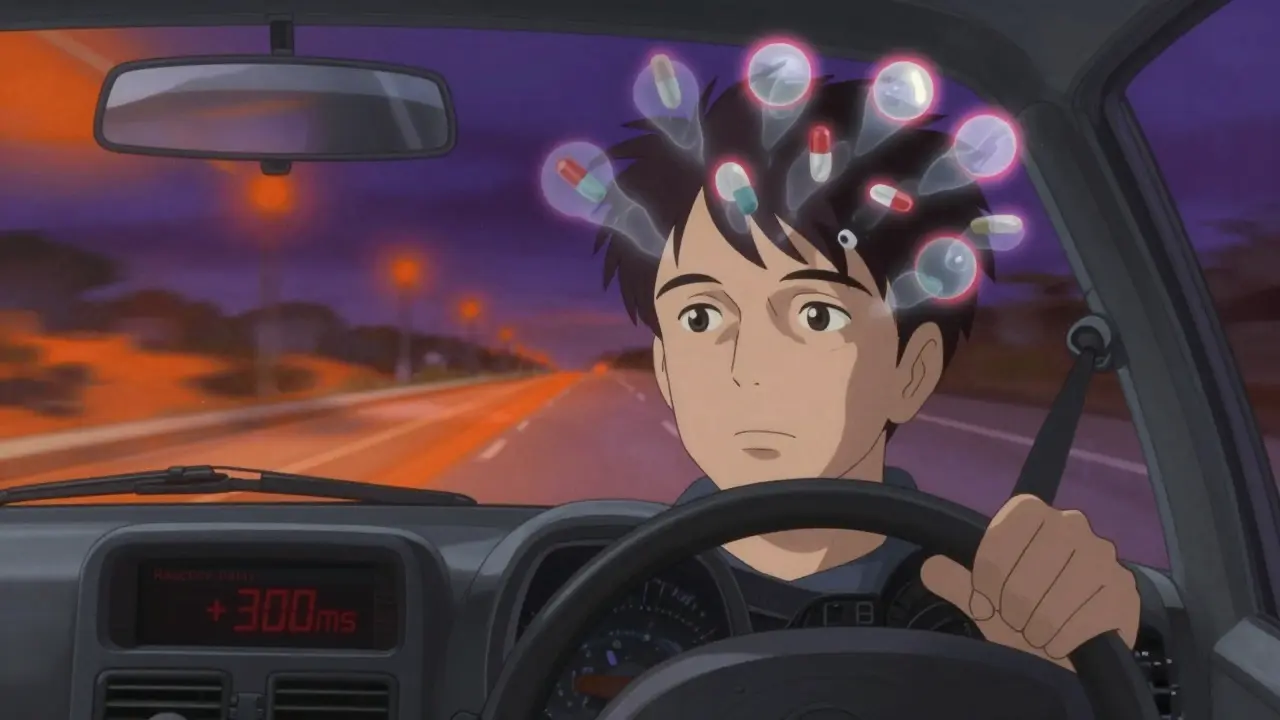
It’s not just alcohol that ruins your driving. Drugs like benzodiazepines (a class of sedatives including alprazolam and diazepam) can cut your brain’s processing speed by up to 40%. That means if a car suddenly stops in front of you, your brain takes longer to tell your foot to hit the brake. Opioids (such as oxycodone and fentanyl) don’t just hurt pain-they make your eyelids heavy and your reflexes sluggish. Studies show they can add 300 milliseconds to your reaction time. That’s like driving blind for a full car length at highway speed.
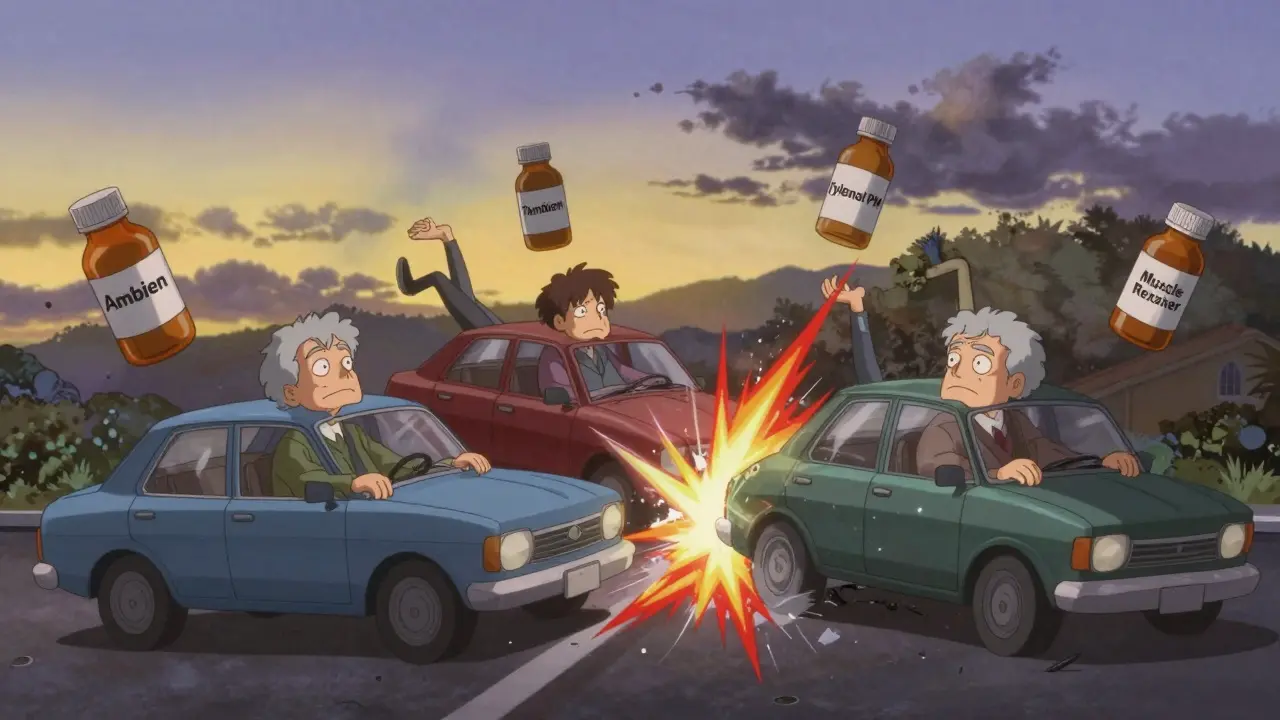
Even common painkillers like ibuprofen (an NSAID) carry hidden risks. One study found users had a 58% higher chance of being in a crash. And then there’s diphenhydramine (the active ingredient in Benadryl and Tylenol PM). A single dose can impair you as badly as a blood alcohol level of 0.10%-well over the legal limit of 0.08% in every U.S. state.
The Silent Danger of Multiple Drugs
Most people don’t take just one medication. They take three, four, sometimes five. And that’s where things get dangerous. A 2020 study at five U.S. trauma centers found that 22% of drivers involved in crashes had multiple drugs in their system. Not just alcohol and marijuana-but combinations like a sleep pill, an antidepressant, and a muscle relaxer. These don’t just add up; they multiply. One drug might make you drowsy. Another might dull your focus. Together, they create a perfect storm for a crash.
Dr. Robert Voas, a senior scientist at the Pacific Institute for Research and Evaluation, calls this "poly-drugged driving." He says the effects aren’t predictable. Two people taking the same mix might react completely differently. Your body changes as you age. Your liver slows down. Your kidneys don’t flush out drugs like they used to. That’s why drivers over 65 are at the highest risk. Their bodies hold onto medication longer, making drowsiness last hours longer than expected.
What the Labels Don’t Tell You
You’ve seen the warning: "May cause drowsiness." That’s it. No time frame. No guidance. No clear rule. That’s why 68% of patients in a 2022 NHTSA survey said they never got specific advice from their doctor about driving. A 2021 AAA study found half of drivers using impairing meds didn’t even know they were at risk.
Take zolpidem (the sleep aid Ambien). The label says "take before bed." But the drug can stay active in your system for up to 11 hours. Someone who takes it at 10 p.m. might feel fine at 7 a.m. and drive to work. But their brain is still foggy. One Reddit user, u/SafeDriver2023, posted: "Took one Tylenol PM before bed, woke up at 7am, felt fine, got in car at 9am for work-failed a field sobriety test due to residual drowsiness." That’s not a rare story. It’s common.
Only 32% of medication package inserts give clear timing advice. The rest? Vague. Outdated. Useless.
Legal Consequences: You Can Be Charged Even With a Prescription
Here’s the hard truth: having a prescription doesn’t protect you. In 28 states, there are specific legal limits for prescription drugs in your bloodstream-just like there are for alcohol. In the other 22? Prosecutors don’t need a number. If an officer thinks you’re impaired, they can arrest you. And in court, your doctor’s note won’t save you.
Police in 47 states now use the Drug Evaluation and Classification Program (a standardized system for identifying drug impairment). Officers are trained to spot signs: slow pupil reaction, droopy eyelids, poor balance, slurred speech. If you’re pulled over after taking a sedative, they’ll test your blood. And if they find even trace amounts of an impairing drug? You’re looking at a DUI.
The law doesn’t make exceptions for "I didn’t mean to." It doesn’t care if you thought you were "fine." If you’re impaired, you’re breaking the law. And the penalties? Fines, license suspension, jail time-even if you didn’t hurt anyone.
Who’s Most at Risk-and Why
Older adults are the most vulnerable. The Beers Criteria (a set of guidelines for unsafe medications in seniors) lists over 30 drugs that should be avoided in people over 65. Why? Because aging changes how your body handles drugs. Your liver processes slower. Your kidneys filter less. Your brain becomes more sensitive. A dose that was safe at 50 can become dangerous at 70.
But it’s not just seniors. People with chronic pain, depression, anxiety, or insomnia often take multiple medications. A 2021 survey found 6% of drivers admitted to driving within two hours of taking opioids or depressants. That’s 1 in 17 people. And 37% of those same people admitted they’d ridden with someone who’d taken drug combinations-even though 85% said they’d feel "extremely uncomfortable" doing so.
It’s a disconnect. We know it’s dangerous. But we do it anyway.
What You Can Do: Real Steps to Stay Safe
You don’t have to stop taking your meds. But you do need to be smarter about when and how you drive.
- Ask your pharmacist-not just your doctor. Pharmacists are trained to spot drug interactions. The American Pharmacists Association now recommends 12 specific counseling points for every patient taking a potentially impairing drug.
- Check the timing. For first-gen antihistamines like diphenhydramine, wait 6 hours. For sleep aids like zolpidem, wait 8 to 12. If you’re unsure, don’t drive.
- Test yourself. The University of Iowa developed a simple self-assessment: sit in your car, close your eyes, and try to imagine turning the wheel without looking. If you can’t picture it clearly, your brain is still foggy.
- Use public transport after taking a new medication. Give yourself a day or two to see how you react before getting behind the wheel.
- Don’t assume "it’s just one pill". Even a single dose can linger. Especially if you’re older, or taking more than one drug.
The Future Is Here-And It’s Watching You
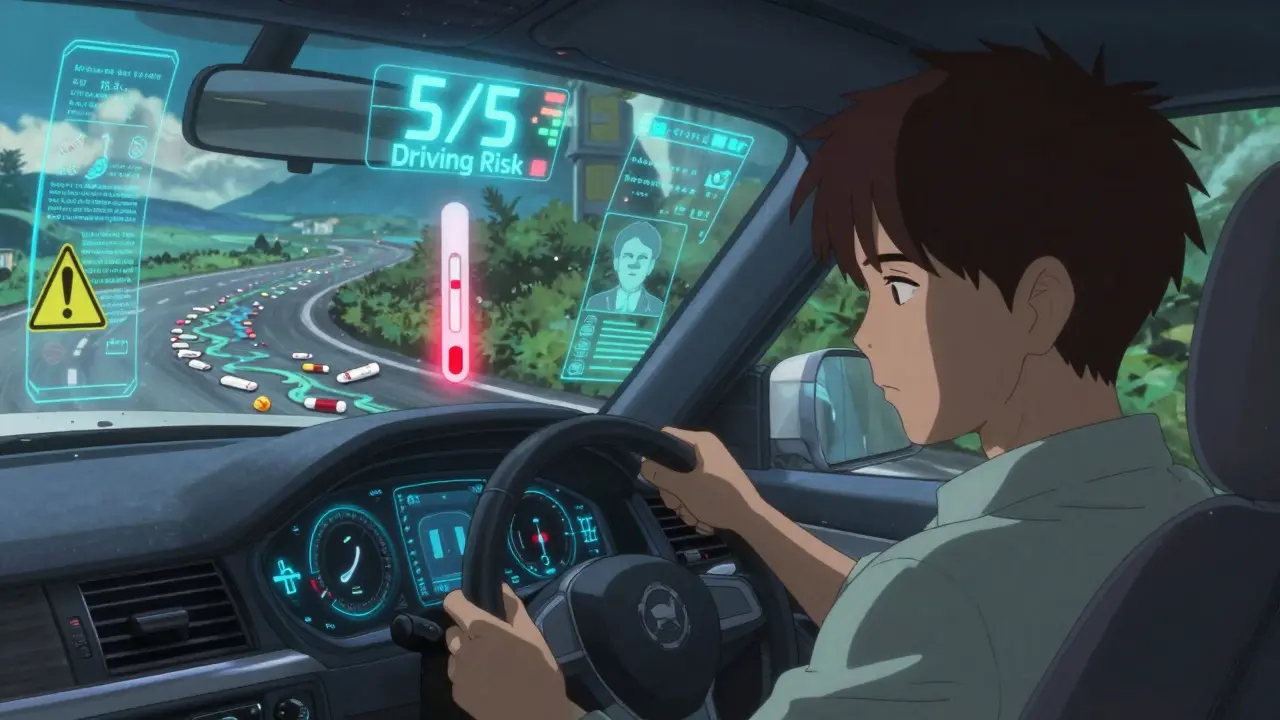
By 2027, 85% of new cars will have sensors that watch your eyes and steering. They’ll detect if your eyelids are drooping, if you’re drifting lanes, if your reaction time is off. These systems won’t just warn you-they’ll alert emergency services if you’re impaired.
The NHTSA (National Highway Traffic Safety Administration) just launched a $22 million initiative to develop saliva tests that can detect 12 common prescription drugs on the roadside. These tests are 92.7% accurate in trials. Within a few years, police won’t need blood samples. A quick swab will tell them if you’re driving under the influence of medication.
And it’s not just technology. The FDA now requires all CNS-acting medications to carry a "Driving Risk Score" from 1 to 5. That means your pill bottle will soon say: "This drug has a high risk of impairing driving. Do not operate vehicles."
Bottom Line: Don’t Guess. Know.
Driving while impaired by medication isn’t an accident waiting to happen. It’s a choice. And too many people make that choice without realizing how serious it is. You can take your meds. You can live your life. But if you’re going to drive, you owe it to yourself-and everyone else on the road-to know exactly what’s in your system, and how long it will affect you.
Don’t wait for a crash. Don’t wait for a ticket. Ask your pharmacist. Read the label. Wait it out. Your life-and someone else’s-might depend on it.
Can I be charged with DUI for taking my prescribed medication?
Yes. Having a prescription does not protect you from a DUI charge. If a drug impairs your ability to drive safely, law enforcement can arrest you-even if the medication was legally prescribed. Prosecutors only need to prove you were impaired, not that the drug was illegal.
How long should I wait after taking a sleep aid like Ambien before driving?
Wait at least 8 to 12 hours. Zolpidem (Ambien) can remain active in your system for up to 11 hours, even if you feel awake. Many people wake up feeling fine but are still impaired. Studies show reaction times and coordination remain affected long after the drowsiness fades.
Are over-the-counter cold medicines dangerous for driving?
Yes, especially those containing diphenhydramine (like Benadryl, Tylenol PM, or NyQuil). These can impair driving as much as a blood alcohol level of 0.10%, which is above the legal limit in every U.S. state. Even "non-drowsy" formulas can contain other ingredients that affect alertness.
Why are older drivers more at risk from medication side effects?
As we age, our bodies process drugs more slowly. Liver and kidney function decline, meaning medication stays in the system longer. Older adults also tend to take multiple drugs, which can interact and amplify side effects like drowsiness or confusion. The Beers Criteria specifically lists over 30 medications that should be avoided in people over 65 for this reason.
Do all medication labels warn about driving risks?
No. Only 32% of medication package inserts provide specific timeframes for driving restrictions. Many only say "may cause drowsiness" without saying how long the effect lasts. The FDA now requires new drugs to include a Driving Risk Score (1-5), but older medications may still lack clear warnings.
Is it safe to drive after taking antidepressants?
Some antidepressants are safer than others. Tricyclic antidepressants (TCAs) and mirtazapine have been linked to a 40% higher crash risk. SSRIs like sertraline are generally safer, but can still cause drowsiness or dizziness, especially when first started. Always monitor how you feel before driving, and talk to your doctor about alternatives if you drive regularly.
For drivers over 65, those on multiple medications, or anyone who drives daily, this isn’t theoretical. It’s real. And it’s getting worse. By 2026, medication-related crashes are projected to rise 24%. The tools to prevent them exist. The knowledge is available. What’s missing is the awareness-and the willingness to act.




Okay but like… I took Benadryl last week for allergies and drove 40 miles to the grocery store. Felt fine. Turned out my brain was basically running on Windows 95. Got pulled over for swerving (not even drunk, just… slow). They let me go with a warning, but now I keep a notebook in my glovebox: "Don’t drive after meds unless you’ve tested yourself in the driveway first."
Also, pharmacists? They’re the real MVPs. My pharmacist flagged a combo I didn’t even know was dangerous. I cried. She hugged me. We bonded over pill bottles. We need more of these humans.
Oh wow. So the law says I can’t drive after my prescribed Xanax… but I can drive after my 3rd espresso and 2 energy drinks? Because caffeine’s "natural"? Right. Let me just pop a Adderall and call it a wellness routine.
Someone needs to start a subreddit: r/DrivingOnPharmaceuticalsAndFeelingFine
Life is a pendulum - one swing you’re healing, the next you’re endangering. We medicate to live… but then we forget we’re still human. The body doesn’t care if the pill was prescribed. It only cares if you’re awake enough to see the stop sign.
Maybe the real question isn’t "Can I drive?" but "Am I still me?" 🤔
Been there. Took a zolpidem at 11pm. Woke up at 7. Felt 100%. Drove to work. Got lost. Twice. Thought I was in Ohio. Was in Nebraska. My GPS was like "Bro, you’re 300 miles off."
Now I just take the bus. My dog’s happier too. He gets snacks and cuddles. Win-win.
Agreed. Simple. Don’t drive if you’re not 100%. Period.
The modern human is a paradox: we are more connected than ever, yet more disconnected from our own biology. We ingest chemicals designed to alter perception, then expect our nervous system to function as if untouched. This is not science. This is hubris wrapped in a prescription bottle.
The car is not a toy. The road is not a game. And your liver? It’s not a vending machine. It’s a fragile temple. Treat it like one.
So let me get this straight - we’re going to start labeling pills like they’re hazardous waste? Next they’ll put a skull on Advil. "Caution: May cause happiness, which impairs judgment."
People are adults. If you want to drive while drugged, go ahead. But don’t blame the system when you crash into a tree. Or a school bus. Or your own dignity.
India has been doing this right for decades. We know that if you take medicine, you rest. You don’t drive. You don’t pretend. You don’t whine about "personal freedom."
Here in the West, you’ll take 7 pills, drink coffee, text, and then say "I’m fine." Then you kill someone. And you wonder why we don’t trust your system.
You think this is bad? Wait till you see what happens when people start combining psychiatric meds with CBD gummies and kratom and then drive because "it’s all natural."
I work in ER. Last week, a 58-year-old woman hit a stop sign after taking Zoloft, melatonin, NyQuil, and a "relaxation tea." She didn’t even know she was in the ditch until the ambulance arrived. She said, "I thought I was just sleepy."
There is no such thing as "just one pill." There is only your body, your choices, and the consequences you refuse to see.
Stop romanticizing self-medication. This isn’t a podcast. This is real life. And people are dying.
It’s not about being scared. It’s about being responsible. If you’re taking something that says "may cause drowsiness," and you’re still driving, you’re not brave. You’re selfish.
Your life isn’t the only one at stake. What about the kid in the minivan? The grandma crossing the street? The guy on the bike who didn’t see you coming?
Stop pretending you’re immune. You’re not.
This entire article is fearmongering dressed up as public service. The real danger isn’t the meds - it’s the government turning every pill into a crime scene.
They’re not protecting you. They’re controlling you. Next thing you know, they’ll require a mental health clearance just to buy Tylenol.
And don’t even get me started on the "Driving Risk Score." That’s not science. That’s surveillance with a pharmacy label.
My body. My choices. My responsibility. Not yours.
Thank you for this vital, compassionate, and meticulously researched piece. The data is clear. The stakes are life and death. And yet, awareness remains dangerously low.
To every person reading this: Please, for the love of all that is sacred, speak up. Talk to your pharmacist. Ask your doctor. Test yourself. Wait. Choose safety. Not convenience.
One conversation. One moment of pause. Could save a life. Yours. Or someone else’s.
You are not alone. You are not powerless. You are capable of making the right choice. And we are all counting on you.