
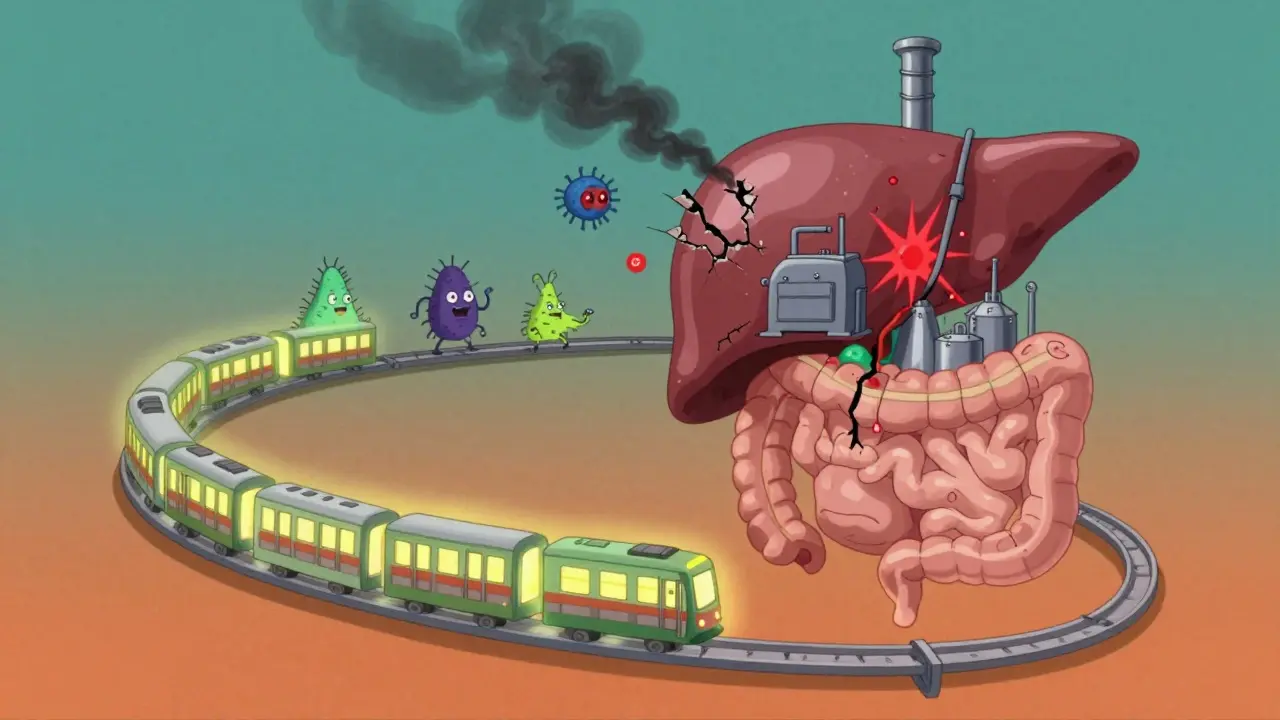
More than one in three adults worldwide has excess fat in their liver - not from drinking alcohol, but from how they eat. This condition, once called nonalcoholic fatty liver disease (NAFLD), is now more accurately named metabolic dysfunction-associated steatotic liver disease (MASLD). It’s not just about being overweight. It’s about what’s happening inside your gut and how it talks to your liver.
The Gut-Liver Connection You Can’t Ignore
Your liver doesn’t work alone. It’s wired directly to your gut through the portal vein. Every time you eat, nutrients, toxins, and bacteria from your intestines flow straight to your liver. When your gut lining gets damaged - and it often does in people with fatty liver - harmful substances leak through. One of them, called lipopolysaccharide (LPS), triggers inflammation in the liver. Studies show NAFLD patients have 2.3 times more LPS in their blood than healthy people. That’s not a coincidence. That’s a cause.At the same time, your gut bacteria change. Healthy guts have a wide variety of microbes. In NAFLD, that diversity drops. Some bad guys multiply: Barnesiella intestinihominis and Lachnospiraceae bacterium 609 show up more often. Good guys like Bacteroides vulgatus disappear. And your body makes less of a key compound called butyrate - a fuel for your gut lining. People with NAFLD have 58% less butyrate than those without it. That means your gut barrier weakens, letting more toxins into your liver.
Diet Is the First Line of Defense
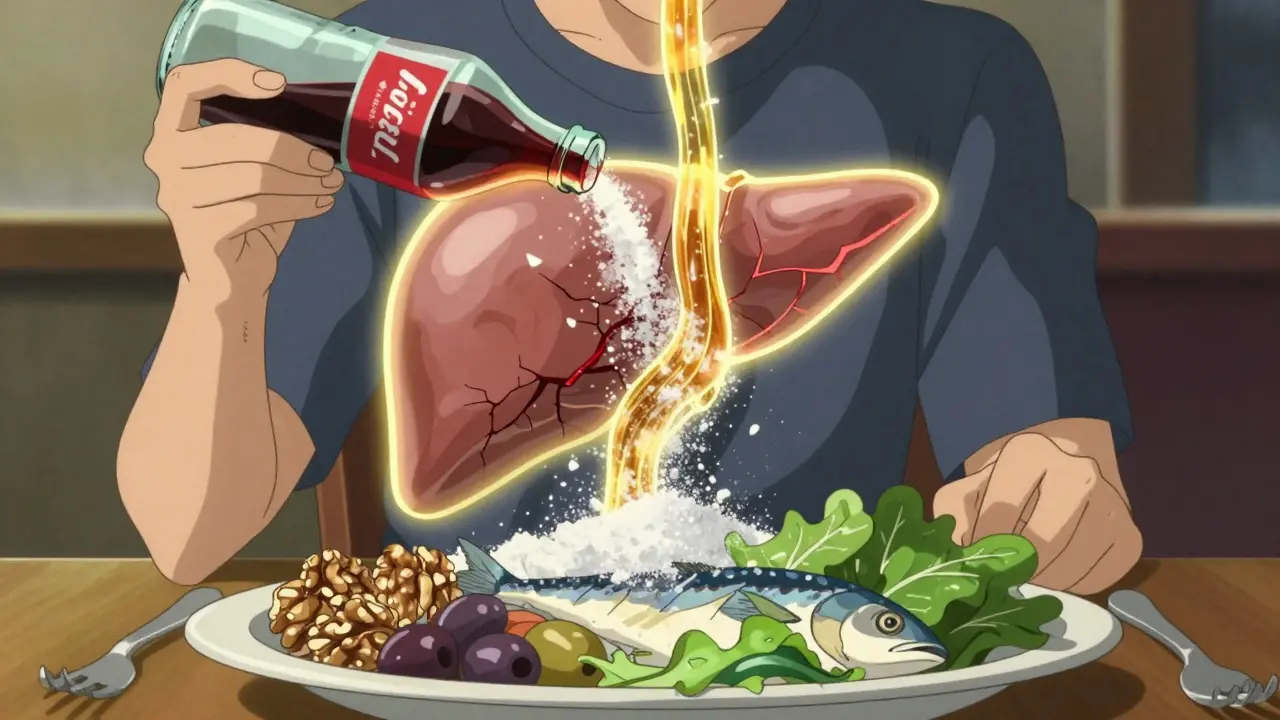
You can’t fix fatty liver with a pill. You fix it with food. And not just any food - the right kind, in the right amounts.A Mediterranean-style diet is the most studied and most effective. That means olive oil, nuts, vegetables, whole grains, fish, and legumes. A 2024 trial gave 70 NAFLD patients 30 grams of walnuts daily - about 10 halves - along with this diet. After six months, their liver fat dropped by 32%. Walnuts aren’t magic. They’re packed with fiber and healthy fats that feed good gut bacteria and reduce inflammation.
What to cut? Fructose. Not the natural kind in fruit, but the added kind in soda, candy, and processed foods. More than 25 grams a day - about two cans of soda - worsens liver fat. And sugar-sweetened drinks are the biggest source. One study found that people who drank one sugary drink a day had 70% higher odds of advanced liver disease.
Don’t fear fat - choose the right kind. Monounsaturated fats from avocados, olive oil, and almonds help reduce liver fat. They also improve insulin sensitivity, which is broken in most NAFLD cases. Protein matters too. Aim for 1.2 to 1.6 grams per kilogram of body weight. That’s about 80-100 grams a day for most people. It helps preserve muscle while you lose fat, which keeps your metabolism active.
Weight Loss Isn’t Optional - It’s the Treatment
Losing weight isn’t just about looking better. It’s about saving your liver.Studies show that losing 5% of your body weight improves liver fat in 81% of people. Lose 7% and inflammation starts to drop. Lose 10% and nearly half of people with the more serious form, NASH, see their liver damage reverse. That’s not a guess. That’s from a 2023 meta-analysis of over 10,000 patients.
But here’s the catch: losing weight slowly works better than crashing diets. Aim for 0.5 to 1 kilogram (1-2 pounds) per week. That’s a daily deficit of 500-750 calories. Most people think they need to starve. They don’t. A 1,500-calorie diet with high fiber and protein is sustainable. Add movement - even just walking 10,000 steps a day - and you cut liver enzymes (ALT) twice as much as diet alone.
Real people succeed with structured programs. At the Mayo Clinic, patients who followed a plan with diet, exercise, and weekly coaching kept their liver healthy two years later 68% of the time. Those who tried to do it alone? Only 29% stayed in remission.
Probiotics and Prebiotics: Helpful, But Not a Magic Bullet
You’ve seen ads for probiotics that claim to cure fatty liver. They don’t. But they can help - if you pick the right ones.A 2024 double-blind trial gave 100 NAFLD patients a mix of Lactobacillus rhamnosus GG, Bifidobacterium longum, and Streptococcus thermophilus twice a day for six months. Their liver fat dropped 23%. ALT levels fell 31%. That’s as good as some prescription drugs - without the side effects.
But not all probiotics work. You need at least 10 billion CFUs per day, from multiple strains, for at least 12 weeks. Single-strain supplements? Usually useless. Also, probiotics work best when paired with prebiotics - the fiber that feeds good bacteria. Inulin and fructooligosaccharides (FOS) are proven. Taking 10 grams of inulin daily for 12 weeks raised butyrate levels by 47% and lowered liver stiffness by 15%.
Some people get bloated or gassy at first. That’s normal. It means the bacteria are waking up. If it doesn’t improve after two weeks, switch brands. And remember: probiotics won’t fix a diet full of sugar and fried food. They’re support, not a replacement.
What Doesn’t Work - And Why
There’s a lot of noise out there. Fasting? Intermittent fasting (like 5:2) helps some people control calories and reduce liver fat. But it’s not better than consistent, balanced eating. And if you binge on junk food during your eating window, it backfires.Fecal transplants? Still experimental. A 2022 pilot study showed minor improvements in liver enzymes, but no change in actual liver damage. Too early to recommend.
Detox teas, liver cleanses, or supplements like milk thistle? No solid proof they reduce liver fat. Some may even harm your liver if taken in high doses. Stick to food, weight loss, and science-backed probiotics.

Practical Steps You Can Start Today
You don’t need a fancy plan. Just start here:- Swap soda and juice for water, herbal tea, or sparkling water with lemon.
- Add one serving of vegetables to every meal - even breakfast (spinach in eggs, for example).
- Replace white bread, pasta, and rice with whole grains: oats, quinoa, brown rice.
- Snack on nuts (walnuts, almonds) or fruit instead of chips or cookies.
- Walk 30 minutes a day, five days a week. No gym needed.
- If you’re overweight, aim to lose 5% of your body weight in the next three months. That’s 5 pounds if you weigh 100.
- Try a multi-strain probiotic with at least 10 billion CFUs daily. Look for Lactobacillus and Bifidobacterium strains.
Track your progress with simple markers: how you feel, how your clothes fit, and your energy levels. Liver tests take time to improve. But your gut will thank you sooner.
The Bigger Picture
The medical world is shifting. NAFLD is no longer seen as just a liver problem. It’s a metabolic disorder - and your gut is ground zero. Experts predict that by 2030, gut microbiome testing will be part of routine liver care. But you don’t need to wait for that.Right now, you have power. You can change your diet. You can lose weight. You can support your gut. And you can reverse liver damage - without drugs, without surgery, without waiting for approval from a doctor.
It’s not easy. But it’s simple. And it’s the only way that actually works.
Can you reverse fatty liver without losing weight?
No. Weight loss is the only proven way to reduce liver fat and reverse damage. Even with perfect diet and probiotics, if you don’t lose weight, the liver will keep accumulating fat. Losing just 5% of your body weight improves liver fat in most people. More weight loss means better results.
Are probiotics safe for NAFLD patients?
Yes, when chosen correctly. Multi-strain probiotics with at least 10 billion CFUs per day are safe for most people. Some report mild bloating at first, which usually fades. Avoid probiotics with added sugar or artificial fillers. Always check the strain names - Lactobacillus rhamnosus GG and Bifidobacterium longum are well-studied for NAFLD. If you have a compromised immune system, talk to your doctor first.
Does intermittent fasting help NAFLD?
It can help - if it helps you eat fewer calories. The 5:2 method (eating normally five days a week, cutting calories two days) has worked for many in online communities. But studies show it’s not better than consistent daily calorie control. The key is not when you eat, but what and how much. If you overeat on your eating days, fasting won’t help.
How long does it take to see improvement in liver health?
You may feel better - less bloating, more energy - within 2-4 weeks of changing your diet. Liver enzymes (ALT) often drop in 3-6 months. Liver fat reduction shows up on scans after 6-12 months. Reversing fibrosis takes longer - often over a year of consistent effort. Patience and consistency matter more than speed.
Can I eat fruit if I have NAFLD?
Yes - but limit high-fructose fruits like grapes, mangoes, and watermelon. Stick to berries, apples, pears, and citrus. One serving per meal is fine. The fiber in whole fruit slows sugar absorption, unlike juice or dried fruit. You’d need to eat 5-6 apples to get the same fructose as one soda - and you’d also get fiber, vitamins, and antioxidants.
Is alcohol allowed with NAFLD?
Even small amounts can worsen liver damage. NAFLD means your liver is already stressed. Alcohol adds another burden. Most experts recommend complete avoidance. If you do drink, limit it to no more than one drink per week - and never on an empty stomach.





So the gut-liver axis is basically a direct line for toxins to wreck your liver? That makes so much sense now. I always thought it was just about calories in, calories out. Turns out it’s more like garbage in, garbage out.
I’ve been eating way more walnuts since reading this. Not because I’m trying to be healthy, but because I like them. Funny how the body rewards you for doing things you already enjoy.
OMG YES 🥹 I swapped soda for sparkling water with lemon and my bloating vanished in 3 days. I didn’t even realize how bad it was until it was gone. Also started walking after dinner - turns out my dog loves me more when I’m not a zombie on the couch. 🐶💚
Let’s be real - this article reads like a supplement ad disguised as science. Probiotics ‘help’? 23% reduction? That’s not a cure, it’s a placebo with a fancy name. And don’t get me started on ‘Mediterranean diet’ - it’s just olive oil and denial wrapped in a Pinterest post.
Real treatment? Lose the weight or keep the liver failure. No magic bacteria are going to undo decades of soda and pizza. Stop selling hope. Sell results.
It is, indeed, a matter of profound public health significance. The erosion of dietary discipline across Western societies has precipitated a silent epidemic of metabolic dysfunction. The data presented, while broadly corroborated, lacks sufficient contextualization within the broader epidemiological framework of post-industrial nutrition.
One must question the efficacy of recommending walnuts as a primary intervention when systemic dietary reform remains unaddressed. The suggestion of a 1,500-calorie regimen, without reference to macronutrient distribution or glycemic load, is methodologically insufficient.
I’ve been thinking a lot about how we’ve detached food from its biological purpose. We treat it like entertainment - flavor bombs, Instagram snacks, dopamine hits. But the liver doesn’t care about taste. It just processes. It just remembers.
Maybe the real problem isn’t the sugar. It’s that we’ve forgotten how to listen to our bodies. We’ve outsourced hunger to algorithms and cravings to marketing. The gut doesn’t lie. It just gets louder when we stop ignoring it.
Let me cut through the noise - this is a microbiome dysbiosis cascade triggered by fructose-induced zonulin upregulation, leading to endotoxemia-driven hepatic inflammation via TLR4/NF-kB signaling. You want to reverse it? You need to modulate the gut-liver axis with prebiotic fiber (inulin/FOS), multi-strain probiotics (L. rhamnosus GG + B. longum), and caloric restriction to induce autophagic clearance of lipid droplets. No fluff. No placebo diets. Just hard science. If you’re not hitting 10g inulin/day and 1.5g protein/kg, you’re just delaying the inevitable. #MetabolicHealth #GutAxisWarrior
So let me get this straight - I’m supposed to give up my 3pm soda, eat more walnuts, and walk 10k steps… so I can live longer? Wow. What a tragedy. My liver is basically a drama queen who needs a spa day. 🙄
Lauren’s right about the probiotics being overhyped - but she misses the point. It’s not about magic pills. It’s about the fact that food is information. Walnuts aren’t just fat - they’re signals to your microbiome to calm down. Sugar isn’t just empty calories - it’s a red flag that tells your liver to store, not burn.
The real revolution isn’t in supplements. It’s in recognizing that your gut is an organ of perception. It’s sensing what you eat - and telling your liver what to do. We stopped listening. Now we’re paying for it.
I lost 12% of my body weight over 8 months. No keto. No fasting. Just cut soda, ate more veggies, walked every day, and stopped stressing about every calorie. My ALT dropped from 89 to 31. I didn’t even know I was that sick until I got better.
People think you need a plan. You just need to start. One meal. One walk. One less sugary drink. The rest follows.