
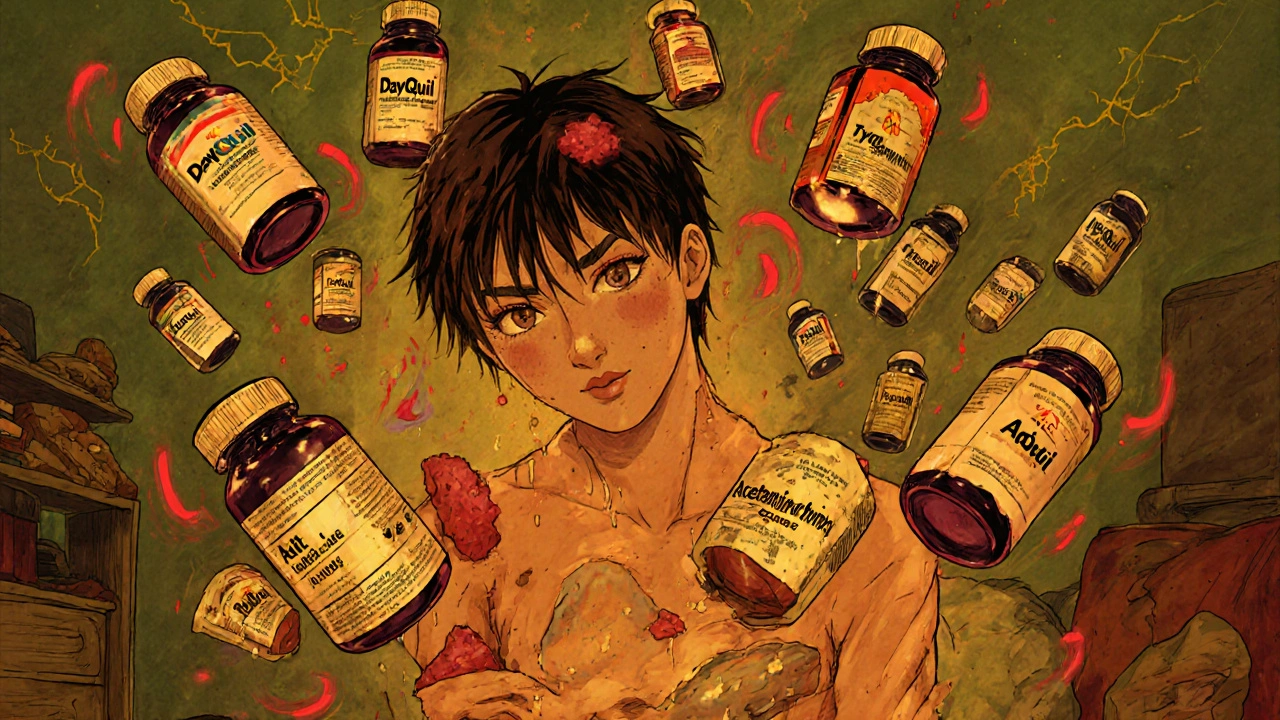
Why OTC Cold and Flu Medicines Are Riskier Than You Think
Most people reach for a bottle of DayQuil or Theraflu when they feel a cold coming on. It’s convenient - one pill, multiple symptoms. But here’s the problem: you might be accidentally overdosing without even knowing it.
Every year, more than 14,000 people call poison control because they took too much acetaminophen from cold and flu meds. That’s not a typo. That’s 14,237 cases in 2022 alone, according to the American Association of Poison Control Centers. And acetaminophen is just one of the hidden dangers in these combo products.
These medicines aren’t magic bullets. They’re mix-and-match formulas designed to treat cough, fever, congestion, and runny nose all at once. But if you’re already taking Tylenol for a headache, or a sleep aid with diphenhydramine, or even a generic pain reliever - you could be stacking dangerous doses without realizing it.
What’s Actually in Your Cold Medicine?
Look at the bottle. Not the brand name. Not the colorful packaging. Look at the Drug Facts label. That’s where the truth is.
Most OTC cold and flu products contain four common ingredients:
- Acetaminophen (also called APAP or paracetamol) - for fever and pain. Found in 73% of combo products.
- Dextromethorphan (often listed as DM) - suppresses cough.
- Phenylephrine - a nasal decongestant. But here’s the catch: studies show it doesn’t work well at the 10mg dose found in most OTC products.
- Doxylamine or chlorpheniramine - antihistamines that cause drowsiness. Used in nighttime formulas.
Some brands swap out acetaminophen for ibuprofen (like Advil Cold & Flu), but that doesn’t make it safer. You still risk taking too much of something you didn’t know was in there.
And here’s the sneaky part: different brands use different names for the same thing. Tylenol Cold & Flu Night has chlorpheniramine. NyQuil has doxylamine. Both make you sleepy. Both can linger into the next day. And if you take one at night and another in the morning thinking they’re different? You’re doubling down on sedatives.
How Double Dosing Happens (And Why It’s Deadly)
Double dosing isn’t about being careless. It’s about confusion.
Here’s a real scenario: You wake up with a fever and sore throat. You take one Tylenol Cold & Flu caplet (325mg acetaminophen). Later, your head starts pounding. You grab your bottle of regular Tylenol - another 325mg. Two hours later, you feel worse. You take another Tylenol Cold & Flu. Now you’ve had 1,300mg of acetaminophen in less than four hours.
The FDA says the max safe daily dose is 4,000mg. Sounds high, right? But it’s easy to hit that limit. Take two caplets of Tylenol Cold & Flu every four hours - that’s 1,950mg per day. Add a nighttime NyQuil (another 325mg) and you’re at 2,275mg. Throw in a few extra doses of Advil Cold & Flu (which also has acetaminophen in some versions) and you’re over 4,000mg before dinner.
Exceeding that limit doesn’t just cause stomach upset. It can cause acute liver failure. You might not feel sick until it’s too late. Symptoms like nausea, fatigue, and yellowing skin can appear days after the overdose. By then, the damage is done.
And it’s not just acetaminophen. Mixing antihistamines can leave you groggy all day. Combining decongestants with high blood pressure meds? That’s a recipe for a hypertensive crisis.
Who’s Most at Risk?
It’s not just older adults or people with chronic conditions. The biggest group getting into trouble? Young adults.
A Kaiser Family Foundation survey found that 68% of adults aged 18-34 prefer combination cold medicines. Why? Because they’re easier. Because they’re marketed as “everything you need.” But this age group is also the most likely to take multiple meds at once - painkillers for workouts, sleep aids for late nights, energy boosters for work.
Meanwhile, older adults (65+) are more cautious. Only 49% use combo products. They’re more likely to ask their pharmacist or stick to single ingredients.
And here’s another surprise: workplaces are catching on. Eighty-seven percent of Fortune 500 companies no longer stock combo cold medicines in first aid kits. They know the liability. They know the risk. They only offer plain acetaminophen or ibuprofen - and sometimes just tissues and cough drops.
How to Stay Safe: A Simple 3-Step Plan
You don’t need to avoid cold meds entirely. You just need to be smarter about them.
- Read the Drug Facts label - every time. Don’t rely on the brand name. Look for the active ingredients. If you see acetaminophen, APAP, or paracetamol - write it down. If you see dextromethorphan, DM, or cough suppressant - note it. Keep a list of everything you take.
- Use single-ingredient products when possible. If you only have a cough? Take dextromethorphan alone. Only fever? Just acetaminophen. Only congestion? Try saline spray instead of phenylephrine (which doesn’t work well anyway). You’ll avoid unnecessary drugs and reduce your risk.
- Check everything else you’re taking. Your multivitamin? Your sleep aid? Your headache pill? All of them could have acetaminophen. Even some prescription painkillers do. Make a list of all your meds and cross-reference them with your cold medicine.
Pharmacists at CVS and Walgreens say the average consultation on cold meds now takes 5-7 minutes. That’s how much checking needs to happen. Spend those minutes. It’s worth it.
What’s Changing in the Cold Medicine Market?
The FDA isn’t sitting still. In November 2024, they proposed removing oral phenylephrine from OTC cold medicines because research shows it’s ineffective at standard doses. That means in the next 18 months, you’ll see products reformulated - possibly with guaifenesin (an expectorant) or other alternatives.
That’s good news. It means manufacturers are finally listening. But it also means you’ll see even more confusion as new products hit shelves.
Sales data tells us something else: people are starting to shift away from combo products. Single-ingredient acetaminophen sales rose 12.7% last year. Combo product sales? Only 2.3%. Consumers are waking up.
Experts agree: the future of cold medicine isn’t more ingredients. It’s fewer. Industry analysts predict most combo products will have no more than three active ingredients within five years - down from the current average of 4.2.
What to Do If You Think You’ve Overdosed
If you took more than you meant to - especially if you’re not sure what’s in what you took - don’t wait. Don’t hope it’ll pass.
Call Poison Control immediately: 1-800-222-1222. It’s free. It’s confidential. It’s available 24/7. They’ve handled over 14,000 acetaminophen cases in one year. They know what to do.
If you’re having symptoms - nausea, vomiting, sweating, confusion, dark urine - go to the ER. Liver damage from acetaminophen doesn’t always show up right away. But it can be reversed if caught early.
Final Tip: Use the Free Tools That Actually Work
The American Pharmacists Association has a free tool called Medication Checkup. It asks you to list every pill, liquid, or patch you take. In 8-10 minutes, it flags any overlaps - including hidden acetaminophen or duplicate antihistamines. It’s not flashy. But it works. It catches 92% of double-dosing risks.
Or download the FDA’s Safe Use of Acetaminophen guide. It’s been downloaded over 247,000 times. It’s simple. It’s clear. It’s updated as of January 2024.
And if you’re ever unsure - ask your pharmacist. Don’t feel dumb. They’ve seen it all. They’ve seen the ER visits. They’ve seen the liver transplants. They’re there to help.
Can I take OTC cold medicine with my prescription painkiller?
Maybe - but only if you check the active ingredients. Many prescription painkillers like Vicodin or Percocet already contain acetaminophen. Taking them with Tylenol Cold & Flu could push you over the 4,000mg daily limit. Always ask your pharmacist or doctor before mixing OTC and prescription meds.
Is phenylephrine useless in cold medicines?
At the standard 10mg dose found in most OTC products, yes - research shows it doesn’t work better than a placebo. The FDA proposed removing it in late 2024 because of this. Some products may switch to guaifenesin or other alternatives. For now, saline sprays or humidifiers are more effective for congestion.
Why do nighttime cold medicines make me so groggy the next day?
Nighttime formulas often contain doxylamine or diphenhydramine - antihistamines that cause drowsiness. These drugs stay in your system for 8-12 hours. If you take them at 10 p.m., you could still feel sluggish at 10 a.m. next day. Avoid driving or operating machinery until you know how your body reacts.
Are generic cold medicines safer than brand names?
No - generics have the same active ingredients as brand names. A store-brand DayQuil has the same acetaminophen, dextromethorphan, and phenylephrine as the Vicks version. The difference is price, not safety. Always compare the Drug Facts label, not the brand.
What should I do if I accidentally take too much?
Call Poison Control at 1-800-222-1222 immediately. Do not wait for symptoms. Acetaminophen overdose can damage your liver before you feel sick. If you’re dizzy, nauseous, or have dark urine, go to the ER. Early treatment can prevent serious harm.





Just took a DayQuil and a Tylenol. Now I’m paranoid. Thanks for the wake-up call.
It’s not just about reading labels-it’s about demanding transparency. The FDA should require a standardized, color-coded active ingredient system across all OTC products. No more guessing games. This isn’t rocket science; it’s basic consumer protection. And yet, corporations prioritize packaging over safety. Shameful.
Oh great. Another article telling me I’m dumb for using cold medicine. Because clearly, I didn’t realize that NyQuil has acetaminophen. I mean, who else would think that the bottle labeled ‘Nighttime Relief’ might make you sleepy? Maybe I should’ve read the fine print. Oh wait-I did. And still, I didn’t know that ‘APAP’ meant poison. Thanks for the guilt trip, Dr. Know-It-All.
Thank you for this meticulously researched piece. The data on acetaminophen overdoses is alarming, and the systemic failure of labeling clarity is a public health crisis. I’ve trained pharmacy interns to walk patients through Drug Facts labels for over a decade, and I can confirm: 80% of patients cannot identify active ingredients without assistance. This isn’t negligence-it’s structural. We must advocate for mandatory plain-language labeling, standardized ingredient codes, and pharmacist-led OTC counseling in all retail chains. The cost of inaction is liver failure, transplant lists, and unnecessary death. This isn’t a suggestion. It’s a call to action.
ok so i used to take that nyquil every time i had a cold like its my bff but then one day i took it and then took a tylenol and i just felt so weird the next day like my brain was in a fog and my eyes felt heavy even after 8 hours of sleep. i thought i was just tired but now i realize maybe i was poisoning myself? i feel kinda dumb but also kinda relieved i didnt get worse. i just started using single meds now and honestly? im sleeping better and not feeling like a zombie. also, i found that free med checkup tool and it scared me but in a good way? like wow i had 3 things with acetaminophen. thanks for making me not feel alone in this.
As someone from India where OTC meds are sold without prescription and often without proper labeling, I can confirm this is a global issue. In Delhi markets, you can buy a bottle labeled ‘Cold & Flu Relief’ that contains acetaminophen, phenylephrine, and chlorpheniramine, and the label is printed in tiny font with no English translation. Many elderly patients here take multiple brands thinking they’re different, and I’ve seen cases of liver toxicity from repeated overdosing. The solution isn’t just individual awareness-it’s regulatory reform. Pharmacies need to be mandated to provide printed ingredient summaries, and manufacturers must be held accountable for misleading packaging. The fact that phenylephrine is still sold despite being ineffective is a scandal. We need global standards, not just American guidelines. This isn’t just about safety-it’s about justice for the uninformed.
I used to think combo meds were a shortcut. Now I know they’re a trap. I took one last week and didn’t realize my sleep aid had the same antihistamine. Woke up feeling like I’d been hit by a truck. I’m not mad-I’m just done playing Russian roulette with my liver. I keep a little notebook now. Every pill, every liquid, every patch. It’s annoying, but it’s saving me. And honestly? I feel smarter for it.
Just checked my medicine cabinet. Found three bottles with APAP. I’m deleting my old cold meds. And yes, I’m calling my pharmacist tomorrow. No shame in asking.