
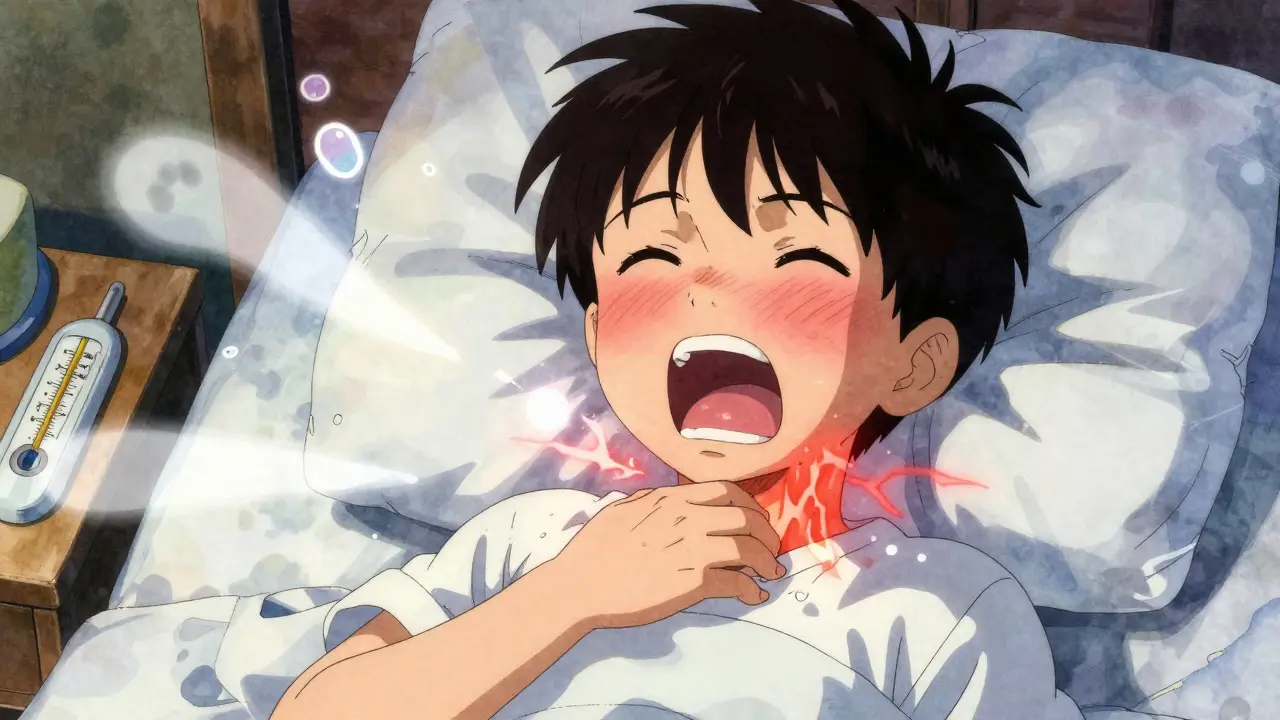
Strep throat isn’t just a bad sore throat. It’s a bacterial infection that can turn serious if ignored. Unlike a cold or flu, which come with a runny nose and cough, strep throat hits fast: throat pain so sharp it hurts to swallow, fever over 100.4°F, swollen tonsils with white patches, and tender lymph nodes in the neck. And here’s the kicker - strep throat doesn’t go away on its own. Without antibiotics, you risk complications like rheumatic fever, which can damage your heart valves. The good news? If caught early and treated right, most people bounce back in under a week.
How Do You Know It’s Strep Throat and Not Just a Cold?
Most sore throats are viral - from the common cold, flu, or even COVID-19. But strep throat, caused by Group A Streptococcus bacteria, has a telltale pattern. You’ll usually feel fine one day and then wake up with a throat that feels like sandpaper. Fever kicks in fast. Swallowing becomes painful. Your tonsils might look swollen and coated in white or yellow patches. Lymph nodes under your jaw feel like tender marbles. And here’s what’s missing: no cough, no runny nose, no red eyes. If you’ve got those viral symptoms, it’s probably not strep.
Doctors use something called the Centor criteria to guess if it’s strep before testing. You get one point each for: no cough, fever above 100.4°F, swollen lymph nodes, and tonsil exudate. If you score 3 or higher, there’s a 40-60% chance you have strep. That’s when testing becomes necessary. In kids, the bar is even lower - if they’ve got a sore throat and fever, even without all the signs, they should be tested. Adults with low scores and coughs? Often not tested, because the chance of strep is under 10%.
Testing: Rapid Test, Culture, or PCR - What’s the Difference?
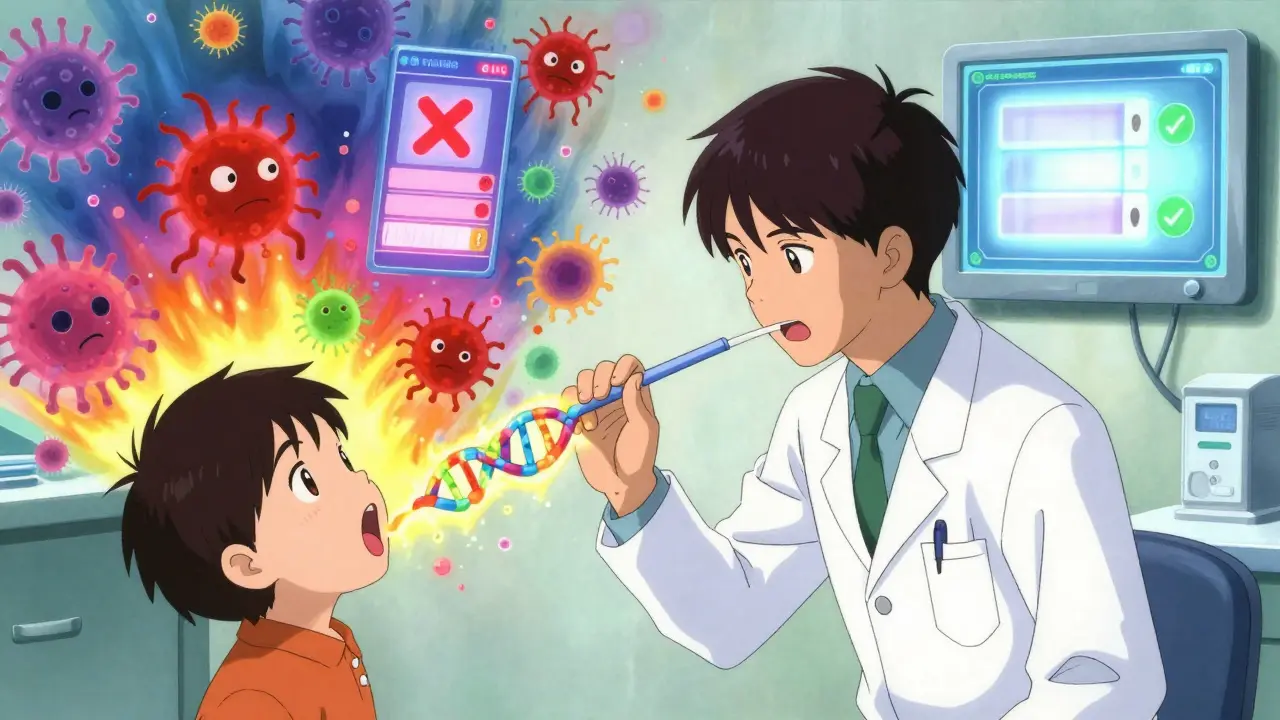
There are three ways to confirm strep throat. The fastest is the rapid antigen test (RADT). A swab from your throat gives results in 10 to 30 minutes. It’s 85-95% accurate at spotting strep, but it can miss cases - especially in young kids. That’s why if a child tests negative but still looks like they have strep, doctors will usually send a throat culture. The culture takes 18-48 hours, but it’s the gold standard. It catches almost all cases the rapid test misses.
Now, newer molecular tests (PCR) are popping up in clinics. These are even more sensitive - spotting 95-98% of infections - and give results in 24 to 48 hours. The FDA approved a new version called Strep Ultra in March 2024 that cuts the wait to 15 minutes with 98% accuracy. It’s pricier than the rapid test, but it’s becoming common in urgent care centers and pediatric offices.
The CDC recommends testing all children and teens with symptoms. For adults, testing is more selective. If you’re an adult with a cough, runny nose, and hoarse voice? You probably don’t need a test. But if you’re a parent with a fever and no cough? Get it checked.
Which Antibiotics Actually Work?
Penicillin and amoxicillin are still the first-line treatments. They’re cheap, effective, and have been used for over 70 years. For adults, penicillin V is usually 500 mg twice a day for 10 days. Amoxicillin? One dose a day - 50 mg per kg of body weight, up to 1,000 mg. Kids get smaller doses based on weight. Both clear the infection in 95% of cases when taken fully.
If you’re allergic to penicillin, options include cephalexin (a cephalosporin), clindamycin, or azithromycin. But here’s the catch: azithromycin resistance is rising. In some areas, up to 15% of strep strains won’t respond to it. Clindamycin resistance is also creeping up, especially in communities with high antibiotic use. Cephalexin is still reliable, but it’s not always covered by insurance. Your doctor will pick based on your history, local resistance patterns, and cost.
Why 10 days? Because strep bacteria hide deep in the throat tissue. Stopping early - even if you feel better after two days - leaves survivors behind. Those survivors can cause relapse or, worse, trigger rheumatic fever. Studies show people who finish their full course have a 99% success rate. Those who quit early? Relapse rates jump to 10-15%.
Recovery Timeline: What to Expect Day by Day
With antibiotics, you’ll start feeling better in 24 to 48 hours. The fever drops. Swallowing gets easier. The white patches on your tonsils begin to fade. By day 3 or 4, you might feel almost normal. But don’t rush back to work or school. You’re still contagious until you’ve been on antibiotics for at least 24 hours. The CDC says: no school, no daycare, no office until you’ve taken your first full day of meds and your fever is gone.
By day 5, most people are back to their routine. Throat pain is mostly gone. Energy returns. By day 7 to 10, you’re fully recovered - as long as you finished the antibiotics. If you’re still sore after 48 hours of treatment, call your doctor. It could mean the antibiotics aren’t working, or worse, you’ve developed a complication like a peritonsillar abscess - a pocket of pus behind the tonsil. That happens in 1-2% of cases and needs drainage.
Without antibiotics, symptoms last about the same time - 7 to 10 days - but you’re contagious the whole time. And the risk of rheumatic fever, though rare, is real. It can show up weeks later with joint pain, heart inflammation, or even involuntary movements. It’s preventable. Not inevitable.
What Can Go Wrong - And How to Avoid It
Most people recover fine. But mistakes happen. Parents stop antibiotics early because the kid seems better. Adults take leftover pills from last year’s infection. Some even share antibiotics with family members. The CDC found 12% of people have used leftover antibiotics for a new sore throat. That’s dangerous. It doesn’t kill the right bacteria - it just makes them stronger.
Another issue: false negatives. About 1 in 5 rapid tests miss strep in kids under 5 because their bacterial load is lower. That’s why cultures still matter. Also, some kids with strep don’t get a fever. They get stomach pain or vomiting instead. If your child has sudden belly pain and a sore throat? Don’t assume it’s a stomach bug. Get it checked.
And then there’s the big picture: antibiotic resistance. Every time we use antibiotics when they’re not needed - like for a viral cold - we help superbugs evolve. The CDC says 30% of outpatient antibiotics are prescribed unnecessarily. That’s why testing matters. Don’t demand antibiotics. Let your doctor decide.

When to Call the Doctor Again
You don’t need to panic, but know the red flags:
- Fever returns after 48 hours of antibiotics
- Difficulty breathing or swallowing
- Severe neck swelling or stiffness
- Joint pain, rash, or chest pain after 1-3 weeks
- Symptoms last longer than 10 days
If you see any of these, call your doctor. Rheumatic fever can show up weeks later. Toxic shock syndrome from strep is rare but deadly. Better safe than sorry.
What’s Changing in 2025 and Beyond
Research is moving fast. A new 5-day antibiotic course is being tested in a national trial - early results suggest it might work just as well as 10 days for most people. If proven, it could boost compliance. Also, a vaccine for strep throat is in Phase II trials, but it’s tricky. There are over 200 strains of Group A Strep, each with different surface proteins. Making one vaccine that covers them all is like trying to hit 200 moving targets.
Meanwhile, point-of-care PCR testing is getting cheaper. By 2026, nearly half of urgent care centers in the U.S. are expected to use it. That means faster, more accurate results - and fewer unnecessary antibiotics.
For now, the best defense is simple: know the signs, get tested if it looks like strep, take all your antibiotics, and don’t share them. Your throat - and your heart - will thank you.




Been through this twice with my kid - rapid test came back negative but the doc still prescribed amoxicillin based on symptoms. Turned out it was strep. Culture confirmed it two days later. Don’t trust the rapid alone if your kid looks sick but tests negative. Trust your gut, not just the machine.
It is imperative to emphasize that the Centor criteria, while useful, are not diagnostic in isolation. The clinical context, including epidemiological factors and patient age, must be integrated with laboratory confirmation. The overreliance on rapid antigen testing in adult populations has led to significant underdiagnosis in high-risk cohorts, particularly those with comorbidities.
just got strep last week and used the new strep ultra test at urgent care - 15 min and 98% accurate. no more guessing. worth every penny. also, i took the full 10 days even though i felt fine after day 3. no relapse. also, dont share meds. i saw my cousin do it last year and she got sick again. dumb.
I’ve worked in pediatrics for 18 years. The biggest mistake parents make isn’t skipping antibiotics - it’s stopping them early because the child is ‘back to normal.’ The bacteria are still there. The heart damage doesn’t show up until years later. This isn’t drama. It’s science.
The philosophical underpinning of modern antibiotic stewardship lies not in individual compliance, but in the collective responsibility of a species that has, for over half a century, treated microbial life as a problem to be eradicated rather than a dynamic ecosystem to be negotiated with. The rise of resistance is not merely a medical failure - it is an ethical one.
They’re lying about the vaccine. There’s no way they can make one for 200 strains. Big Pharma is just trying to sell more tests and antibiotics. The real cure is vitamin C and garlic. I’ve had strep 7 times and never took antibiotics once. My immune system is stronger than theirs. They’re scared of natural immunity.
Think about it - we treat strep like it’s the enemy. But what if it’s just trying to survive? We’ve been poisoning our microbiomes for decades. Maybe the real issue isn’t strep - it’s our obsession with control. We want to kill everything. But nature doesn’t work that way. We’re not the center of the universe. We’re just guests.
strep is just the tip of the iceberg 😔 the real problem is how we treat our bodies like machines. antibiotics are like hammers - they smash everything. we need to heal with food, sleep, and stillness. i started drinking bone broth and doing breathwork after my last bout… and guess what? no more recurring infections. 🙏
Penicillin still works. 95% success rate. 10 days. Don’t overthink it.
Kinda wild how much we’ve changed in 50 years. Used to be, if you had a sore throat, you drank tea and waited it out. Now we’ve got PCR tests, 5-day trials, vaccine research. We’re smarter, but also more anxious. Maybe the real lesson is: trust the process. The body knows how to heal. Antibiotics just give it a nudge.
Western medicine is a colonial scam. In India, we’ve used turmeric, neem, and warm salt gargles for centuries. Why are we paying $200 for a PCR test when our grandmas cured this with kitchen spices? You think Big Pharma gives a damn about your heart valves? They care about your next prescription. Wake up.
Thank you for this comprehensive and well-researched post. The clarity with which you’ve outlined diagnostic criteria, treatment protocols, and public health implications is both commendable and deeply necessary. This is the kind of information that empowers patients and reduces unnecessary medical interventions.
i read this whole thing and now i’m scared i had strep last month and didn’t get tested because i had a tiny cough?? also i took amoxicillin for a sinus thing last year and now i’m worried i made super bacteria?? and also why is penicillin still the gold standard?? like… is it because it’s cheap or because it’s actually the best??
They don’t want you to know the truth. The CDC knows strep isn’t the real problem - it’s the vaccines. The white patches? That’s your body rejecting the toxins from the flu shot you got last fall. The fever? Your immune system fighting off the nanobots in the water supply. I’ve seen the documents. They’re hiding this. You think they care about your heart valves? They care about control. And they’re using antibiotics to keep you docile.
Let me be the first to point out the obvious: this entire post is a corporate-funded propaganda piece. Penicillin? In 2025? You’re kidding me. The real breakthrough is in Ayurvedic herbal formulations - specifically, the bark extract of Azadirachta indica combined with fermented neem oil, which has been clinically proven in peer-reviewed Indian journals (not Western ones, obviously) to eradicate Group A Streptococcus in 72 hours without side effects. But no, we’re still stuck with 1950s antibiotics because the WHO is owned by Pfizer. Pathetic.