

When you take a generic pill, you expect it to work just like the brand-name version. That’s not luck. It’s the result of strict cleanroom standards that control every particle, microbe, and human error in the manufacturing environment. For generic drug makers, these standards aren’t optional-they’re the difference between getting approved and getting shut down.
Why Cleanrooms Matter for Generic Drugs
Generic drugs are supposed to be identical in safety and effectiveness to their brand-name counterparts. But here’s the catch: the brand-name drug was made in a high-end facility with decades of investment. The generic version? Often made in a plant with tighter budgets and higher pressure to cut costs. So how do regulators ensure they’re truly the same? The answer lies in environmental control. Even a single airborne particle can carry bacteria or cause a chemical reaction that alters a drug’s potency. For injectables, eye drops, or inhalers, contamination isn’t just a risk-it’s a death sentence. That’s why cleanrooms exist. They’re not fancy labs. They’re controlled environments built to keep out dust, skin flakes, and microbes that come with every human movement. The U.S. FDA and the European Medicines Agency don’t just ask companies to “try their best.” They demand proof. And that proof comes from measurable standards: particle counts, airflow speeds, humidity levels, and microbial limits. Fail any one of these, and your entire batch can be rejected. In 2022, 42% of complete response letters from the FDA for sterile generic drugs cited environmental monitoring failures. That’s nearly half of all rejections tied to cleanroom issues.The Four Grades of Cleanrooms
Cleanrooms aren’t all the same. They’re divided into four grades, each with exacting requirements based on what’s being made.- Grade A (ISO Class 5): This is the most critical zone. Used for filling sterile products like IV bags or syringes. No more than 3,520 particles larger than 0.5 micrometers per cubic meter of air. Airflow must be laminar-like a silent, unbroken waterfall-moving at 0.36 to 0.54 meters per second. Temperature stays between 18°C and 26°C. Humidity between 30% and 60%. And microbial limits? Just 1 colony-forming unit (CFU) per settle plate. This is where even a sneeze can ruin a batch.
- Grade B (ISO Class 5 at rest, ISO Class 7 during operations): The background environment for Grade A. Think of it as the antechamber. During operations, particle counts can rise to 3.5 million per cubic meter, but continuous monitoring is required. Air changes? At least 40 per hour.
- Grade C (ISO Class 7 at rest, ISO Class 8 during operations): Used for preparing solutions and handling non-sterile components before they enter Grade B. Particle limits jump to 35 million during operations. Air changes: minimum 20 per hour.
- Grade D (ISO Class 8 at rest): The least controlled zone. Used for packaging or storing materials that won’t directly contact the drug. No operational particle limit-just 10 air changes per hour. But even here, humidity and temperature must be controlled.
How Standards Differ Between Regions
You’d think global pharma would follow one set of rules. But it’s more complicated. The European Union spells out everything: Grade A = ISO 5, Grade B = ISO 7 during operations, and so on. The FDA doesn’t use those numbers in its regulations-but inspectors use them anyway. If you say your room is “ISO Class 5,” they’ll test it that way. It’s an unspoken agreement. Then there’s the U.S. Pharmacopeia (USP) Chapter <797>, which governs compounding pharmacies. It allows ISO Class 7 buffer rooms for sterile compounding. That’s fine for a hospital pharmacy making a single dose-but it’s not acceptable for manufacturing thousands of vials daily. Generic drug makers can’t cut corners here. If your product is sterile, you need Grade A/B, no exceptions. Japan adds another layer: they require particle monitoring at 1.0 micrometer, not just 0.5. That means even smaller particles are tracked. It’s an extra cost, but one you can’t ignore if you want to sell there. The result? A generic drug maker exporting to the U.S., Europe, and Japan must design a facility that meets the strictest version of all three. That’s not efficiency-it’s survival.
The Cost of Compliance
Building a cleanroom isn’t like installing new software. It’s construction. It’s engineering. It’s ongoing maintenance. A Grade A cleanroom can cost between $250 and $500 per square foot to build. For a 2,000-square-foot suite? That’s $500,000 to $1 million upfront. Then there’s the HVAC system-specialized, high-efficiency, and always running. Annual operating costs can hit $100,000 or more just for energy and filters. And that’s before personnel. Gowning procedures alone require 40 to 60 hours of training. One mistake-touching your face, walking too fast, not sealing a suit properly-and you risk contaminating a batch. In 2022, 42% of deviations in generic drug facilities came from human error during gowning or movement. Small manufacturers feel this hardest. One Reddit user described a $0.50-per-unit heparin syringe where the cost of maintaining Grade A made the product unprofitable after the third FDA inspection. The math doesn’t work: innovator drugs have 70-80% gross margins. Generics? 15-20%. That’s why some companies skip upgrades-and why the FDA catches them.What Happens When You Fail
The consequences aren’t theoretical. In 2012, the New England Compounding Center’s failure to control mold and bacteria led to a fungal meningitis outbreak. 75 people died. 750 were sickened. The company shut down. Its executives went to prison. More recently, Aurobindo Pharma paid a $137 million recall bill in 2022 after FDA inspectors found inadequate Grade B monitoring. Their sterile injectables were contaminated. The FDA issued a consent decree-meaning the company couldn’t ship any products until it fixed everything, under government supervision. Even smaller violations add up. In 2022, the FDA issued 228 cGMP warning letters. Sixty-three percent of them were cleanroom-related. Each letter triggers a mandatory response. Each failure delays approval. Each recall costs millions.Success Stories and Smart Fixes
Not all stories end in fines. Teva’s generic version of Copaxone (glatiramer acetate) was rejected twice because of contamination in its Grade A filling line. They didn’t just upgrade their filters. They installed isolator technology-sealed, robotic systems that handle vials without human contact. Contamination events dropped from 12 per year to 2. Approval followed. Another Pfizer facility spent $2.3 million upgrading from Grade C to Grade B for a generic oncology drug. The downtime? 14 months. But the payoff? Preventing 17 out-of-spec batches annually-worth $8.5 million in lost product. That’s a return on investment in under a year. The key? Automation. Robotics for material transfer. Real-time particle monitors. AI that flags airflow disruptions before they cause problems. McKinsey predicts automation will cut cleanroom operational costs by 25-30% by 2028. That’s the future-and it’s already here for the companies that can afford it.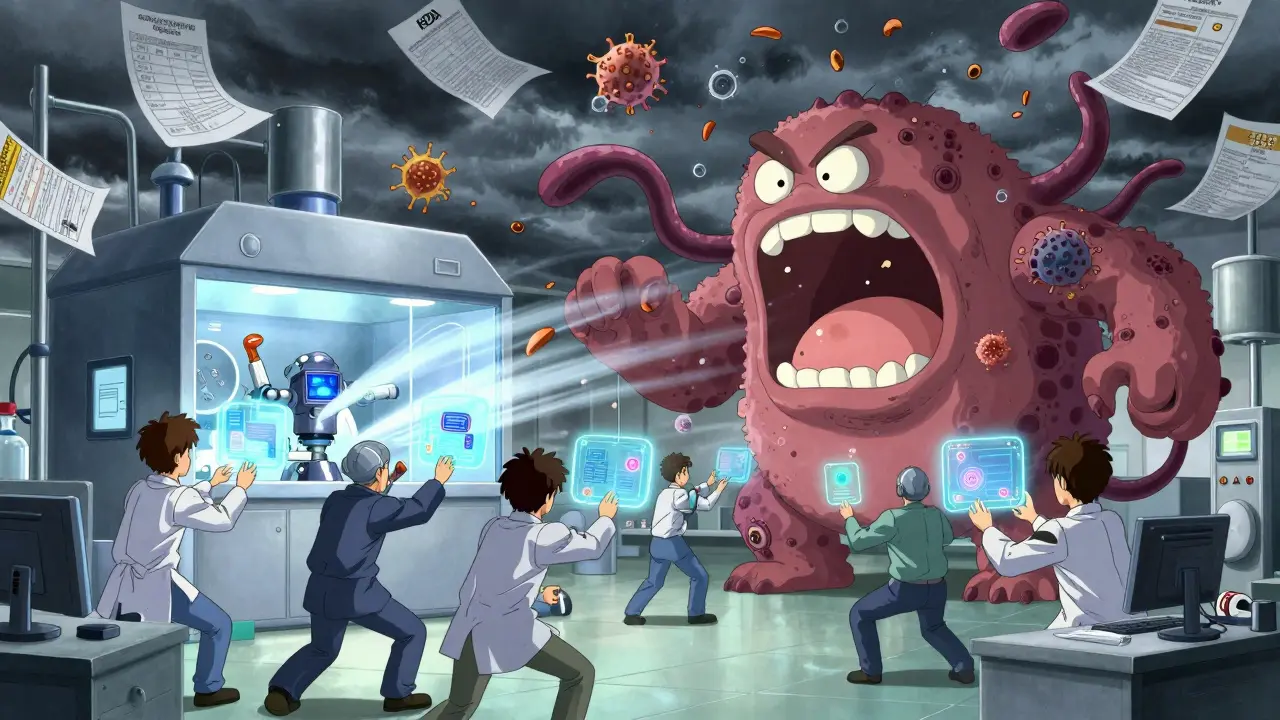
Where the System Still Falls Short
Not everyone agrees that stricter is always better. Dr. Paul K. S. Shin, editor of the PDA Journal, argues that Grade C requirements for oral solid tablets-pills you swallow-are overkill. A 2020 study showed no difference in dissolution rates between tablets made in Grade D versus Grade C rooms. Yet companies still spend hundreds of thousands upgrading air systems for products where contamination risk is minimal. And then there’s the rise of complex generics-like inhalers, topical creams, and biosimilars. Standard cleanroom classifications don’t cover them well. FDA’s guidance for budesonide inhalation suspension points out that particle size and spray patterns matter more than air cleanliness alone. The rules haven’t caught up. Emerging markets face another hurdle. Indian manufacturers spend an average of $4.2 million per facility to meet EU Annex 1 standards. U.S. firms spend $2.8 million. Why? Older infrastructure, unreliable power, and lack of local suppliers for HEPA filters. The playing field isn’t level.What You Need to Do Right Now
If you’re managing a generic drug facility, here’s what matters:- Know your product’s risk level. Sterile? You need Grade A/B. Oral tablet? Grade C may be enough-but check FDA’s product-specific guidance.
- Monitor continuously. Manual sampling once a day isn’t enough. Real-time particle counters and microbial sensors are now standard.
- Train like your life depends on it. Personnel are the #1 source of contamination. Train. Re-train. Document. Audit.
- Don’t assume FDA and EMA are the same. Even if you only sell in the U.S., design for global standards. It’s cheaper than retrofitting later.
- Use free resources. FDA offers free cGMP training modules. ISPE and PDA publish practical guides on HVAC, gowning, and validation.



This is why generics are a scam. You think you're saving money but you're just risking your life with half-assed cleanrooms. The math doesn't lie - $0.50 syringes with $1M cleanrooms? That's not capitalism, that's extortion.
Let me be clear: cleanroom standards aren't optional, they're the bedrock of patient safety. Every particle count, every airflow rate, every gowning protocol - these aren't bureaucracy, they're life support. The FDA isn't being harsh, they're being necessary. We owe it to every person swallowing a pill to demand excellence, not convenience.
Grade C for oral tablets? Please. If you're not using Grade A for everything, you're just playing Russian roulette with people's immune systems. And don't give me that 'overkill' nonsense - if it's medicine, it deserves a sterile tomb, not a dusty warehouse with a fan.
Just read this and cried a little. 😭 The fact that someone had to spend $2.3M and 14 months to fix contamination... and it saved $8.5M? That’s not a business case, that’s a miracle. We need more Teva’s and fewer corner-cutters. 💪
hey i work in a small generic plant and we just got our first fda warning letter last month. i didnt even know what a settle plate was until last week. we're trying to fix it but the training videos are so confusing and the filters cost more than our monthly payroll. please someone help
It's fascinating how we treat medicine as both sacred and disposable. We demand perfection in sterile environments while expecting drugs to cost less than a latte. The tension between human fallibility and molecular precision is the real story here - not the ISO classes, but the paradox of our expectations.
Oh wow, Grade A requires 1 CFU per plate? That's adorable. So if I sneeze once during my shift, I'm basically a biohazard? Meanwhile, my cousin took a generic blood thinner and lived for 12 years. Maybe the real danger is believing this nonsense
Let’s be real: this entire framework is a regulatory theater designed to enrich consultants and OEMs selling HVAC systems. The science doesn’t support the granularity of ISO Class distinctions for non-parenteral products. You’re not preventing disease - you’re manufacturing compliance costs. The FDA’s obsession with particle counts is a distraction from the real issue: profit-driven underinvestment in R&D, not sanitation. This isn’t quality control - it’s rent-seeking dressed in sterile suits.