

More than 1 in 3 adults in the U.S. have prediabetes-and most don’t even know it. That’s over 96 million people walking around with blood sugar levels that are too high to be normal, but not high enough yet to be called diabetes. The scary part? Without action, half of them will develop type 2 diabetes within five years. But here’s the good news: you don’t need drugs, surgery, or extreme diets to stop it. The science is clear-lifestyle changes can reverse prediabetes, and they work better than any pill.
What Prediabetes Really Means
Prediabetes isn’t just a warning label. It’s your body screaming that something’s off. Your cells are starting to ignore insulin-the hormone that moves sugar from your blood into your muscles and organs. When insulin stops working well, sugar piles up in your bloodstream. That’s what raises your HbA1c above 5.7%, your fasting glucose over 100 mg/dL, or your 2-hour glucose after a meal hits 140 mg/dL or higher.
This isn’t a disease you catch. It’s a signal. A sign that your eating habits, activity levels, and maybe even sleep or stress are out of sync with how your body was built to function. And the longer you ignore it, the more damage builds up. High blood sugar doesn’t just lead to diabetes. It silently harms your heart, kidneys, eyes, and nerves long before you ever feel sick.
Why Lifestyle Changes Work Better Than Pills
You might think, “Why not just take a pill?” There are medications that can lower blood sugar-GLP-1 agonists, metformin, even magnesium supplements. Some studies show they can reverse prediabetes in 23% to 47% of cases. Sounds good, right?
But here’s the catch: lifestyle changes beat them all. A major 2023 review of dozens of studies found that people who changed their diet and moved more were 18% more likely to get their blood sugar back to normal than those who didn’t change anything. That means for every six people who stick to real lifestyle changes, one person avoids diabetes entirely. And unlike pills, these changes don’t come with side effects, costs, or the risk of dependency.
Even better? You don’t need to lose 50 pounds. You don’t need to run marathons. You just need to make small, consistent shifts. The CDC’s Diabetes Prevention Program found that losing just 5% to 7% of your body weight-say, 10 to 14 pounds if you weigh 200-cuts your diabetes risk by 58%. That’s not magic. That’s biology.
The Three Keys to Reversing Prediabetes
There’s no single trick. No miracle food. No secret workout. But there are three pillars that always show up in the science:
- Move more-at least 150 minutes a week of moderate activity. That’s 30 minutes, five days a week. Brisk walking counts. Gardening counts. Dancing around your kitchen counts. You don’t need a gym. Just get moving.
- Eat differently-swap out the white stuff. White rice, white bread, sugary cereals, juice, soda. These spike your blood sugar fast and leave you hungry again in an hour. Replace them with whole grains-oatmeal, quinoa, barley, brown rice-and pile your plate with vegetables. Aim for half your plate to be non-starchy veggies: broccoli, spinach, peppers, zucchini, mushrooms. Add beans, lentils, and berries for fiber and antioxidants.
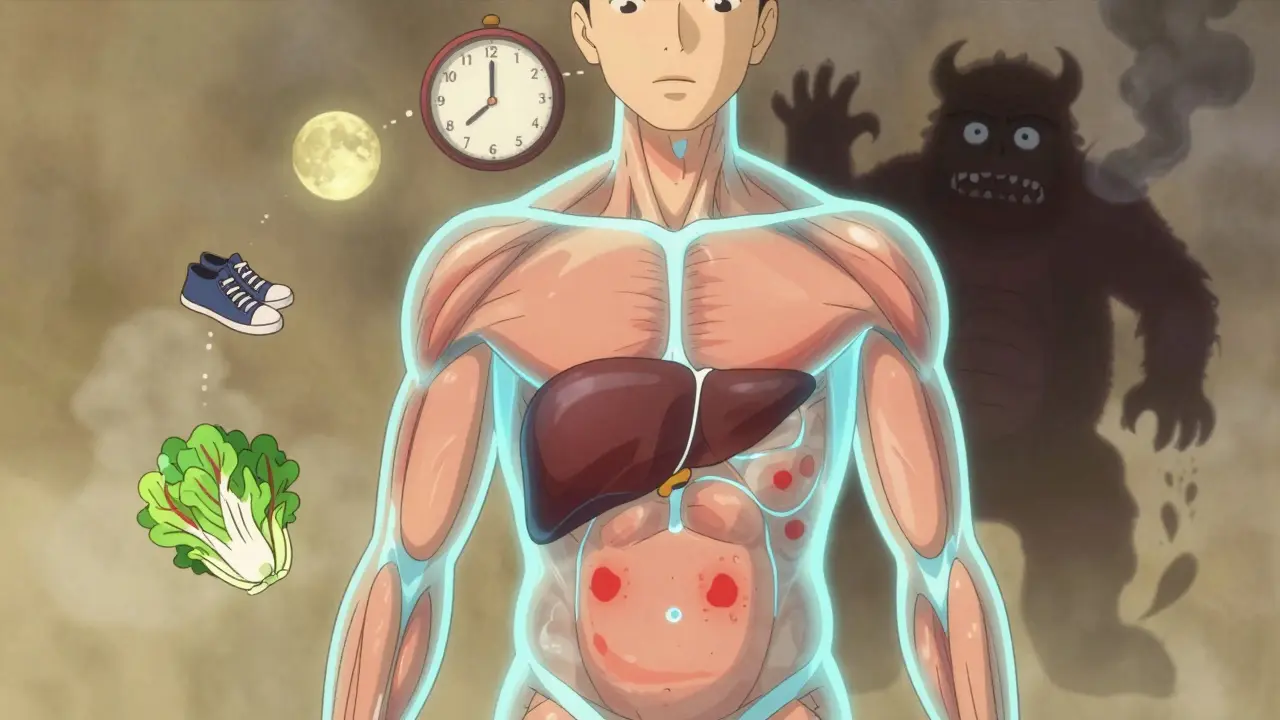
- Manage your weight-not by starving yourself, but by eating less processed food. The goal isn’t to be thin. It’s to lose belly fat. Visceral fat-the fat around your organs-is the real troublemaker. One study found that people who reversed prediabetes lost more of this dangerous fat than those who didn’t, even if their total body fat didn’t change much. That’s why you can reverse prediabetes without losing weight at all.
You Can Reverse It Without Losing Weight
This is the game-changer most people don’t know. A 2023 study in Nature Medicine showed that people who normalized their blood sugar-even if they gained a few pounds-still cut their future risk of type 2 diabetes by 70% over ten years. How? Because they changed where their fat was stored.
When you eat too many refined carbs and sugars, your liver and belly soak up fat like a sponge. That fat interferes with insulin. But when you switch to whole foods, move regularly, and cut out sugary drinks, your body starts burning that visceral fat-even if the scale doesn’t budge. Your muscles get better at using glucose. Your liver gets cleaner. Your pancreas stops working overtime.
So if you’ve tried losing weight and failed? Don’t give up. Focus on eating real food, moving daily, and sleeping well. Your blood sugar will improve. Your risk will drop. And that’s what matters.
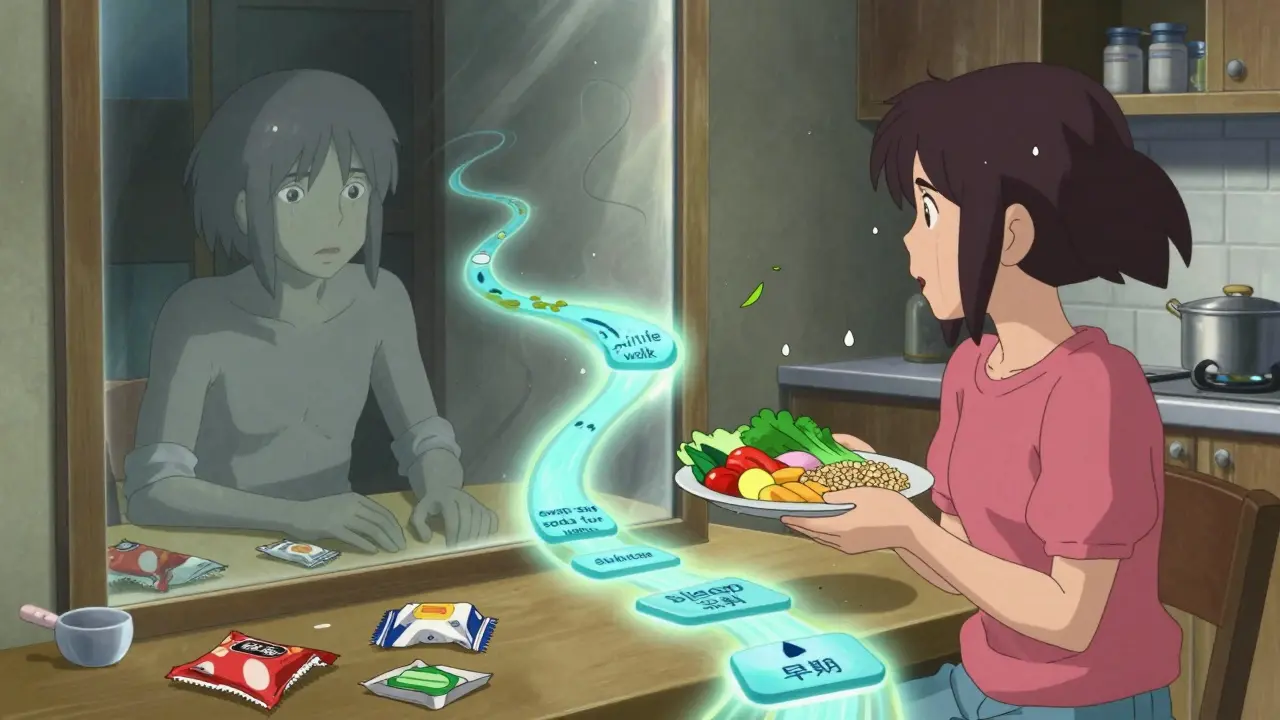
What to Eat (And What to Avoid)
Forget fad diets. There’s no keto, no intermittent fasting, no “one true way.” The best diet for prediabetes is the one you can stick to. But here’s what works for almost everyone:
- Do eat: Non-starchy vegetables (broccoli, kale, tomatoes, cucumbers), legumes (lentils, chickpeas, black beans), whole grains (steel-cut oats, farro, barley), nuts and seeds (almonds, chia, flax), fatty fish (salmon, mackerel), eggs, plain yogurt, and fruit (berries, apples, pears-limit dried fruit and juice).
- Avoid: Sugary drinks (soda, sweet tea, energy drinks), white bread, white rice, pastries, candy, processed snacks (chips, crackers), and processed meats (bacon, sausage, deli meats). Even “healthy” packaged foods like granola bars and flavored yogurts often hide sugar.
Here’s a simple rule: if it comes in a bag, box, or bottle with a label full of ingredients you can’t pronounce, skip it. If it grows in the ground or comes from an animal, you’re probably safe.
How to Start (Without Overwhelming Yourself)
You don’t need to overhaul your life overnight. Start with one thing.
- Swap soda for sparkling water with lemon.
- Take a 10-minute walk after dinner.
- Put vegetables on half your plate at lunch.
- Go to bed 30 minutes earlier.
Do that for two weeks. Then add one more. That’s how habits stick. The CDC’s Diabetes Prevention Program doesn’t ask you to lose 20 pounds. It asks you to show up, eat better, move more, and talk to your coach. And it works.
Most people who join the program lose 5.6% of their weight in a year. That’s not huge. But it’s enough. And it’s sustainable.
Why Timing Matters
The earlier you act, the better. Prediabetes is reversible. But once your pancreas starts to burn out from overworking, it gets harder. Beta cells-the ones that make insulin-can’t regenerate easily. That’s why people over 50 see the biggest benefits from lifestyle changes. Their bodies are more sensitive to improvement.
But it’s never too late. Even if you’ve had prediabetes for years, changing your habits now can still cut your diabetes risk in half. The goal isn’t perfection. It’s progress.
What About Supplements or Medications?
Some people turn to magnesium, cinnamon, or berberine. There’s weak evidence they help. And while metformin is sometimes prescribed, it’s not a replacement for lifestyle change. In fact, the American Diabetes Association says lifestyle changes should always come first.
Medications can help in the short term, but they don’t fix the root problem. Only real food, real movement, and real rest can do that.
If you’re considering a drug, talk to your doctor. But don’t skip the basics. No pill can undo years of sugar, stress, and sitting.
Where to Get Help
The CDC’s National Diabetes Prevention Program is available across the U.S.-online, in person, even through your employer or insurance. Many programs are free or covered by Medicare. You’ll work with a trained coach who helps you set goals, track progress, and stay motivated. No judgment. Just support.
You don’t have to do this alone. And you shouldn’t.
Can prediabetes be reversed permanently?
Yes, but only if you keep making the same healthy choices. Prediabetes reversal means your blood sugar levels return to normal. But if you go back to eating processed foods and sitting all day, it can come back. Think of it like cleaning a dirty room. You can clean it, but if you keep making messes, it gets dirty again. The key is consistency, not perfection.
Do I need to lose weight to reverse prediabetes?
Not necessarily. While losing 5% to 7% of your body weight helps, research shows you can reverse prediabetes without losing weight at all. The real goal is reducing belly fat and improving how your body uses insulin. Eating whole foods and moving regularly can shrink visceral fat-even if the scale doesn’t change.
How long does it take to reverse prediabetes?
Most people see improvements in blood sugar within 3 to 6 months of making consistent changes. But full reversal-getting your HbA1c below 5.7%-can take up to a year. The key is sticking with it. Studies show that people who maintain healthy habits for at least three years have the lowest risk of developing diabetes later on.
Is walking enough exercise to reverse prediabetes?
Yes, if you do it often enough. The CDC recommends 150 minutes of moderate activity per week. Brisk walking-where you can talk but not sing-counts perfectly. You don’t need to run, lift weights, or join a gym. Just move more than you did last year. Even small increases in daily steps can improve insulin sensitivity.
Can children reverse prediabetes too?
Absolutely. In fact, kids often respond faster than adults. The key is family involvement. Swap sugary cereals for oatmeal, go for walks after dinner, play outside instead of watching screens. When healthy habits become routine, they stick. Pediatric experts say even small changes-like adding one extra vegetable to dinner or turning off screens after 8 p.m.-can make a big difference.
What Comes Next
Prediabetes isn’t a life sentence. It’s a wake-up call. And you have more power than you think. You don’t need to be perfect. You just need to be consistent. Eat real food. Move your body. Sleep well. Manage stress. And don’t wait until it’s too late.
One change today can stop a lifetime of health problems tomorrow. Start small. Stay steady. And remember-you’re not fighting diabetes. You’re reclaiming your health.




Just wanted to say this post hit different. I was prediabetic last year, didn’t even know it until my doc flagged it. Started walking after dinner, swapped soda for sparkling water, and cut out the white bread. Six months later, my HbA1c dropped from 6.1 to 5.4. No meds. Just consistency. It’s not glamorous, but it works.
Still mess up sometimes - pizza on Friday night, I’m not a robot - but I keep coming back to the veggies and the walk. Small stuff adds up.
LMAO at the ‘lifestyle changes beat pills’ thing. 😂 You know what else beats pills? Placebos. And yet people still take metformin like it’s candy. This whole ‘just walk and eat broccoli’ narrative is so… quaint. Like we’re all living in a 1950s health pamphlet.
Real talk? Insulin resistance is a symptom of systemic inflammation, chronic stress, and environmental toxins - not ‘too much white rice.’ But sure, keep blaming your carbs. 🤷♀️
Y’all, I’m a nurse and I’ve seen this play out a hundred times. The magic isn’t in the diet. It’s in the rhythm. When people stop thinking of food as ‘good’ or ‘bad’ and start thinking of it as fuel + comfort + joy? That’s when things shift.
I had a patient who reversed her prediabetes by eating one bowl of oatmeal every morning, taking the stairs instead of the elevator, and dancing with her grandkids for 20 minutes after dinner. No tracking. No deprivation. Just… presence.
Also - yes, you can reverse it without losing weight. I’ve got three patients right now with normal HbA1c and the same BMI as before. Their bellies just… shrank. Like magic. But it’s biology, not luck.
Love this. As someone from the UK who’s watched the NHS struggle with diabetes for years, it’s wild how little emphasis is placed on prevention. We’re all about ‘fix it after it breaks’ here.
My mum reversed hers by ditching sugary tea and starting a daily 10-minute stretch routine. No gym. No shakes. Just… movement. And sleep. Turns out, your body doesn’t need a PhD to heal - just a little respect.
Also, ‘if it comes in a bag with ingredients you can’t pronounce’ - that’s my new life motto. 😎
There’s a deeper layer here that’s rarely discussed: prediabetes isn’t just about insulin resistance. It’s about disconnection. From food. From movement. From rest. From community.
We’ve turned health into a product to be consumed - a diet plan, a supplement, a wearable tracker. But the real reversal happens when you reconnect. When you cook for yourself. When you walk without headphones. When you sleep without scrolling.
It’s not about willpower. It’s about returning to a way of being that our bodies recognize. The science backs it. But the soul feels it.
I’m not a doctor, but I’ve spent 12 years working in public health. Let me tell you - the CDC’s Diabetes Prevention Program has a 58% success rate. That’s not anecdotal. That’s peer-reviewed, randomized, controlled data.
And guess what? People who stick with it for three years? Their diabetes risk drops by 71%. Not because they lost weight. Because they changed their relationship with food. They stopped seeing it as punishment and started seeing it as care.
Also - dancing counts. So does gardening. So does playing with your dog. Movement doesn’t have to be ‘exercise.’ It just has to be movement.
Thank you for this comprehensive and evidence-based overview. The data is unequivocal: lifestyle intervention is superior to pharmacological intervention in both efficacy and sustainability for prediabetes reversal.
Furthermore, the emphasis on visceral fat reduction over total body weight loss aligns with recent findings in adipose tissue biology, particularly regarding ectopic lipid deposition in the liver and pancreas.
It is imperative that public health messaging shift from weight-centric narratives to metabolic health-centric frameworks. The current paradigm is not only ineffective, it is harmful.
Okay but have you heard about the new AI glucose monitor that syncs with your fridge? It’s insane. I got mine last month. It tells me exactly what to eat and when. I’ve already dropped 12 lbs and my HbA1c is 5.2. No one’s talking about this.
Also, I did keto for 90 days and it worked like magic. Why isn’t anyone saying keto is the real answer? The science is CLEAR. Broccoli is overrated. Bacon is medicine. 😎
Been there. Done that. Took 14 months. Didn’t lose a pound. But my blood sugar? Normal. How? Walked after dinner. Ate veggies first. No juice. Sleep at 10. That’s it.
And yeah - dancing counts. I do the macarena with my cat. He hates it. But my pancreas loves it. 🐱💃
My buddy Mike reversed his prediabetes by just starting to cook. No fancy stuff. Just chicken, rice, and broccoli. He used to eat microwaved burritos three times a day. Now he makes a pot on Sunday and eats it all week.
He didn’t join a program. Didn’t buy a tracker. Just… started. And now he’s got more energy than his 25-year-old son.
It’s not about perfection. It’s about showing up. Even once a day. That’s the secret.
You’re all missing the real issue. This is all a Big Pharma scam. They don’t want you to reverse prediabetes - they want you to stay prediabetic forever so you keep buying metformin, GLP-1 drugs, and glucose monitors.
Did you know the FDA banned berberine in 2022? Because it’s 10x more effective than metformin and costs $5 a month? And now you’re being told to ‘eat broccoli’ while Big Pharma rakes in billions?
Wake up. This isn’t health. It’s control.
OH MY GOD. I CAN’T BELIEVE YOU GUYS ARE STILL TALKING ABOUT ‘WALKING’ AND ‘BROCCOLI’ LIKE IT’S 1999!!!
THE REAL SOLUTION IS INTERMITTENT FASTING + KETO + COLD SHOWERS + RED LIGHT THERAPY + GUT MICROBIOME TESTING + ACHIEVING 8.7 HOURS OF DEEP SLEEP + ACHIEVING A 12:1 VAGAL TONE RATIO!!!
MY COACH IS A FORMER NBA TRAINER WHO LOST 89 LBS IN 3 MONTHS USING ONLY BEE POLLEN AND BREATHWORK!!!
WHY ARE YOU STILL LISTENING TO THE CDC?!?!?! THEY’RE IN BED WITH SUGAR CORPORATIONS!!!
WE NEED A REVOLUTION. NOT A WALK.
I get that lifestyle changes work. But what about people who work two jobs, have three kids, and can’t afford organic veggies? The ‘just move more’ advice feels like a luxury.
I walked 20 minutes last week. That’s all I had. And I still ate a bag of chips. So… what now?
So… you’re telling me the government just… suddenly decided to care about our health? 🤔
Remember when they told us fat was bad? Then carbs? Then sugar? Now it’s ‘visceral fat’? Who’s really pulling the strings here?
I’ve been eating bacon and butter since 2015. My glucose is fine. Coincidence? Or are they just changing the script to sell new supplements?
Don’t trust the ‘experts.’ They’re all paid by someone.
Let me tell you about my cousin Linda. She’s 68. Diagnosed with prediabetes in 2018. Didn’t lose weight. Didn’t join a program. Just started eating dinner with her husband again - no TV, no phone. Just conversation. And she swapped out the white rice for brown rice. That’s it.
Three years later, her HbA1c is 5.3. She says the best part? She’s not lonely anymore. She says the food was the vehicle, but the connection was the cure.
So yeah. Broccoli helps. But so does sitting across from someone you love and eating slowly. I think we’ve forgotten that part.
Someone above said ‘just eat broccoli.’ I get it. But what if you hate broccoli? What if it makes you gag?
Then eat kale. Or spinach. Or zucchini. Or mushrooms. Or pickled cabbage. Or a damn smoothie with greens and berries. The point isn’t the veggie. It’s the swap. Replace the empty carbs with fiber-rich, nutrient-dense stuff. Doesn’t have to be green. Just not processed.
And if you’re too tired to cook? Batch-cook once a week. Or buy frozen. It’s just as good. No guilt. No perfection. Just progress.