

When you're traveling to a tropical destination, packing your meds isn't just about throwing pills into a bag. High heat and wet air can wreck your medication faster than you think - and you might not even notice until it's too late. In places like Southeast Asia, Central America, or coastal Africa, humidity often hits 80% or higher, and temperatures stay above 28°C. That’s not just uncomfortable - it’s dangerous for your drugs.
Why Tropical Humidity Destroys Medications
Medications aren’t meant to sit in steamy bathrooms or sweaty suitcases. The real enemy is hydrolysis, a chemical reaction where water breaks apart the active ingredients in pills, capsules, and powders. According to NIH studies, this accounts for about 70% of all moisture-related drug failures. Take amoxicillin trihydrate: if left in 75% humidity, it can absorb up to 10% of its own weight in water, losing half its potency in just 30 days. That’s not a theory - it’s lab-tested fact.Other damage is visible. Tablets can stick together, forming hard lumps. Capsule shells turn soft and sticky, sometimes leaking. Powder inhalers clog up as particles clump, making it impossible to get the full dose. Even freeze-dried vaccines, which need humidity below 20% to stay stable, can fail if stored in a humid hotel room. And if moisture levels climb past 70%, mold starts growing - Aspergillus and Penicillium fungi can colonize your pills in under three days.
The WHO estimates that 30% of medications in tropical regions degrade before reaching patients. That’s not just wasted money - it’s lives at risk. Imagine taking antibiotics that no longer kill bacteria, or asthma inhalers that don’t open your airways. You won’t feel sick from bad medicine. You’ll just get worse.
Which Medications Are Most at Risk?
Not all drugs are equally vulnerable. Some are like sponges for moisture. Here’s what to watch out for:- Antibiotics - Amoxicillin, tetracycline, and erythromycin degrade rapidly in humidity. Tetracycline can lose effectiveness 3.5 times faster at 75% RH than at 40%.
- Antifungals - Fluconazole and clotrimazole tablets soften and crumble.
- Pediatric formulations - Orally disintegrating tablets (ODTs) swell and take up to five times longer to dissolve in high humidity, meaning kids won’t get the full dose.
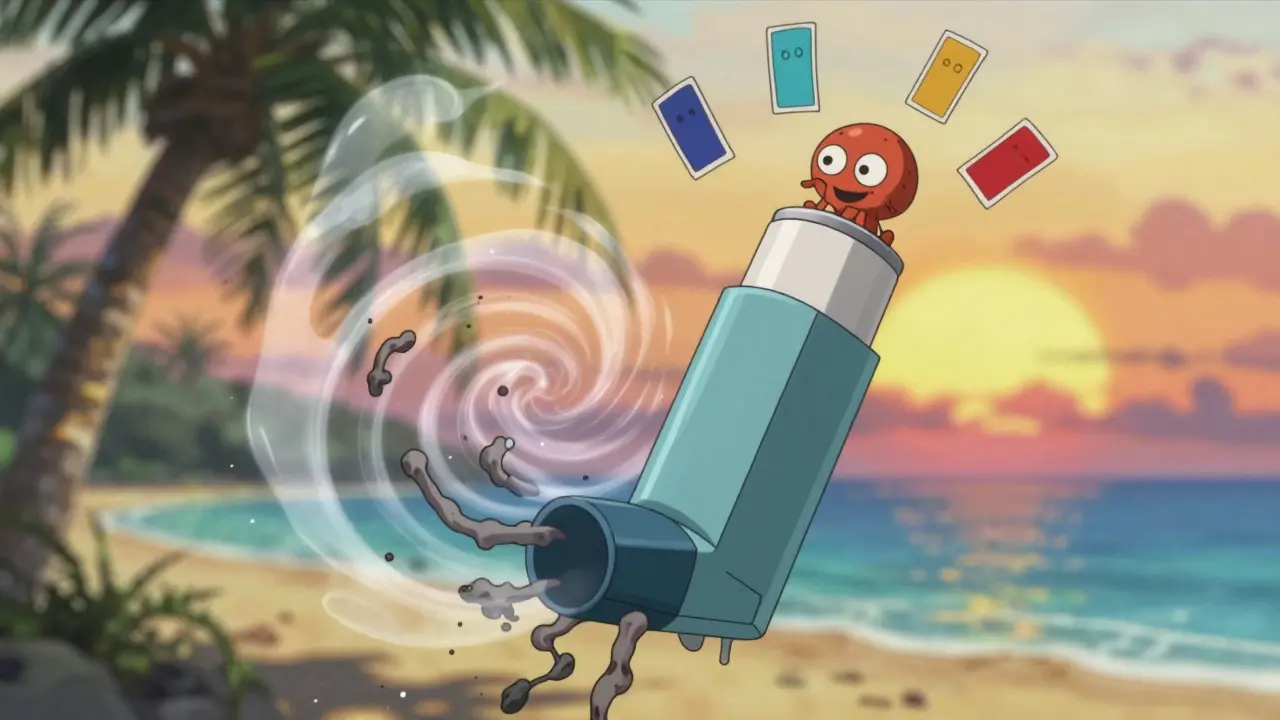
- Dry powder inhalers (DPIs) - Moisture causes particles to stick, reducing lung delivery by 15-25%.
- Biologics and vaccines - Insulin, epinephrine auto-injectors, and some COVID or malaria vaccines require cold, dry storage. Even a few hours in humidity can ruin them.
According to a 2023 survey of 1,200 pharmacists in tropical countries, 42% of reported cases involved antibiotics, 29% antifungals, and 24% pediatric meds. If you’re taking any of these, treat them like fragile electronics - not something to toss in your beach bag.
What’s the Ideal Storage Environment?
The goal is simple: keep things dry and cool. The International Pharmaceutical Federation (FIP) recommends storing medications at 30-45% relative humidity and 15-25°C. That’s not easy in a tropical hotel room where the bathroom hits 85% RH after a shower.Here’s what you need to know:
- Temperature matters more than you think. For every 10°C rise above 25°C, degradation speeds up by double. That means a drug that lasts 2 years at 20°C might only last 6 months at 35°C.
- Light exposure breaks down 65% of drugs. Keep them in dark containers or wrap them in foil.
- Never store meds in the bathroom. Even if it’s the only dry place, humidity spikes after every shower. Kitchen cabinets near the sink or fridge are better - but only if they’re not too warm.
- Refrigeration isn’t always safe. If you need to keep meds cold (like insulin), make sure the humidity inside the fridge stays below 60%. Condensation forms when cold items hit warm air - and that’s just as bad as high humidity.
Proven Prevention Strategies - From Hospitals to Backpacks
You don’t need a lab to protect your meds. Here’s what works - backed by real-world use in tropical countries.1. Use Airtight Containers with Desiccants
The cheapest, most effective fix? Airtight plastic containers + silica gel packs. Buy small, resealable containers (like those used for jewelry or supplements). Add one or two silica gel desiccants - the kind that come with new electronics or shoes. For every 100 mL of container space, use 1-2 grams of silica gel. Replace them every 30 days, or when they turn pink (if they’re color-changing type).Pharmacies in Uganda and the Philippines have used this method for years. A 2022 field trial with 15,000 patients showed a 47% drop in spoiled meds using this simple system.
2. Choose the Right Packaging
If you’re buying meds locally, look for blister packs made of aluminum foil. These block 99.9% of moisture. Avoid plastic bottles with screw tops - they’re useless in humidity. If you’re bringing meds from home, transfer them into aluminum blister packs or vacuum-sealed pouches before travel.Since 2021, the Gates Foundation has distributed over 500 million blister packs with built-in desiccants across sub-Saharan Africa. Results? A 58% drop in degradation. That’s not marketing - that’s data.
3. Use Humidity Indicator Cards
These cheap, coin-sized cards change color when humidity rises. Blue means dry. Pink means wet. Put one in your container. If it turns pink, replace your desiccants immediately. They cost less than $0.10 each and are used in hospitals from Thailand to Tanzania.4. Invest in a Dry Cabinet (For Long-Term or High-Value Meds)
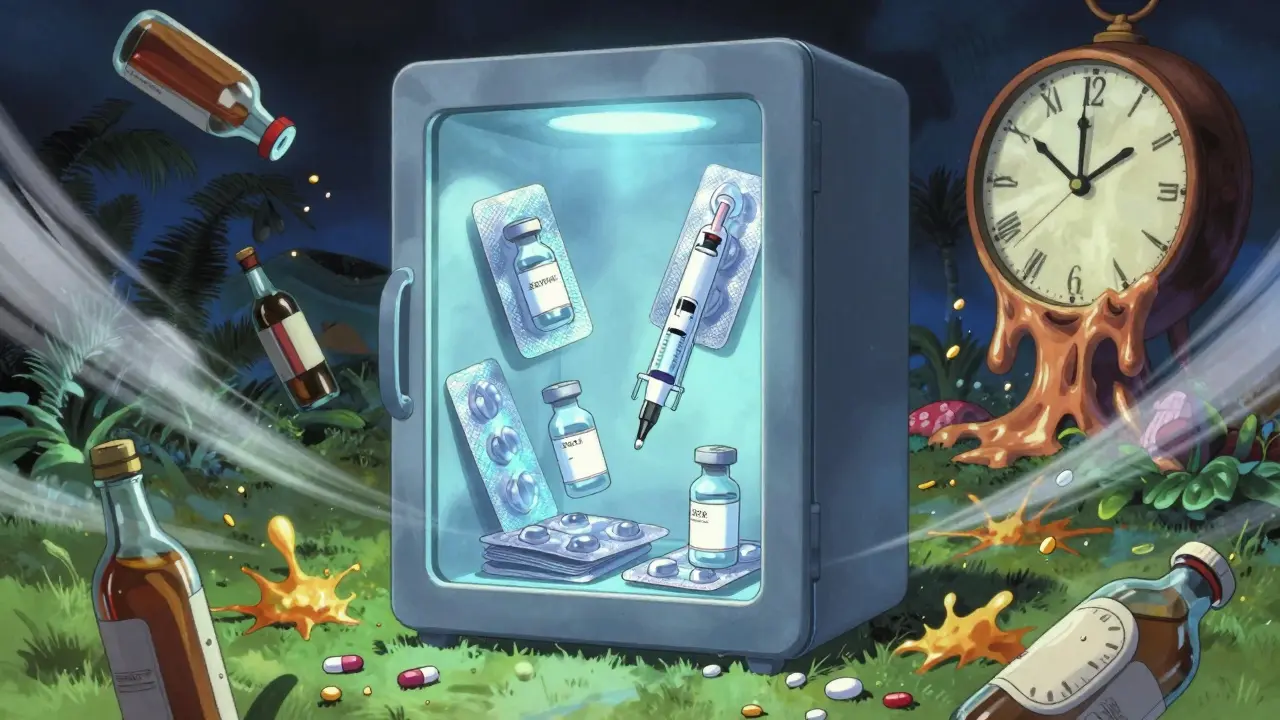
If you’re living in a tropical country or carrying expensive insulin, epinephrine, or biologics, consider a small dry cabinet. SMT DryBoxes or similar units maintain 5-15% RH and stable temperature. They cost $500-$2,000, but for life-saving meds, it’s worth it. One study showed these cabinets reduce hydrolysis by 75-85% compared to room storage.5. Avoid Common Mistakes
- Don’t leave meds in your car - even for 10 minutes. Heat builds up fast.
- Don’t use ziplock bags alone - they’re not airtight enough.
- Don’t assume ‘cool room’ means safe. A room at 30°C with 70% RH is still a degradation zone.
- Don’t rely on expiration dates alone. A pill might look fine but be 50% weaker.
What’s New in Medication Protection?
The industry is catching up. New tech is making protection easier:- Activ-Polymer™ - A new moisture-scavenging material in bottle caps from Aptar. It lasts 18 months and keeps humidity below 30% RH. Already used in 12 countries.
- Graphene oxide coatings - MIT researchers developed a nano-coating that blocks 99.7% of moisture. Still in testing, but it could replace aluminum foil in the next 5 years.
- IoT-enabled storage - The Global Health Security Agenda deployed 12,500 smart storage units in Southeast Asia. They send real-time humidity alerts to clinics. Spoilage dropped by 63%.
By 2025, the ICH plans to release new guidelines (Q1H) requiring all new drugs targeting tropical markets to prove stability at 30°C/75% RH. That means better packaging will become standard - but not fast enough for you right now.
What to Do If Your Meds Look Off
If you see any of these signs, stop using the medication:- Tablets are stuck together or crumbling
- Capsules are sticky, swollen, or leaking
- Powders are clumped or discolored
- Odor changes - especially a sour or musty smell
- Color changes - tetracycline turns yellow-brown when degraded
Don’t guess. If in doubt, replace it. Taking degraded antibiotics can lead to treatment failure and antibiotic resistance. Taking weak insulin can cause dangerous blood sugar spikes. The risk isn’t worth it.
Final Checklist: Your Tropical Medication Survival Kit
Before you leave for a humid destination, do this:- Transfer all pills into airtight containers (glass or hard plastic with tight seals).
- Add 1-2 silica gel desiccant packs per container.
- Place a humidity indicator card inside each container.
- Store containers in a cool, dark place - not the bathroom, not the car, not the bedside table.
- For insulin or vaccines: use a portable cooler with a humidity pack and thermometer.
- Carry extra doses in a separate container - just in case.
- Check desiccants monthly. Replace if they’re saturated or pink.
This isn’t overkill. It’s basic survival. In tropical humidity, your meds don’t just expire - they die. And if they die, so might your chances of staying healthy.
Can I store my medications in the refrigerator in a tropical country?
Yes - but only if you manage humidity. Fridges in tropical homes often have condensation on the walls and shelves. Water droplets can form on your pill bottles, making things worse. If you refrigerate meds, put them in airtight containers with desiccants. Keep them away from the back wall (where moisture collects). Ideal fridge humidity should stay below 60% RH.
Are silica gel packs safe to use with medications?
Yes, as long as they’re pharmaceutical-grade and sealed in non-toxic packets. The silica gel inside is inert and non-reactive. Never open or ingest the packets. Just place them in the container with your meds. Avoid cheap silica gel from hardware stores - it may contain additives. Buy packs labeled for pharmaceutical or food use.
How do I know if my pills have degraded?
Look for changes in appearance: sticking, discoloration, crumbling, or odd smells. Tetracycline turns yellow-brown. Amoxicillin may smell sour. ODTs that take longer than 30 seconds to dissolve are likely compromised. If you’re unsure, don’t take it. Get a replacement. Degraded meds don’t just lose strength - they can form harmful byproducts.
Is it safe to carry medications in checked luggage on a tropical flight?
No. Cargo holds can reach 40°C and high humidity, especially on long-haul flights. Always carry medications in your carry-on. Use a small cooler bag with a desiccant if you’re worried about heat. Airlines don’t control cargo conditions - and neither should your meds.
What’s the best way to carry insulin in a hot, humid climate?
Use an insulated travel case with a cold pack. Keep it in your carry-on. Add a small silica gel pack to absorb moisture. Check the insulin daily - if it looks cloudy, clumpy, or has particles, throw it out. Even if it’s within the expiration date, heat and humidity can destroy it. Don’t rely on the pharmacy’s advice - tropical conditions are different.



Wow, so now I gotta turn my suitcase into a lab? I just wanted to go to Bali and not die. This is insane. Why do they even make pills that can’t handle a little heat? It’s like they don’t want us to live.
lol i just throw my meds in my bag and hope for the best. i’ve been to thailand 3x and still alive. also who has time to buy silica gel packs? 🤡
This is actually so important 🙏 I’m so glad someone broke this down. I used to keep my insulin in my hotel bathroom (bad idea, I know) and once my pen got weirdly sticky. I didn’t know why I felt worse until I read this. Silica gel packs are a game-changer. Just got a pack for my vitamins too 💊✨
Oh my god this is the most basic survival guide you’ll ever need and yet 90% of people still treat their meds like candy in a beach bag. I’ve seen people leave their epinephrine pens in a hot car while they went snorkeling. You’re not just risking your life-you’re risking everyone else’s if you end up in the ER because you were too lazy to buy a $2 desiccant pack. It’s not rocket science. It’s not even science. It’s common sense. And apparently we’re out of that too.
As someone who’s lived in Lagos for 8 years, this hits hard. I’ve seen people take expired antibiotics because they couldn’t afford to replace them. The real tragedy isn’t the science-it’s the lack of access. Desiccants and dry cabinets? Great for tourists. But for locals? They need systemic change, not just DIY hacks.
So you’re telling me I need to carry a humidity sensor in my purse now? Cool. I’ll just add that to my list of 17 things I have to do to not die while traveling. Meanwhile, Big Pharma is making billions off pills that turn to dust in the sun. 🤡
Thank you for this. I’ve been traveling with my son’s ODTs and didn’t realize they were absorbing moisture. I started using the silica gel trick last trip and he didn’t get sick once. Small changes, big results. You don’t need fancy gear-just awareness. 💪
USA thinks it knows everything but in Nigeria we’ve been storing meds in clay pots for centuries. Cool, dry, natural. You don’t need plastic and silica gel. You need tradition. This is just western overcomplication. We survived before your silica packs.
Amoxicillin degrades fast in humidity true but you dont need all this drama just keep it in a closed box away from water
My cousin works in a clinic in Cambodia. They use those humidity cards everywhere now. It’s low-tech but it works. I brought some home for my meds. Simple. No apps. No gadgets. Just color change. I’m impressed.
THIS IS WHY AMERICA IS WEAK. You people can’t even handle a little humidity? I’ve been taking my meds in my pocket in Mumbai for 10 years and never had an issue. You’re all just scared of your own shadows. Stop overthinking and live.
Wait so if my pills look fine but the humidity card is pink should I still toss them? I mean they don’t smell weird or anything and the expiration date is next year
Just bought a dry cabinet for my insulin. Worth every penny. 🥹 I used to panic every time I traveled. Now I sleep. Also, the little humidity cards are so satisfying to check. Blue = good. Pink = panic mode. 😅
Of course you’re going to say that. You’re the person who thinks a ziplock bag is a ‘cool storage solution’. I’ve seen your posts. You left your asthma inhaler in the glovebox for three days and still swore it was fine. Your body is a science experiment. Stop.