
When you pick up a prescription at the pharmacy, you might not realize that the price you pay - or don’t pay - is the result of a carefully engineered system built by your health plan. This system isn’t random. It’s designed to save money, and the biggest tool in that toolbox? Generic drugs.
Generics aren’t just cheaper versions of brand-name pills. They’re FDA-approved copies that work the same way, with the same active ingredients, dosage, and effectiveness. But here’s the catch: even though they cost 80-85% less, many patients still end up paying more than they should. Why? Because how insurance plans are designed to use generics doesn’t always line up with what’s best for the patient.
How Generics Became the Default Choice
The modern system started in 1984 with the Hatch-Waxman Act, which created a clear path for generic drug approval. Before that, generics were rare. Now, they make up 91.5% of all prescriptions filled in the U.S. - but only 22% of total drug spending. That’s the math insurers love: nearly every prescription is a generic, and nearly every dollar saved comes from avoiding expensive brand-name drugs.
Health plans don’t just encourage generics - they force them. Most commercial plans use something called a tiered formulary. Think of it like a pricing ladder. Tier 1 is where generics live - often $0 to $10 for a 30-day supply. Tier 2 is preferred brand-name drugs - $25 to $50. Tier 3? Non-preferred brands, sometimes $60 to over $100. If your doctor prescribes a brand-name drug when a generic is available, your plan will either refuse to cover it or charge you a huge chunk of the cost.
The Mechanics Behind the Savings
It’s not just about putting generics on the lowest tier. Health plans use several tools to push patients toward them:
- Mandatory substitution: In 49 states, pharmacists can swap a brand-name drug for a generic without asking your doctor - as long as it’s approved by the FDA.
- Step therapy: You might be required to try the generic first. Only if it doesn’t work can you get the brand-name version. As of 2023, 92% of Medicare Part D plans use this rule.
- Closed formularies: Some plans don’t cover brand-name drugs at all if a generic exists. One Medicare HMO saw brand-name use drop by nearly 30% after switching to this model.
- Cost-sharing incentives: Copays for generics have barely budged since 2010 - up just 12%. Meanwhile, brand-name copays jumped 47%. The gap is intentional: make generics so cheap, and brands so expensive, that the choice is obvious.
These aren’t just theory. A Johns Hopkins study found two large self-insured employers saved 9% to 15% on drug costs simply by switching patients to therapeutically equivalent generics - with no drop in health outcomes.
Who’s Really Saving Money?
Here’s where it gets messy. The savings look great on paper: generics saved the U.S. healthcare system $3.7 trillion between 2013 and 2022. But who gets that money?
It’s not always you.
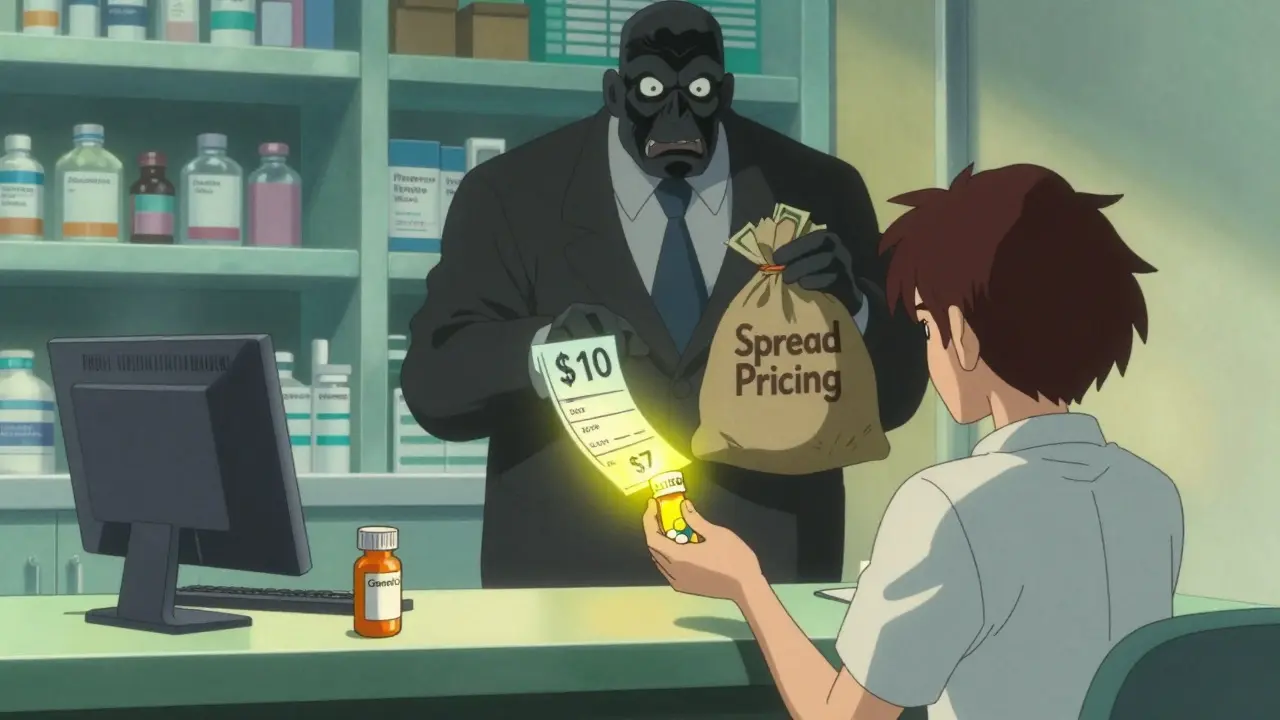
Pharmacy Benefit Managers (PBMs) - the middlemen between insurers, drugmakers, and pharmacies - negotiate discounts and rebates. In 2022, they secured $195 billion in savings for health plans. But here’s the problem: many PBMs use a practice called spread pricing. They tell your insurer they’re paying $10 for a generic. They actually pay the pharmacy $7. The $3 difference? They keep it. And you, the patient, still pay a $10 copay.
That’s why a 2022 USC Schaeffer Center study found patients overpaid by $10-$15 per generic prescription because of these opaque practices. You think you’re saving money. But the real savings are going to intermediaries.

How Different Plans Handle Generics
Not all insurance plans are built the same:
- Medicare Part D: Covers over 50 million seniors. All plans have tiered formularies. Generic copays range from $0 to $15. But since 2025, there’s a $2,000 annual cap on out-of-pocket drug costs - which changes how people use generics. Seniors now have more flexibility, but still face prior authorization hurdles.
- Medicaid: Uses federal price caps on generics (250% of average manufacturer price). In 2022, Medicaid dispensed generics at an 89.3% rate - slightly higher than commercial plans. A new 2026 program called GENEROUS aims to cut Medicaid drug spending by $40 billion over ten years.
- Commercial plans: 98.7% use tiered formularies. Most employers now offer high-deductible plans with Health Savings Accounts (HSAs). These often have $0 generic copays even before you meet your deductible - a smart way to encourage early use.
- Self-insured employers: These companies skip PBMs and negotiate directly. One study found they saved 9-15% by switching to generics without hurting patient outcomes.
Even the market is shifting. The Mark Cuban Cost Plus Drug Company launched in 2022, selling generics at transparent prices - often cheaper than insurance copays. A 2023 analysis found patients saved $4.96 per prescription on average. But here’s the catch: Medicaid patients didn’t save anything. The savings only apply to people paying out of pocket.
What Patients Actually Experience
Most people like the idea of $0 generic copays. A Kaiser Family Foundation survey found 68% of Medicare beneficiaries were satisfied with their generic coverage. On Reddit, threads like “Generic copay went from $5 to $0 last month - anyone else?” got 142 comments, 87% positive.
But the complaints are real:
- 14% of patients said their doctor had to appeal multiple times just to get a brand-name drug approved after a generic failed.
- Some patients paid $15-$25 more than expected due to “copay clawbacks” - when the pharmacy collects your copay, but the PBM later refunds part of it to the insurer, leaving you stuck with the full cost.
- 31% of physicians reported patients had adverse reactions after being switched to a generic - not because it was unsafe, but because some people react differently to inactive ingredients.
And here’s the kicker: only 38% of Medicare beneficiaries could correctly explain how their plan’s generic coverage worked in 2023. The system is complex. The rules change. The paperwork is confusing.

What’s Changing in 2025 and Beyond
The system is under pressure - and it’s changing fast.
The Inflation Reduction Act, which took effect in 2025, caps Medicare Part D out-of-pocket costs at $2,000 per year. That means seniors can now use more expensive drugs without hitting financial cliffs. It also opens the door for Medicare to negotiate prices directly with drugmakers - starting in 2026. The first set of negotiated drugs will hit the market that year.
Starting January 1, 2025, insurers must show you exactly how much they paid for your prescription on your Explanation of Benefits (EOB). No more hidden spreads. No more mystery pricing.
And in 2026, the CMS GENEROUS Model will launch - a new Medicaid program designed to force state-level price transparency and uniform coverage rules for generics. If it works, it could cut $40 billion in Medicaid drug spending over ten years.
The Big Picture
Generic drugs are the single most effective tool we have to control prescription costs. They’re safe, effective, and cheap. But the system built around them is designed to save money for insurers and PBMs - not always for you.
The real question isn’t whether to use generics. It’s whether the money saved is actually reaching patients. Right now, too often, it’s not.
As transparency improves and new models like direct-to-consumer pricing emerge, patients may finally start seeing the full benefit - not just the promise - of generic drugs.



Honestly? I love that my generic copay is $0. My diabetes med used to cost me $45 a month. Now? Free. No complaints here. 🙌
bro i swear pbms are the real villains here. they be ghostin' the pharmacy like 'yo i paid $10' then payin' $7 and pocketin' the rest like its a side hustle. we ain't savin' money, we just gettin' scammed in slow motion 💀
I mean, sure, generics are great-until you get switched to one and your anxiety spikes because the fillers are different and now you're crying in the bathroom at work. I’m not anti-generic, I’m pro-patient-choice. And also, why do we let middlemen decide what our bodies can handle? 🤷♂️
This whole system is a scam. Insurance companies don't care about you. They care about profit. PBMs? Same. You think you're saving? You're just being exploited. End of story.
From a utilization management standpoint, tiered formularies and step therapy are clinically sound cost-containment levers. The real bottleneck is PBM opacity and lack of alignment between formulary design and therapeutic equivalence validation. We need value-based contracting, not just cost-based arbitrage.
I appreciate how much safer and cheaper generics are… but I also know how many people get caught in the system. One friend had to go through *three* appeals just to get her original seizure med back. It shouldn’t be this hard to get the medicine that works for you. 🤍
It’s fascinating how we’ve optimized for cost efficiency while neglecting patient autonomy. The math works. The ethics? Less so. We’ve turned healthcare into a spreadsheet, and people into line items. I wonder if we’ll ever recalibrate.
I find it deeply concerning that so many patients are unaware of how their formulary works. This isn’t incompetence-it’s intentional obfuscation. If you can’t explain your own system to the people it affects, you don’t deserve to run it.
I’m not mad. I’m just disappointed. I thought we were supposed to be helping people. Instead, we’ve built a machine that makes $195 billion in ‘savings’… and then tells the patient to pay $15 for a pill that costs $7. This isn’t capitalism. This is a horror movie with a PowerPoint presentation.