
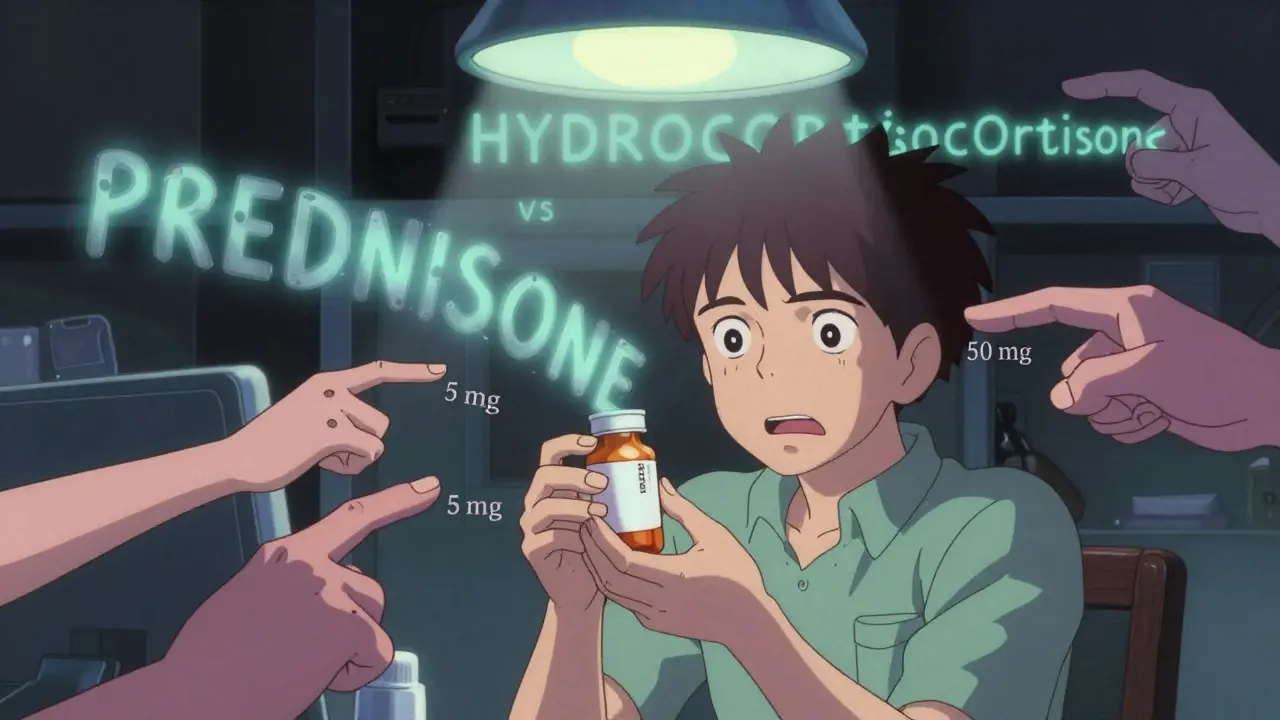
Every year, over 1.5 million people in the U.S. suffer preventable harm from medication errors. Many of these mistakes happen because someone didn’t stop to check the medication name, strength, or dosage form before giving or taking a drug. It’s not always a mistake by a doctor or pharmacist - sometimes, it’s just a quick glance at a label that misses a tiny but deadly detail. You don’t need to be a clinician to protect yourself or a loved one. Learning how to verify these three things can literally save a life.
Why Checking Medication Details Matters
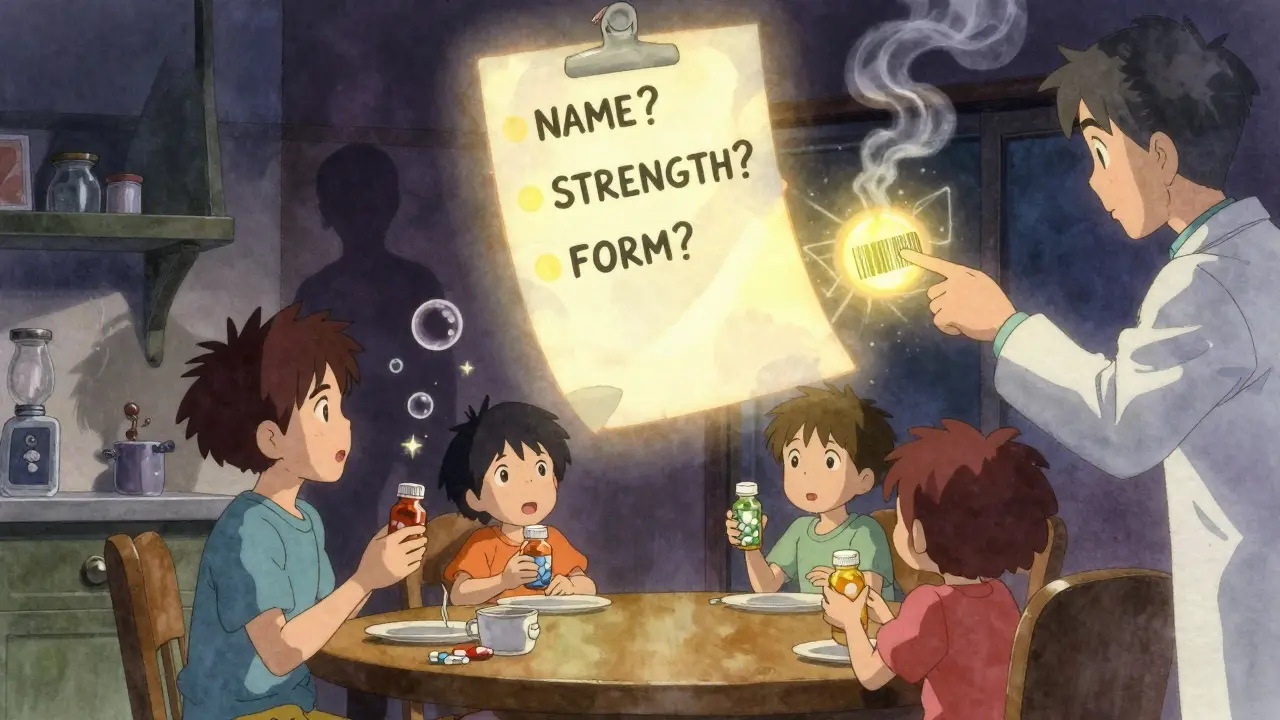
Medication errors aren’t rare. They happen in hospitals, nursing homes, pharmacies, and even at home. The Institute of Medicine found that at least one in every 200 prescriptions filled contains a mistake. The most common errors? Confusing similar-sounding drug names, misreading strengths, or giving the wrong dosage form. For example, someone might get prednisone instead of prednisolone. Or they might think a pill labeled "5 mg" is the same as "50 mg" because the zero was smudged. Or worse - they’re given a liquid meant to be swallowed, but they apply it to their skin because the label didn’t say "oral use only." These aren’t hypotheticals. They’re real incidents documented by the FDA and the Institute for Safe Medication Practices (ISMP). The good news? Most of these errors are preventable. The key is simple: slow down and verify. Every time you receive a new medication - whether it’s from a hospital, pharmacy, or home delivery - check three things: the name, the strength, and the dosage form.Step 1: Confirm the Medication Name
Start with the drug name. Look at the prescription, the bottle label, and the pill itself. Are they all the same? Don’t assume. Even small spelling differences matter. Look-alike, sound-alike drugs are a major problem. Take hydralazine and hydroxyzine. One treats high blood pressure. The other treats allergies. Mix them up, and you could cause a dangerous drop in blood pressure. Or consider epinephrine and epinephrine - wait, that’s the same word. But sometimes, it’s written as epinephrine on one label and epinephrine on another. That’s a trick. The correct spelling is epinephrine. But if you’re not paying attention, you might miss it. Healthcare providers use something called "Tall Man lettering" to reduce this confusion. That means capitalizing the different parts of similar names. So you’ll see:- PredniSONE vs. PredniSOLONE
- HydroCORtisone vs. HydroCOrtisone
Step 2: Verify the Strength - Numbers and Units Matter
Strength tells you how much of the drug is in each dose. A tiny mistake here can be deadly. The most common error? Missing or misreading the unit. For example:- "5 mg" vs. "50 mg" - a tenfold difference
- "0.5 mL" vs. "5 mL" - ten times too much liquid
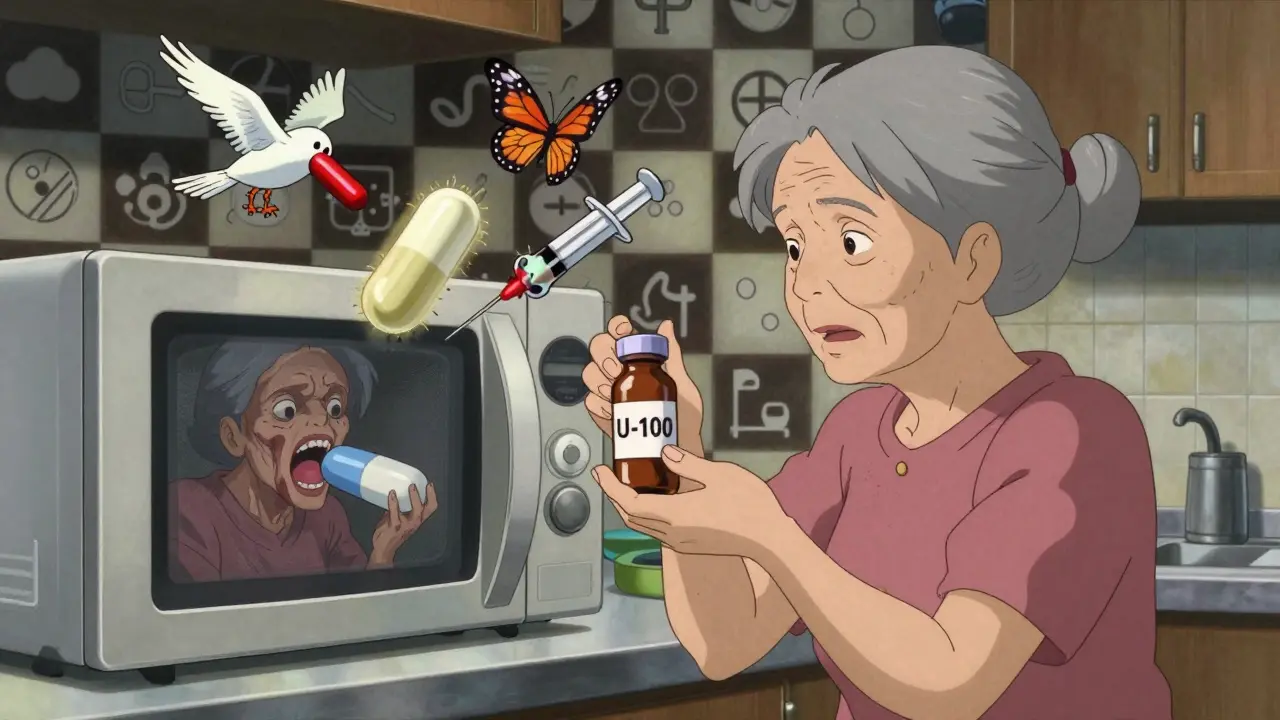
- "U" for units - this is a banned abbreviation because it looks like "0" or "4". Always write "units".
Step 3: Check the Dosage Form
The dosage form is how the medication is delivered: tablet, capsule, liquid, patch, injection, inhaler, suppository. Getting the wrong form can be dangerous. A patient might be prescribed a tablet to swallow. But if they get a capsule labeled "for oral use" - and they open it and sprinkle the powder on food - they could get too much of the drug too fast. Or worse, if they’re given a topical cream meant for skin, but they swallow it thinking it’s a pill. This happens more often than you think. A 2023 Reddit thread from pharmacy professionals listed over 140 cases where people were given the wrong form. One case: a patient received insulin in a vial labeled "U-100" - which is correct - but the nurse gave it as if it were "U-500". That’s a fivefold overdose. The vial looked identical. The only difference was the label. The nurse didn’t check the strength or the form carefully enough. Always confirm: Is this a pill? A liquid? A patch? A shot? And is it meant to be taken by mouth, injected, applied to the skin, or inhaled? If the form doesn’t match what you were told, don’t take it. Call your pharmacist or doctor.How to Verify: The Three-Point Check
The American Society of Health-System Pharmacists says verification must happen at three points:- When you receive the order - Did the prescription include the full name, strength, and form? If it says "Heparin" without strength, ask for clarification.
- When you prepare the medication - Compare the bottle or package to the original order. Does the pill color, size, and imprint match? Does the liquid look right? Is the expiration date visible?
- Before you give or take it - Say it out loud: "This is [drug name], [strength], [dosage form], for [patient name]." This "read-back" method is used in hospitals and has been shown to reduce errors by up to 89% in patient reports.
Red Flags to Watch For
Here are common warning signs that something’s wrong:- The label doesn’t list the strength - "Heparin" without units/mL
- The pill looks different from last time - color, shape, imprint changed
- The instructions say "take as needed" but the strength is unusually high
- The label uses abbreviations like "U" for units, "QD" for daily, or "MS" for morphine sulfate
- The dosage form doesn’t match your condition - e.g., a patch for a child who can’t wear patches
What to Do If You Find a Mistake
If you catch an error - whether it’s your own or someone else’s - report it. Don’t assume it was a one-time glitch. In hospitals, most have a medication error reporting system. Use it. In pharmacies, ask to speak to the pharmacist in charge. At home, call your doctor’s office and say: "I think there was a mistake with my prescription. Here’s what I received. Can you confirm this is correct?" Keep a written record. Write down: drug name, strength, form, date received, who gave it to you, and what you noticed was wrong. This helps if you need to follow up later.Tools That Help
You don’t have to do this alone. Many tools exist to help you verify:- RxNorm - A standardized drug name database used by most EHR systems. You can search it for free at the National Library of Medicine’s website.
- DrugBank - A free online resource with detailed drug profiles, including images of pills and exact strengths.
- Barcode scanning - If you’re in a hospital, ask if they scan your wristband and the medication before giving it. This reduces errors by over 80%.
- ISMP’s Medication Safety Tips - Their website has downloadable checklists for patients and caregivers.
Final Thoughts: Slow Down to Stay Safe
Medication safety isn’t about having a medical degree. It’s about being curious, asking questions, and refusing to rush. The most dangerous thing you can do is assume. You wouldn’t drive a car without checking the fuel gauge. Why take a pill without checking the label? Every time you verify the name, strength, and dosage form, you’re not just following rules - you’re protecting your body, your family, and your future. Start today. The next time you get a prescription, pause. Read the label out loud. Ask one question. That’s all it takes to prevent a mistake that could change everything.What should I do if the medication looks different from last time?
If the pill’s color, shape, size, or imprint has changed, or if the liquid looks cloudy or has particles, do not take it. Call your pharmacy immediately. The manufacturer may have changed the generic version, or there could be a mix-up. Always compare the new label to your previous prescription and ask the pharmacist to confirm it’s the same medication and strength.
Can I trust the pharmacy label if the doctor wrote the prescription?
No, you cannot assume the label is correct just because the doctor wrote it. Studies show that 34% of medication errors happen because the strength was misread or missing from the original order. Always verify the label against the prescription you received. If the label doesn’t match what the doctor told you, call the pharmacy to clarify. It’s your right - and your responsibility - to double-check.
Why are abbreviations like ‘U’ or ‘QD’ dangerous?
Abbreviations like ‘U’ for units can be mistaken for ‘0’ or ‘4’, leading to 10-fold dosing errors. ‘QD’ (daily) can be read as ‘QID’ (four times daily). These are banned in most healthcare settings because they’ve caused deaths. Always write out full terms: ‘units’, ‘daily’, ‘milligrams’, ‘milliliters’. If you see an abbreviation on a label, ask the pharmacist to explain it in plain language.
What if I’m giving medication to an elderly parent or child?
Extra caution is needed. Older adults often take multiple medications, increasing the chance of mix-ups. Children’s doses are weight-based and easily miscalculated. Always use a measuring syringe for liquids - never a kitchen spoon. Read the label aloud to another adult before giving the dose. Keep a written list of all medications, including strength and form, and update it every time something changes.
Are generic drugs less safe than brand names?
No, generic drugs are required by the FDA to be identical in strength, dosage form, and how they work in the body. But they may look different - different color, shape, or imprint - because they’re made by different companies. That’s normal. What’s not normal is if the strength is different. Always verify the strength on the label matches the prescription. Don’t assume a pill looks different means it’s wrong - but do always check the numbers.
How can I tell if a liquid medication has been mixed incorrectly?
Liquid medications should be clear unless they’re suspensions (which are cloudy but evenly mixed). If a liquid looks oily, has floating chunks, or has changed color since you last saw it, don’t use it. Some drugs, like insulin or certain antibiotics, are very sensitive to temperature and light. If it was left out too long, it may have degraded. Always check storage instructions on the label and ask your pharmacist if you’re unsure.
What’s the best way to keep track of my medications?
Keep a written or digital list that includes: drug name, strength, dosage form, how often to take it, and why you’re taking it. Update it every time your doctor changes something. Use a pill organizer with clear labels. Take your list to every doctor’s appointment - even if you think you know your meds. Many errors happen because providers don’t have the full picture.







Look, I get it - check the label, blah blah. But let’s be real, most people don’t even know what 'mg' stands for. I once took a pill because it looked like the one from last time. Turned out it was for my cat’s thyroid. He’s fine. I’m not.
Also, why do we still have 'U' for units? Someone’s gonna die over this. And no, I’m not joking. I’ve seen it.
tl;dr - if it doesn’t come with a QR code that auto-checks against the FDA database, it’s a gamble.
:/
It is, indeed, a profound and necessary reminder that human beings - despite centuries of medical advancement - continue to place their trust in ink on plastic, and sometimes, in handwriting that resembles ancient cave art.
One might reasonably expect that in 2025, a medication label would be as clearly legible as a traffic sign. Yet here we are, asking our grandparents to distinguish between '0.5 mg' and '.5 mg' - a distinction that, statistically, has claimed lives.
Perhaps the real innovation isn’t in the drug itself, but in the humility to pause - to read aloud - to ask.
Thank you for this. Truly.
Why is no one talking about the fact that pharmacies outsource labeling to India and the fonts are unreadable? I got a pill that looked like a tiny Lego brick with '500' on it. Turns out it was 50 mcg. I almost swallowed a whole dose of lithium. No one at CVS cared. I had to call the doctor’s office at 11pm. Don’t trust the label. Trust your gut.
Also stop using 'QD' - it’s 2025. Write 'daily'.
And yes I’m a nurse. And yes I still get this wrong sometimes. We’re all human.
They want us to check labels but the FDA lets them print 'U' for units on bottles. Coincidence? Nah. They want us to die quietly so they can sell more meds. I’ve seen the memos. 'U' isn’t a typo - it’s a feature. Same with the tiny print on insulin vials. You think that’s an accident? Try reading 'U-100' under fluorescent lights after 3 hours of sleep. It’s designed to fail.
Also - why do all meds come in the same damn blue bottle? So you can’t tell if you’re taking your blood pressure pill or your antidepressant? That’s not a mistake. That’s a control system.
Wake up.
ps. I’ve got 14 prescriptions. I don’t trust any of them.
This is so important!! 😊 I showed my mom how to read the label out loud before she takes anything - now she makes me do it too. We even have a little ritual: 'This is Lisinopril, 10 mg, tablet, for high blood pressure.' She laughs but she’s alive because of it.
Also - use DrugBank! It has pictures of every pill. I found a fake one once because the imprint was off by one dot. Saved my uncle from a stroke. 💪
Keep sharing this. People need to hear it.
As someone from India where pharmacies often dispense meds without proper labeling, I can confirm - this is not just an American problem.
My aunt once took 'Metformin' thinking it was 'Metoprolol' - both look identical in small brown bottles. She ended up in the ER. The pharmacist just shrugged and said, 'It’s the same thing, no?'
So yes - check the name. Check the number. Check the form.
And if you’re in a developing country - ask for a printed sheet. If they say no - walk out. You’re worth more than their laziness.
🙏
Thank you for writing this with such care. I’ve been a caregiver for my brother with autism, and he can’t read labels. We use color-coded pill organizers and take photos of each med with its name and strength written on sticky notes. It’s not glamorous - but it works.
Also - I’ve started asking pharmacists to say the name out loud as they hand it over. They’re usually surprised… then grateful.
Small acts. Big impact. 🌍
There’s an underlying assumption here that patients have the time, literacy, and emotional bandwidth to verify every medication. But for many - especially those juggling multiple chronic conditions, low income, or language barriers - this is not a 'simple' step. It’s a burden.
Systemic change is needed: standardized labeling, mandatory read-back protocols in all pharmacies, and funding for patient navigators. Individual vigilance is necessary - but insufficient.
Let’s not romanticize the burden of self-advocacy. It should not be the patient’s job to prevent institutional failure.
Y’all are overcomplicating this. It’s not rocket science. If your pill looks like a tiny rainbow unicorn and your script says 'metoprolol' - STOP. Don’t be that guy who takes a blue oval thinking it’s his blood pressure med because 'it’s probably fine.'
Here’s the truth: 90% of errors come from rushing. You’re late for work. You’re tired. You’re distracted. You grab the bottle. Boom - mistake.
So here’s my hack: Put a sticky note on your bathroom mirror: 'NAME. STRENGTH. FORM.'
Read it. Out loud. Every. Single. Time.
That’s it. No apps. No scanners. Just you. And your damn eyes.
And if you’re still confused? Call the pharmacy. They’re paid to answer questions. Use ‘em.
Live long, dumbasses. 😎