
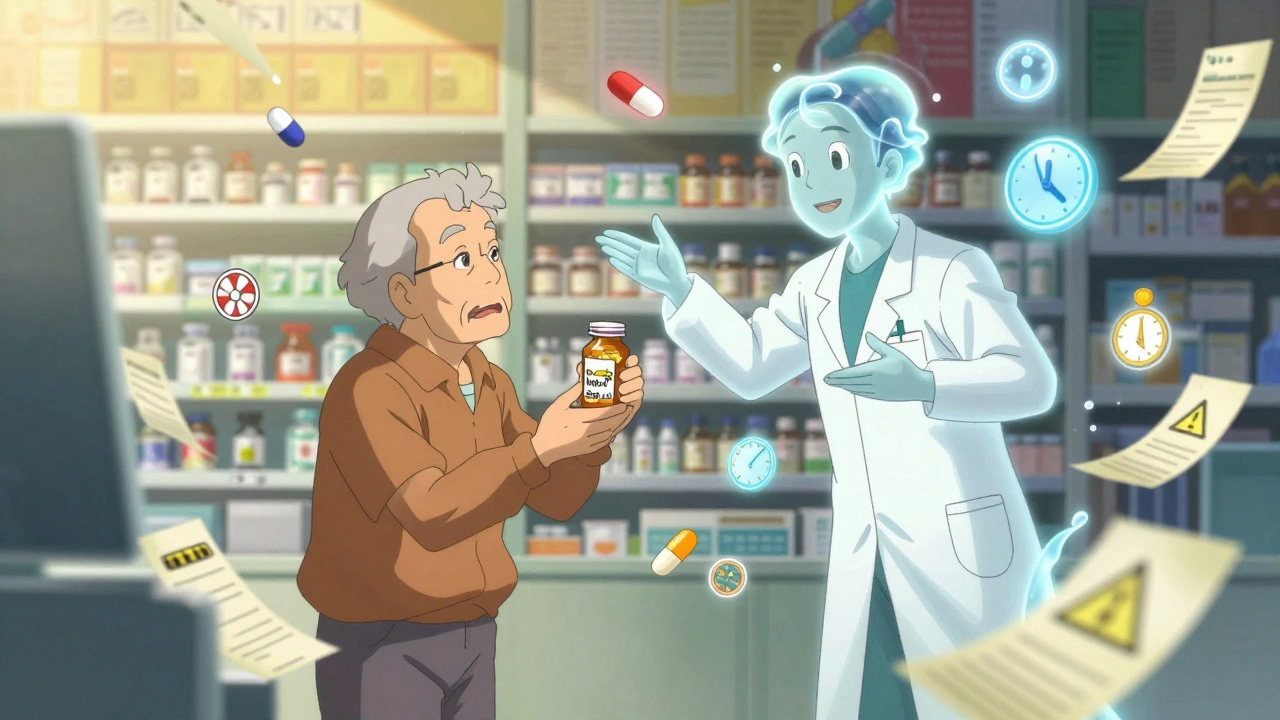
When you’re prescribed a new medication, understanding how to take it isn’t just helpful-it’s life-saving. But if English isn’t your first language, you might not catch the difference between once daily and twice daily, or miss a warning about mixing pills with alcohol. That’s where professional translator services for medication counseling come in. By law, pharmacies must provide them-at no cost to you.
Why You Need a Professional Interpreter for Medication Counseling
Using a family member, friend, or even a bilingual pharmacy staff member to translate your medication instructions is risky. A 2021 study in JAMA Pediatrics found that patients who relied on untrained interpreters had a 49% higher chance of making a serious medication error. That’s not a small risk. It’s the difference between feeling better and ending up in the hospital. Professional medical interpreters aren’t just fluent in two languages-they know medical terms. They understand what “take on an empty stomach” really means, or why you shouldn’t crush a capsule labeled “extended-release.” They’re trained in confidentiality, ethics, and how to handle tense moments when a patient is confused or scared. The law backs this up. Section 1557 of the Affordable Care Act, updated in 2025, requires any pharmacy that takes federal funds-including Medicaid and Medicare-to provide qualified interpreters for medication counseling. This isn’t optional. It’s mandatory. And you don’t pay for it.How to Ask for an Interpreter-The Right Way
You don’t have to wait for someone to ask you if you need help. Step into the pharmacy, and say clearly: “I need a professional interpreter for my medication counseling.” Don’t say, “Can someone help me?” or “My daughter speaks English.” That opens the door for someone to offer a family member or an untrained employee. Pharmacists are required to ask you about your language needs when you pick up a prescription. But if they don’t, speak up. You have the right to a qualified interpreter before you leave with your meds. Here’s what happens next:- The pharmacist will confirm your preferred language.
- They’ll connect you with an interpreter-either by phone, video call, or in person.
- You’ll have time to ask questions about your pills: why you’re taking them, what side effects to watch for, and what to avoid.
- The interaction will be documented in your file with a billing code (T-1013) to show the service was provided.
Types of Interpreter Services You Can Expect
There are three main ways pharmacies deliver interpreter services, each with pros and cons:- Phone interpreting: Fast and cheap. Services like RxTran connect you in under 30 seconds, 92% of the time. But if you’re elderly or have hearing issues, it can be hard to follow without seeing the pharmacist’s face. A 2019 study found 32% of older patients got confused during phone-only sessions.
- Video interpreting: Now used by 65% of healthcare facilities. You see the interpreter on a screen, which helps with nonverbal cues. It’s more expensive than phone but less than in-person. Common tech issues? Poor Wi-Fi or a camera that won’t turn on-reported in 28% of attempts.
- In-person interpreters: The gold standard. Especially useful for complex meds like blood thinners or insulin. But they’re hard to find outside big cities. Most rural pharmacies can’t afford to keep one on staff.

What to Look for in a Qualified Interpreter
Not everyone who speaks two languages is qualified to interpret medical instructions. The American Translators Association says a true medical interpreter must:- Complete at least 40 hours of specialized training
- Pass a certification exam
- Stay up to date with continuing education
What You Should Never Accept
Avoid these situations at all costs:- Using your child as an interpreter-even if they’re fluent. It’s emotionally stressful and medically unsafe.
- Accepting a staff member who says, “I studied Spanish in college.” That’s not training.
- Letting the pharmacist rush you through instructions because they’re “busy.”
- Signing a prescription label without understanding it. If you don’t understand, say so.

What’s Changing in 2025
New rules took effect January 1, 2025: AI tools like Google Translate or chatbots can no longer be used for prescription labels or medication guides-even if they seem accurate. Human review is required. This was a direct response to cases where automated translations got dosage instructions wrong. Also, the government is increasing funding. As of late 2023, Medicaid now reimburses pharmacies 75% (up from 50%) for interpreter services provided to children in non-English-speaking households. That’s pushing more pharmacies to invest in better systems. California is expanding its translated SIGs to include Tagalog and Arabic, with pilot programs running in Los Angeles. Other states are watching closely.What to Do If You’re Denied Service
If a pharmacy refuses to provide an interpreter, or tries to charge you for it, you have options:- Ask to speak with the pharmacy manager. Most don’t know the rules and will fix it immediately.
- Call the pharmacy’s corporate office. Chain pharmacies like CVS or Walgreens have national language access policies.
- File a complaint with the U.S. Department of Health and Human Services (HHS) Office for Civil Rights. They’ve settled 47 cases since 2016-including a $1.2 million penalty against a national pharmacy chain in 2022.
Final Tip: Bring Your Medication List
Before you go to the pharmacy, write down:- All your current medications (including supplements)
- Any side effects you’ve noticed
- Questions you want answered
Can I be charged for a translator when picking up my prescription?
No. Federal law under Section 1557 of the Affordable Care Act prohibits pharmacies from charging patients for interpreter services during medication counseling. This includes phone, video, or in-person interpreters. If a pharmacy tries to charge you, ask to speak with a manager or file a complaint with the HHS Office for Civil Rights.
What if I speak a language not covered by my pharmacy’s translations?
Even if your language isn’t among the five commonly translated (Spanish, Chinese, Korean, Russian, Vietnamese), you still have the right to a live interpreter. Pharmacies must provide services through phone or video for any language. Many use services like RxTran or LanguageLine that offer interpreters for over 200 languages. Don’t accept a printed sheet in a language you don’t understand-ask for a person.
Can I use a family member instead of a professional interpreter?
You can choose to use a family member, but the pharmacy cannot encourage or pressure you to do so. Using untrained interpreters increases the risk of medication errors by nearly 50%, according to research from Dell Medical School. Pharmacists are required to offer a professional interpreter first. If you decline, they must document your choice.
Are video interpreters reliable for complex medication instructions?
Yes, video interpreters are reliable for most medication counseling. They allow you to see facial expressions and gestures, which helps with understanding. A 2023 CMS report found 65% of healthcare facilities use video interpreting successfully. However, it requires good internet and a quiet space. If the connection drops, ask for a phone backup or to reschedule.
How do I know if the interpreter is qualified?
Ask: “Is this interpreter certified in medical terminology?” Qualified interpreters have completed at least 40 hours of training and passed a certification exam. Only 12% of bilingual pharmacy staff meet these standards. If the pharmacist can’t answer, request someone who does. You have the right to a qualified professional.
What should I do if I still don’t understand after the interpreter speaks?
Say, “I still don’t understand. Can you explain it differently?” or “Can you show me how to take this pill?” Pharmacists are trained to rephrase instructions using plain language. You can also ask for a printed handout in your language or request a follow-up call. No question is too small-your safety matters more than their time.






Pharmacies still try to slip in family members as interpreters all the time and it’s insane. I’ve seen it myself. Your 14-year-old shouldn’t be translating your blood pressure meds. That’s not help, that’s negligence.
Section 1557 is clear. No charges. No exceptions. If they push back, call HHS. Done.
Stop normalizing bad practices.
Professional medical interpretation is a basic human right in healthcare. It is not a luxury. The data is overwhelming: untrained interpreters lead to dangerous errors. Pharmacies are legally obligated to provide this service. Patients should never feel like they are asking for a favor.
Clarity saves lives.
I work in a community pharmacy and we’ve had interpreter services for years. It’s not complicated. We use a tablet with video access. Takes five minutes. We document it. No cost to the patient.
It’s not about being nice. It’s about doing the job right.
And yes, we’ve had patients refuse interpreters. We document that too. But we always offer first. Always.
Just had this happen last week. My grandma got her new diabetes script and the tech said ‘I speak Spanish, I’ll help.’ She didn’t know what ‘hypoglycemia’ meant. We waited 20 minutes for the real interpreter.
Turns out the meds were supposed to be taken with food, not before. Could’ve been bad.
Thanks for posting this. Needed to hear it again.
i had to fight for an interpreter at cvs last month and they acted like i was being difficult 😔
like no i just wanna know if this pill will make me pass out or not
they finally called someone after i threatened to call the state. so yeah. speak up. even if you’re scared.
Been using video interpreters for my mum’s heart meds. Works great unless the Wi-Fi dies. Then it’s a mess.
But honestly? Better than phone. You see the face, the hand gestures. It makes a difference.
Also, I’ve noticed the interpreters at our pharmacy are way more trained than the ones at the hospital. Weird.
Let’s be real. Most of these ‘professional interpreters’ are just people who passed a 40-hour course. They don’t know anatomy. They don’t know pharmacology.
And let’s not forget the 88% of bilingual staff who are *not* certified but get used anyway because it’s cheaper.
This whole system is a performative compliance theater.
Stop pretending this is safe.
Why are we even talking about this? It’s 2025. Use Google Translate. It’s free. It’s fast. It’s better than some of these ‘interpreters’ who don’t even know what ‘sublingual’ means.
My cousin used it for her asthma meds. Worked fine.
Stop overcomplicating everything.
People just need to learn English.
It is imperative that all healthcare institutions adhere to the mandates outlined in Section 1557 of the Affordable Care Act. The provision of qualified medical interpreters is not a discretionary service. It is a non-negotiable component of equitable care.
Failure to comply constitutes a violation of civil rights.
Documentation, accountability, and enforcement must be prioritized at all levels.
My brother is deaf and uses ASL. He was once given a printed sheet in English for his new insulin. No interpreter. No explanation.
He ended up in the ER.
Now every time we go, I bring a tablet with a video interpreter app pre-loaded. Pharmacies hate it. But he’s alive.
Advocate. Always.
My mom’s from Vietnam. We used to rely on my sister, who’s 19. Then she got scared after a bad reaction to a wrong dose.
We started using the pharmacy’s video service. The interpreter knew exactly how to explain ‘extended-release’ in Vietnamese. My mom finally stopped being afraid of her pills.
It’s not about language. It’s about trust.
Let’s be candid-the entire ‘medical interpreter’ industry is a bureaucratic Rube Goldberg machine. 40 hours of training? Please. You need clinical immersion, not a webinar.
And don’t get me started on ‘T-1013’ billing codes. It’s compliance theater designed to appease regulators, not patients.
Real solution? Integrate interpreters into pharmacy school curricula. Not outsourced apps.
Otherwise, we’re just rearranging deck chairs on the Titanic.
One thing no one mentions: interpreters aren’t just translating words-they’re translating intent, fear, confusion.
I’ve seen interpreters pause, rephrase, and even gently correct a pharmacist who said ‘take as needed’ when the script said ‘every 6 hours.’
That’s not language. That’s clinical judgment.
And yes, they’re certified. Ask for their credentials. It’s your right.
Y’all don’t even know how much this stuff matters until you’ve watched your grandma cry because she didn’t understand if she was supposed to take the blue pill before or after coffee.
Then you realize-this isn’t about language.
It’s about dignity.
And yeah, it’s worth the 10 minutes.
My pharmacy just started offering Tagalog interpreters. I didn’t even know they had that. My abuela cried. Said she finally felt seen.
Also, the video guy knew how to say ‘kailangan mong uminom bago kumain’ without sounding like a textbook.
That’s the magic.
Not the tech. The person behind it.