
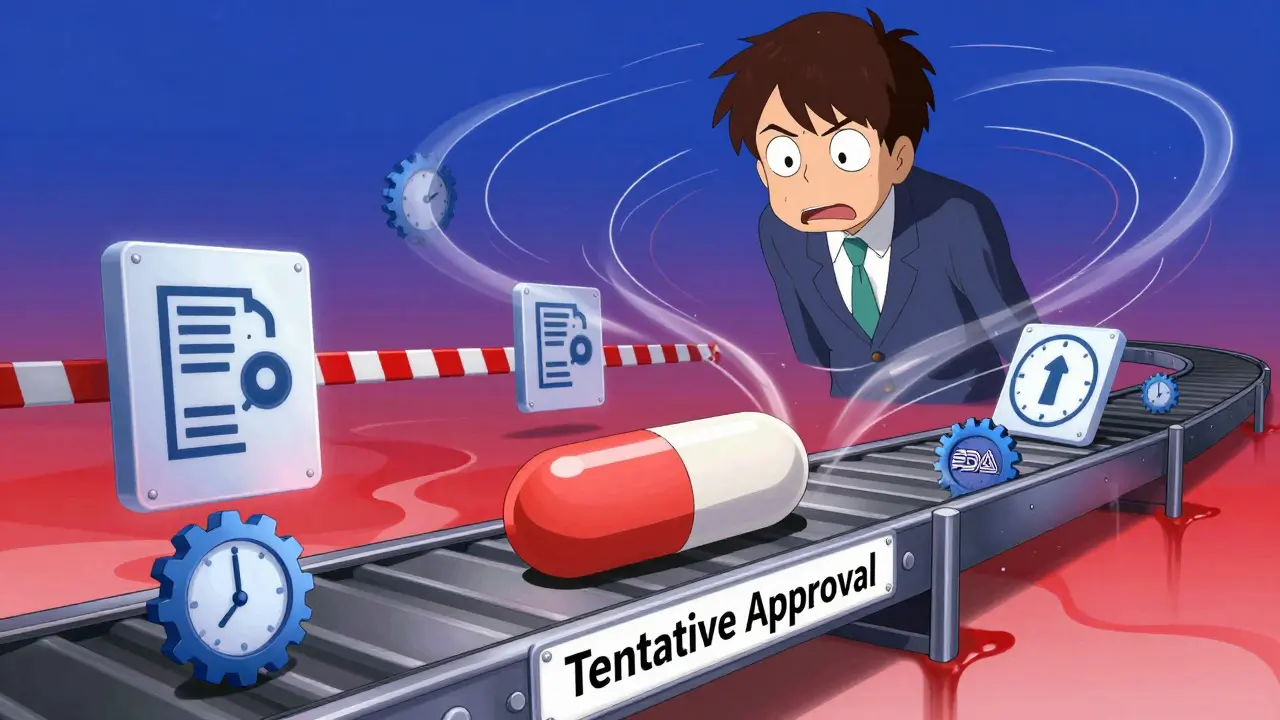
When a generic drug gets tentative approval from the FDA, it doesn’t mean it’s ready to hit shelves. It means the agency has checked every box - safety, effectiveness, quality - but can’t let it go on sale yet. This happens because the brand-name version is still under patent protection or has some kind of legal exclusivity. Think of it like getting your driver’s license but being told you can’t drive until next year because the road’s closed. Thousands of these tentative approvals pile up every year, and many never actually make it to market. Why? Because the system is full of roadblocks, and most of them aren’t about science.
Review Cycles Are the Hidden Time Sink
The FDA doesn’t approve generic drugs in one go. Most applications go through multiple rounds of review. Before 2012, the average application got reviewed nearly four times before approval. Even after the Generic Drug User Fee Amendments (GDUFA) came in to speed things up, the number barely dropped to 3.2 cycles per application by 2022. That’s still a lot of back-and-forth.Why so many cycles? The biggest culprits are missing or sloppy paperwork. About 35% of all deficiencies come from chemistry, manufacturing, and controls (CMC) sections. That means the company didn’t clearly explain how they make the drug, what equipment they use, or how they test it. Another 28% of issues come from bioequivalence studies - the tests that prove the generic works the same way as the brand-name drug. If the study design is weak, or the data doesn’t match FDA standards, the application gets sent back. And 22% of the time, it’s because the analytical methods used to test the drug aren’t properly validated. In plain terms: they didn’t prove their testing tools work right.
Manufacturing facilities are another major source of delays. In 2022, over 40% of complete response letters (CRLs) - the official “we’re not approving this yet” notices - were tied to inspection findings. The most common problems? Poor quality control systems (63% of facility-related CRLs), bad environmental monitoring (29%), and equipment that wasn’t properly tested or calibrated (24%). If your factory can’t pass an FDA inspection, no amount of good science will get you approved.
Patent Litigation Stops Everything
Even if the FDA says a generic is ready, the brand-name company can still block it. Under the Hatch-Waxman Act, if the original drugmaker sues for patent infringement, the FDA is legally required to hold off on final approval for up to 30 months. This is called the 30-month stay. It’s not a delay - it’s a legal freeze.Between 2010 and 2016, 68% of tentatively approved generics never launched because of these lawsuits. Often, the lawsuits aren’t about real patent violations. They’re tactics. Brand-name companies file patents on minor changes - like a different pill shape or coating - just to reset the clock. This is called “product hopping.” A 2018 FTC study found that 17% of top-selling drugs used this trick to delay generics.
Then there are “pay-for-delay” deals. Sometimes, the brand-name company pays the generic maker to stay off the market. Between 2009 and 2014, 987 such deals were documented, delaying generic entry and keeping prices high. The FTC called them anti-competitive. The courts called them legally murky. Either way, they work.
Citizen petitions are another weapon. A brand-name company can ask the FDA to delay approval by claiming the generic’s testing method is flawed. Between 2013 and 2015, 67 petitions were filed. The FDA approved only three. But the delay worked. On average, these petitions added seven months to the approval timeline. The FDA itself found that 72% of these petitions were scientifically unsupported.
Applications Are Often Incomplete From the Start
You’d think companies would submit clean applications. But 29% of initial ANDAs have major gaps - missing clinical data, incomplete labeling, or incomplete chemistry info. The FDA’s Office of Generic Drugs found that 43% of deficiencies in 2022 were about stability data. That’s the data that shows the drug won’t break down over time. If you can’t prove your pill won’t go bad in a hot warehouse, the FDA won’t approve it.Another 31% of issues involve the container - the bottle, blister pack, or vial. If the packaging doesn’t protect the drug from moisture or light, it’s a no-go. And 26% of CRLs came from manufacturing validation problems. This is especially bad for complex drugs like inhalers, creams, or extended-release pills. These take 2.3 times longer to review than simple tablets. In 2021, only 12% of complex generics got tentative approval within the FDA’s 10-month target.
Even when the FDA sends a deficiency letter, companies don’t always respond fast. The average time to reply in 2022 was 9.2 months. The FDA recommends six. That extra 3.2 months adds up - especially when patent clocks are ticking.
Market Economics Don’t Always Add Up
Here’s the twist: even after all the hurdles are cleared, some generics never launch. Why? Because it doesn’t make financial sense.A 2022 analysis from DrugPatentWatch found that 30% of approved generics never hit the market. For drugs with annual U.S. sales under $50 million, that number jumps to 47%. If the profit margin is too thin, manufacturers won’t bother. They’ll wait for a bigger opportunity.
And sometimes, they wait for the right moment. A company might get tentative approval years before patent expiration, then sit on it until the last minute. Why? To maximize profits. If they launch too early, they risk a price war before the market is ready. If they wait, they can grab the whole market at once.
Even when generics do launch, they don’t always bring prices down fast. A 2019 JAMA study found that when only one generic enters the market, prices stay at 80% of the brand’s price for two full years. That means manufacturers don’t rush to enter - why compete for pennies when the market’s already crowded?
What’s Being Done to Fix It?
The FDA has tried to fix this. The Competitive Generic Therapy (CGT) program, launched in 2017, fast-tracks approvals for drugs with little or no competition. Of the drugs that got CGT designation, 78% received tentative approval in just eight months - compared to the usual 18. That’s a huge win.The FDA also launched a 2022 initiative to prioritize 102 high-need tentative approvals. Of those, 67% got final approval within a year - more than double the normal rate. They’ve also updated guidance to help companies submit cleaner applications, especially for complex drugs.
But progress is slow. In 2022, the median time from tentative approval to market launch was still 16.5 months. That’s only slightly better than 18.3 months in 2016. The FDA’s own 2023 report admits that patent litigation, complex manufacturing, and resource limits will keep delays going through at least 2025.
New laws like the CREATES Act (2019) and the Affordable Drug Manufacturing Act (2023) aim to stop brand companies from blocking sample access and abusing patents. But enforcement is patchy. And with generic applications now topping 1,100 per year - up from 500 in 2005 - the FDA is still stretched thin.
What This Means for Patients
The real cost of these delays isn’t measured in months or review cycles. It’s measured in dollars and lives. A 2018 Congressional Budget Office report estimated that patent-related delays added $9.8 billion to U.S. drug spending each year. Analysts now project that number will hit $12.4 billion by 2027.Patients wait longer for affordable versions of life-saving drugs. Chronic conditions like diabetes, hypertension, and asthma become harder to manage when the cheapest option is still locked behind a patent. Even when generics finally arrive, prices don’t always drop as fast as they should.
The system was designed to balance innovation and access. But over time, loopholes and legal tactics have tilted it heavily toward brand-name companies. Tentative approval was meant to be a shortcut - not a detour. Right now, it’s the latter.
What does tentative approval mean for a generic drug?
Tentative approval means the FDA has reviewed the generic drug’s safety, quality, and effectiveness and found it meets all requirements. But the drug can’t be sold yet because the brand-name version is still protected by a patent or regulatory exclusivity. Once those protections expire, the FDA can issue final approval and the generic can launch.
How long does it take for a tentatively approved generic to reach the market?
On average, it takes 16.5 months from tentative approval to market launch, according to 2022 FDA data. But this varies widely. Some launch immediately after patent expiration, while others never launch at all. The median time was 18.3 months in 2016, so progress has been slow. Delays are often caused by patent litigation, manufacturing issues, or strategic business decisions by generic manufacturers.
Why do some tentatively approved generics never get sold?
Many never launch because it’s not profitable. If the drug has low sales volume - under $50 million annually - the profit margin after manufacturing and regulatory costs is too thin. Companies may also delay launch to wait for better market conditions, or they may be blocked by ongoing patent lawsuits. In some cases, the brand-name company pays the generic maker to stay out of the market.
What role do citizen petitions play in delaying generic approval?
Citizen petitions are formal requests filed with the FDA to delay approval, often by challenging the scientific basis of a generic drug’s application. Between 2013 and 2015, 67 petitions were filed - mostly by brand-name companies. The FDA approved only three. But the delay worked: each petition added an average of 7.2 months to the approval timeline. The FDA found that 72% of these petitions were scientifically unsupported and were used as a tactic to block competition.
Can the FDA approve a generic before the brand-name patent expires?
No. Even if a generic meets all scientific requirements, the FDA cannot grant final approval until all patents and exclusivities on the brand-name drug expire. This is required by law under the Hatch-Waxman Act. Tentative approval is a placeholder - it means the drug is ready to go, but legally can’t be sold yet.




I work in pharma compliance and let me tell you, the CMC stuff is a nightmare. Companies submit half-baked protocols like it’s a college homework assignment. One time I saw a batch record where the autoclave temp was listed as 'pretty hot.' No joke. FDA reviewers must have a special hell for these folks.
The systemic inefficiencies in the generic approval pipeline are a direct consequence of regulatory fragmentation and insufficient investment in inspectional capacity. The GDUFA framework, while an improvement, remains structurally inadequate to address the complexity of modern pharmaceutical manufacturing, particularly for biologics and complex dosage forms.
It's frustrating to see how long this takes. I've got a family member who needs a generic version of their med and it's been over a year. The science is solid. The delays are all legal and financial. That's not how it's supposed to work.
You people don't understand. The FDA is just a puppet of Big Pharma. Every 'deficiency' they cite? Manufactured. They're paid off. The real reason generics are delayed? Because the government wants you to keep paying $500 for a pill that costs $2 to make. Wake up.
America built the greatest pharmaceutical industry in the world. Now we're letting foreign manufacturers with shoddy labs sit on our patents? This is why we lost manufacturing. If you can't pass an FDA inspection, you shouldn't be allowed to touch a pill. Stop outsourcing our health.
Did you know the FDA has a secret database of 'approved' generics that never launch? It's called Project Nightingale. They're hoarding them to control supply. Why? So they can trigger artificial shortages and jack up prices. The whistleblower reports are buried. I've seen the documents.
I just want to say I've been on this drug for 12 years. My insurance won't cover the brand. The generic I get? Sometimes it works. Sometimes I feel like I'm dying. Sometimes I feel fine. I don't know what's in it. I just know I'm tired of being a guinea pig.
So basically the whole system is rigged. Patent trolls, pay-for-delay, citizen petitions - it's a casino where Big Pharma owns the house. And we're the suckers betting our health on a rigged wheel. Why do we even pretend this is about science?
The notion that 'tentative approval' is a meaningful milestone is laughable. It's a bureaucratic mirage. The FDA's own metrics show that 78% of deficiencies are avoidable with competent project management. The real issue? Generic manufacturers operate like third-world startups with Excel sheets and hope.
Let me break this down for you. Every single delay? Every single back-and-forth? Every single CRL? It's not about science. It's about money. Billions. The brand-name companies don't care if you can't afford your meds. They care if their quarterly earnings dip. They'll sue, they'll petition, they'll pay, they'll delay - all to protect a $200M/year profit on a pill that cost $500k to develop. And you're supposed to be grateful? You're not a patient. You're a revenue stream. And they're milking you dry.
We are not just talking about pills here. We are talking about dignity. We are talking about autonomy. We are talking about the fundamental right to access the tools that allow us to live - not just survive - with chronic illness. The current system reduces human beings to balance sheets. It is not merely inefficient; it is morally bankrupt. The FDA must be reimagined not as a gatekeeper, but as a steward of public health - not corporate profit.
You know what's funny? The FDA spends more time arguing over whether a blister pack is 'light-resistant enough' than they do investigating why 40% of the world's active pharmaceutical ingredients come from factories with no running water. We're treating symptoms of corruption like it's a chemistry problem. The real bottleneck? The entire global supply chain is a pyramid scheme built on sweatshops and silence.
I'm from Nigeria and we don't even get these tentatively approved generics. Our hospitals are still using expired meds. Meanwhile, the U.S. is debating packaging standards. We need these drugs NOW. Stop over-engineering the solution. Just get the medicine to the people.
The CMC deficiencies are symptomatic of a broader failure in process validation and statistical process control. The industry continues to rely on outdated GMP frameworks that were designed for batch manufacturing in the 1970s. Modern continuous manufacturing and PAT tools are underutilized due to regulatory inertia and risk-averse QA cultures. This is not a compliance issue - it's a technological lag.
I don't care about your 'tentative approvals.' I care about my insulin. I pay $600 a month. If this system was working, I'd be paying $20. The fact that you're still talking about review cycles means you've never had to choose between rent and medicine. This isn't policy. It's cruelty.