
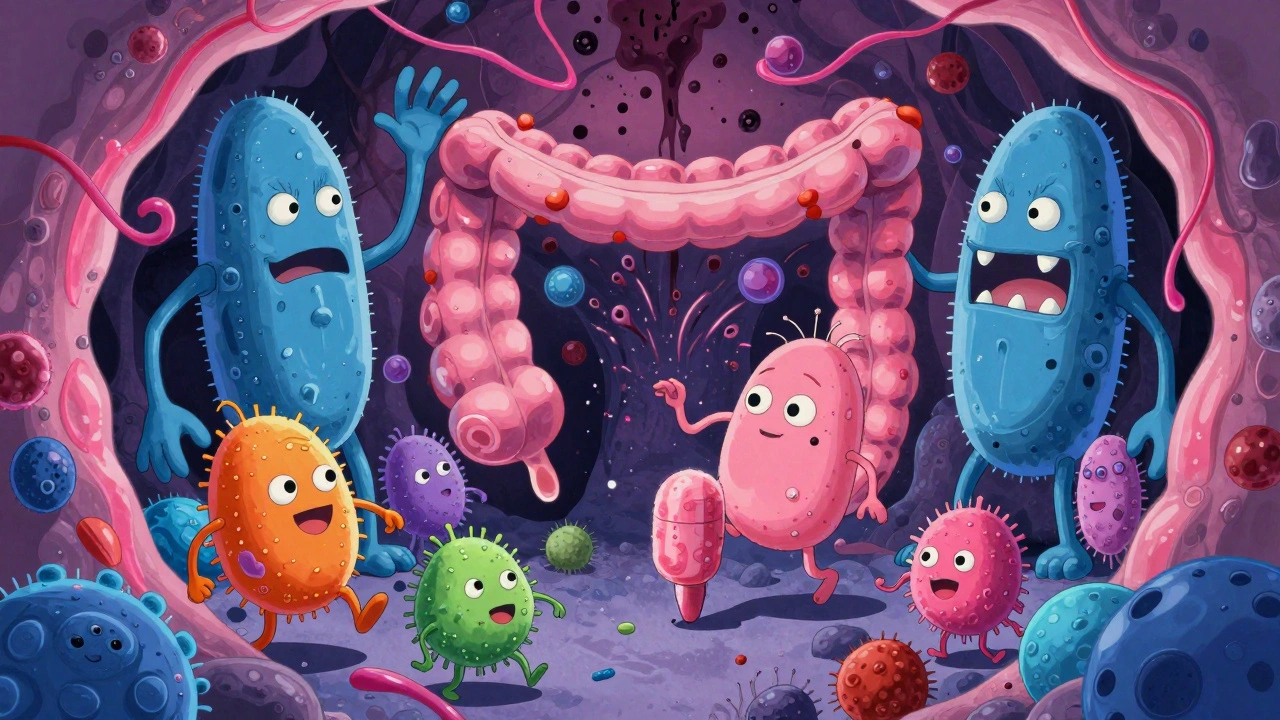
When antibiotics save your life, they can also set you up for something far worse. For tens of thousands of people every year, a simple course of antibiotics leads to a dangerous infection called C. difficile colitis-a gut infection that turns normal digestion into a nightmare of diarrhea, cramps, and sometimes, life-threatening complications.
How Antibiotics Trigger C. diff
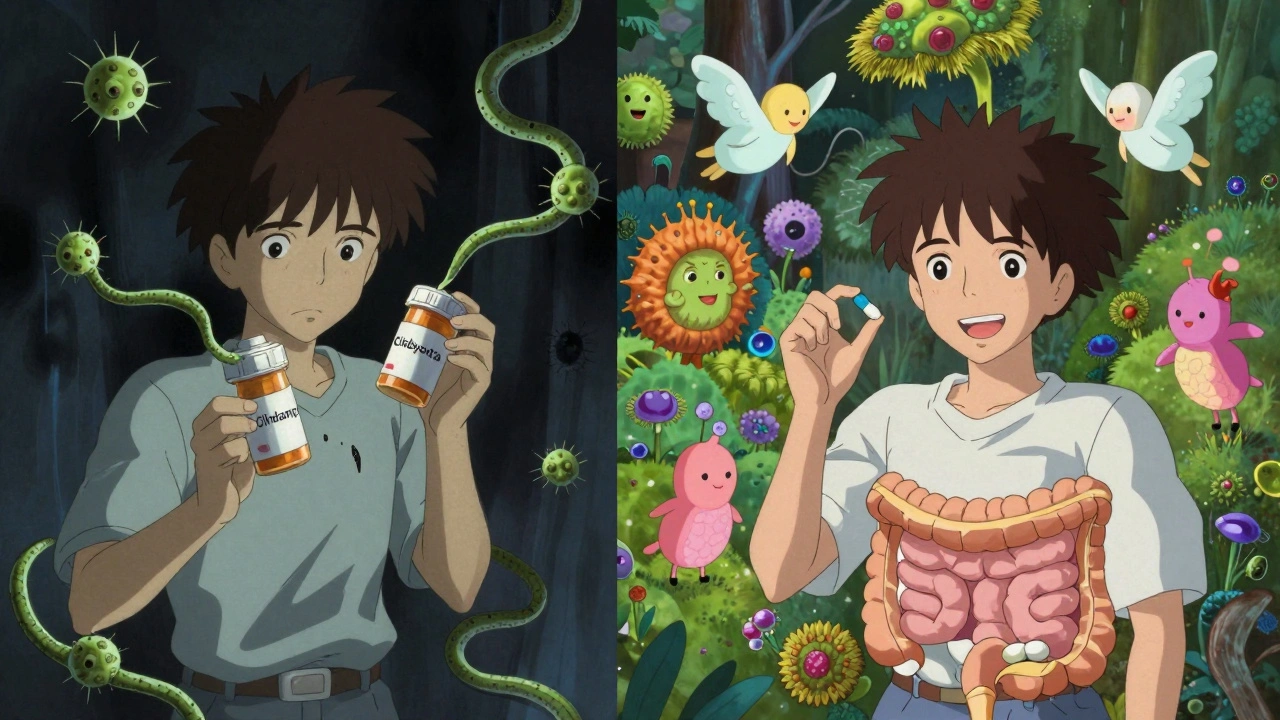
C. difficile, or C. diff, isn’t something you catch from a dirty doorknob. It’s already in your gut-harmlessly-until antibiotics wipe out the good bacteria that keep it in check. Once those friendly microbes are gone, C. diff multiplies fast, releasing toxins that attack the colon lining. The result? Severe diarrhea, fever, abdominal pain, and in the worst cases, colon rupture or sepsis.Not all antibiotics carry the same risk. Some are like wrecking balls to your gut flora. A 2023 study analyzing over 33,000 hospital stays found that piperacillin-tazobactam, a common broad-spectrum antibiotic, nearly doubled the risk of C. diff compared to other drugs. Carbapenems and later-generation cephalosporins like ceftriaxone were just as dangerous. Even more surprising? Clindamycin, once a go-to for skin infections, is still one of the worst offenders. Patients who took it were more than three times as likely to develop C. diff than those who didn’t.
On the flip side, tetracyclines like doxycycline showed the lowest risk. That doesn’t mean they’re safe to use carelessly, but if you need an antibiotic and have a history of C. diff, your doctor might consider one of these lower-risk options.
It’s not just the type of antibiotic-it’s how long you take it. Each extra day on antibiotics increases your C. diff risk by 8%. The danger spikes after 14 days. That’s why doctors are now told to review prescriptions within 48 to 72 hours. If the infection isn’t bacterial-or if a narrower drug will do-they should switch or stop.
Why Recurrent Infections Are So Common
Many people think once the diarrhea stops, they’re done. But C. diff spores survive in the gut long after antibiotics are gone. These spores can lie dormant for weeks, then reactivate when the gut environment is still unstable. That’s why up to 25% of people who get C. diff once will have it again. And after two recurrences, the chance of a third jumps to 60%.Standard treatments-vancomycin or fidaxomicin-work for the first episode. But they don’t fix the broken gut ecosystem. That’s why recurrence is so common. One patient described it on a medical forum: “I did three rounds of vancomycin. Each time, I felt better for a week. Then it came back worse.”
Doctors now know that continuing the antibiotic that caused the infection makes things worse. The Infectious Diseases Society of America says: if you suspect C. diff, stop that drug-unless it’s absolutely necessary to keep taking it.
Fecal Transplant: A Gut Reset
Enter fecal microbiota transplantation (FMT)-a treatment that sounds strange but works like magic. It’s not just “poop in a tube.” It’s a carefully screened, lab-processed transplant of healthy gut bacteria from a donor into the patient’s colon. The goal? Restore the microbial balance that antibiotics destroyed.The evidence is overwhelming. A landmark 2013 study in the New England Journal of Medicine showed FMT cured 94% of patients with recurrent C. diff after just one or two treatments. Compare that to vancomycin, which worked in only 31%. Since then, multiple reviews have confirmed success rates of 85% to 90% for patients with three or more recurrences.
There are three main ways to deliver FMT:
- Colonoscopy (65% of cases): The most direct method. A scope delivers the donor material deep into the colon.
- Enema (20%): Less invasive, done in outpatient clinics. Requires multiple doses.
- Oral capsules (15%): Frozen, encapsulated donor stool. Easy to take, no procedure needed. FDA-approved versions like Rebyota and Vowst are now available.
Donors aren’t just anyone. They’re screened for everything-HIV, hepatitis, parasites, even antibiotic-resistant bacteria. The FDA requires informed consent because, while rare, there’s a risk of transferring unknown pathogens. One case in 2019 involved a patient who developed a drug-resistant E. coli infection after FMT, highlighting why screening is non-negotiable.

What’s New: FDA-Approved Microbiome Therapies
FMT used to be a last-resort procedure done by gastroenterologists in research settings. Now, it’s becoming a standard treatment. In 2022 and 2023, the FDA approved two microbiome-based drugs: Rebyota and Vowst. These aren’t raw stool-they’re purified, standardized, shelf-stable products made from carefully selected donor material.These products are easier to use, more consistent, and less intimidating than traditional FMT. They’re also covered by Medicare, costing between $1,500 and $3,000 per treatment. That’s far cheaper than a hospital stay for recurrent C. diff, which averages $11,000 per episode.
Even more promising? Oral drugs like SER-109, a capsule filled with bacterial spores from healthy donors. In a 2022 trial, it cured 88% of patients with recurrent C. diff-matching FMT’s success without the “yuck factor.” These next-generation therapies are the future: targeted, safe, and scalable.
Who Should Get FMT?
You’re a good candidate for FMT if:- You’ve had three or more episodes of C. diff
- Standard antibiotics failed or didn’t last
- You’re in good overall health (no severe immune problems)
It’s not for everyone. People with weakened immune systems, recent organ transplants, or active cancer treatments may face higher risks. Your doctor will weigh the benefits against your individual health profile.
For first-time C. diff, FMT isn’t recommended. You start with fidaxomicin or vancomycin. If it comes back? Then FMT becomes the best option.
Prevention: Stopping C. diff Before It Starts
The best treatment is no treatment at all. Antibiotic stewardship-using antibiotics only when needed and choosing the right one-is the #1 way to prevent C. diff.Hospitals are now required to track antibiotic use and reduce unnecessary prescriptions. Community clinics are being trained to avoid prescribing broad-spectrum drugs for viral infections like colds or flu-where antibiotics do nothing.
Even small changes help:
- Ask: “Do I really need this antibiotic?”
- Ask: “Is there a narrower-spectrum option?”
- Ask: “How long do I need to take it?”
And if you’ve had C. diff before, avoid clindamycin, cephalosporins, and fluoroquinolones like ciprofloxacin unless absolutely necessary. Keep a list of high-risk drugs in your phone or wallet.
What About Probiotics?
You’ve probably heard that yogurt or probiotic pills can prevent C. diff. The truth? The evidence doesn’t support it. The IDSA says there’s no strong proof that probiotics prevent C. diff-and in some cases, they may cause harm. Immunocompromised patients have developed bloodstream infections from probiotic strains.One small study looked at kefir (a fermented milk drink) combined with a slow taper of antibiotics. It showed promising results, but it was tiny and not replicated. Don’t rely on probiotics as a shield. They’re not a substitute for smart antibiotic use or FMT when needed.
The Bigger Picture
C. diff isn’t going away. The CDC calls it an “urgent threat.” In 2023, there were still over 500,000 cases in the U.S.-and nearly 30,000 deaths. The cost? Over $6 billion a year.But things are changing. Hospitals with strong antibiotic programs have cut C. diff rates by 24%. FMT and new microbiome drugs are turning what was once a chronic nightmare into a treatable condition. The goal now isn’t just survival-it’s preventing recurrence before it starts.
The message is clear: antibiotics are powerful tools, but they’re not harmless. Your gut microbiome is a living ecosystem. Treat it with care.
Can C. diff go away without treatment?
In mild cases, especially in healthy people, stopping the offending antibiotic may be enough. The body’s natural defenses can sometimes restore balance on their own. But this is rare. Most people need treatment-especially if symptoms are severe or last more than a few days. Waiting can lead to complications like dehydration, colon damage, or even death.
Is fecal transplant safe?
When done through approved channels-with donor screening and FDA-compliant products-it’s very safe. The risk of serious infection is less than 1%. The biggest risks are mild side effects like bloating, cramps, or temporary diarrhea. The FDA requires informed consent because long-term effects of microbiome changes are still being studied. But for recurrent C. diff, the benefits far outweigh the risks.
What antibiotics are safest for someone with a history of C. diff?
Tetracyclines like doxycycline and minocycline carry the lowest risk. Penicillins like amoxicillin are also lower risk than broad-spectrum drugs. Avoid clindamycin, ceftriaxone, ciprofloxacin, and piperacillin-tazobactam unless there’s no alternative. Always tell your doctor about your C. diff history before starting any antibiotic.
How long does it take to recover after a fecal transplant?
Most people notice improvement within 24 to 48 hours. Diarrhea usually stops within a few days. Full gut recovery-meaning your microbiome stabilizes and you’re no longer at high risk for recurrence-can take weeks to months. But the key point: after a successful FMT, the chance of another C. diff episode drops from 60% to under 15%.
Can you get C. diff from a fecal transplant?
It’s extremely rare. Donors are screened for over 50 pathogens, including viruses, parasites, and antibiotic-resistant bacteria. The FDA requires testing for C. diff itself, and any donor with a history of C. diff is automatically disqualified. In the few cases where infection occurred, it was linked to inadequate screening-something that’s now rare with FDA-approved products.
Is FMT covered by insurance?
Yes, if it’s done using an FDA-approved product like Rebyota or Vowst, most insurance plans-including Medicare-cover it. For physician-prepared FMT (using donor stool), coverage varies by plan and may require prior authorization. Always check with your insurer before proceeding.





Antibiotics are just another western scam to make pharma rich while destroying our gut flora. In India, we’ve been using turmeric and neem for centuries to fight infections-no need for these toxic drugs. C. diff? More like C. dumb-ass. Stop trusting Big Pharma and start thinking for yourself.
This is one of the clearest, most balanced explanations of C. diff I’ve ever read. The breakdown of antibiotic risks and the FMT options is exactly what patients need to hear. Kudos to the author for cutting through the noise and giving real, actionable info.
Oh. My. GOD. This article just rewired my entire understanding of gut health. I mean, like, the microbiome isn’t just a ‘bunch of bugs’-it’s a sentient, fragile ecosystem that’s been violently colonized by modern medicine. FMT isn’t just a treatment-it’s a microbial resurrection. I’m literally crying. Rebyota? I’m booking it. This is the future of medicine, and I’m so here for it.
Just wanted to add that the 8% increased risk per day on antibiotics is something every primary care doc should print out and tape to their desk. I’ve seen too many patients get a 10-day course for a viral URI. It’s not just unnecessary-it’s dangerous. This data should be mandatory reading for med students.
It’s fascinating how we’ve gone from treating C. diff as a simple infection to recognizing it as a systemic collapse of microbial ecology-like a forest fire where the native species are wiped out and invasive weeds take over. Vancomycin is like throwing gasoline on the fire hoping it’ll stop burning, but FMT is like replanting the entire forest with native saplings. And honestly, the fact that we’re now using standardized, FDA-approved microbiome products instead of raw stool is a huge leap forward-not just medically, but psychologically. Imagine telling your grandma you’re getting a ‘fecal transplant’ versus a ‘microbial restoration therapy’-the stigma evaporates. Plus, the cost comparison is insane: $3,000 for a cure versus $11,000 for a hospital stay? That’s not just medicine, that’s economic wisdom. And I think we’re on the cusp of something bigger: personalized microbiome banking, where you store your own healthy flora before chemo or major antibiotics, like freezing eggs or sperm. This isn’t science fiction anymore-it’s the next frontier of preventive medicine.
I’ve had C. diff twice. The first time, I thought I was just ‘getting over the flu.’ The second time, I was in the ER with a fever of 103, cramping so bad I couldn’t stand, and my husband had to carry me to the bathroom. Vancomycin helped-but only for a week. Then it came back worse. I was terrified. When my GI doctor suggested FMT, I cried. Not because I was scared of the procedure, but because I finally felt like someone understood. The capsules? I took them like vitamins. Two days later, I ate a bowl of spaghetti for the first time in months and didn’t run to the toilet. It’s not magic-it’s science. And I’m alive because of it.
Interesting how the article mentions probiotics don’t work but doesn’t address the fact that some strains like Saccharomyces boulardii have shown modest benefit in meta-analyses. Also, is there any data on how FMT affects long-term immune function? I’m not anti-FMT, just curious about the broader implications.
It is with profound regret that I must inform the reader that the entire paradigm of antibiotic stewardship is fundamentally flawed. The very notion of prescribing synthetic pharmaceuticals to modulate microbial populations is an act of hubris, a colonial imposition upon the natural order of the human biome. One must ask: who authorized this biochemical hegemony? The FDA? The AMA? The pharmaceutical conglomerates? The answer is clear: the silent majority has been silenced. FMT, while marginally less offensive, remains a symptom of the disease, not its cure. True healing lies in ancestral diets, fasting, and spiritual purification-not in laboratory-cultured fecal slurry. This is not medicine. This is modernity’s final, grotesque bow.
My mom got FMT last year. She’s 72, had 4 recurrences, and now she’s hiking again. I used to joke that her colon was haunted. Now I just say, ‘Hey Ma, want some Rebyota?’ She laughs. We’re all just trying not to poop ourselves to death.
weird how we think of our guts as this dumb pipe when really it’s like… a whole civilization. antibiotics are like nuking a city to kill one bad guy. and fecal transplants? rebuilding the whole town with the original architects. i just wonder if we’re missing the point-why did the city collapse in the first place? maybe it’s not just the antibiotics… maybe it’s the sugar, the stress, the sleeplessness. just sayin’.
It is imperative to emphasize, with the utmost seriousness, that the rise of C. difficile colitis represents not merely a medical challenge, but a societal failure in health literacy and antibiotic discipline. The data presented herein is both compelling and unequivocal: the indiscriminate use of broad-spectrum antimicrobials constitutes a public health emergency of the highest order. I urge all healthcare practitioners, policymakers, and patients alike to adopt a posture of rigorous stewardship, to prioritize narrow-spectrum agents, to advocate for standardized protocols, and to embrace microbiome-based therapeutics as the ethical and scientifically validated standard of care. Let this be the turning point-not a trend, but a transformation.