

When your kidneys are failing, a transplant can give you back your life. But getting one isn’t as simple as signing up. It’s a long, detailed process that starts long before you’re placed on a waitlist-and it doesn’t end when you get the call. If you’re preparing for a kidney transplant, you need to understand the three big phases: evaluation, waitlist, and living donors. This isn’t just medical jargon. It’s your roadmap to survival.
Step One: The Evaluation Process
The first thing you’ll face is the transplant evaluation. This isn’t a single appointment. It’s a full medical and emotional audit. Most centers require you to complete it within 90 days of your nephrologist’s referral. If you wait longer, your chances of getting a transplant drop by over 11% over five years. That’s not a small risk-it’s life-changing. You’ll start with paperwork. A transplant coordinator will ask for your full medical history: every hospital visit, every lab result, every medication you’ve taken in the last five years. Bring it all. Missing records can delay your evaluation by weeks. Then come the tests. Blood type. Liver function. Kidney function. Viral screenings for HIV, hepatitis B and C. They use the latest CDC-approved tests-no outdated methods here. Your heart gets checked too. You need an echocardiogram to make sure your ejection fraction is above 40%. You’ll have an EKG, a chest X-ray, and a stress test. If you can’t walk on a treadmill for six minutes, you might need more cardiac work before they’ll consider you. Cancer screenings are mandatory. Men over 50 get a PSA test. Women get mammograms and Pap smears. No exceptions. Then there’s the psychosocial side. This is where many people get stuck. A social worker will sit down with you and ask hard questions: Who will drive you to appointments? Can you afford your meds after the transplant? Do you have someone to help you if you get sick? Northwestern Medicine requires proof you have at least $3,500 in liquid savings just to cover your first year of anti-rejection drugs. Insurance doesn’t pay it all. The committee that decides your fate includes a surgeon, a nephrologist, a social worker, a psychiatrist, and a transplant coordinator. They meet every week. You won’t be there. But they’ll look at every detail. And they’re not just checking if you’re healthy enough. They’re checking if you’re ready to take lifelong responsibility. 32% of people who fail evaluation do so because of psychosocial issues-not medical ones.What Gets You Off the List?
Not everyone who starts the evaluation makes it to the waitlist. The top five reasons people are turned down:- Active cancer (14.2%)
- Severe heart disease (11.8%)
- Uncontrolled infection (9.3%)
- BMI over 40 (8.7%)
- History of missing meds or appointments (7.9%)
The Waitlist: Waiting Isn’t Passive
Once you’re approved, you’re added to the national waitlist. As of January 2024, over 102,000 people in the U.S. are waiting for a kidney. The average wait? 3.6 years. That’s longer than most people expect. But here’s the truth: your wait isn’t just about time. It’s about compatibility. Your blood type matters. Your immune system matters. Your Panel Reactive Antibody (PRA) level tells the system how likely you are to reject a kidney. If your PRA is above 98%, you’re considered highly sensitized. That means you’ve built up antibodies from past transplants, pregnancies, or blood transfusions. You’ll get priority under the new 2024 OPTN rules-but you’ll still wait longer than most. You need to stay ready. Keep your phone on. Your number must be current. If you get sick, miss an appointment, or change your address, tell your coordinator immediately. One missed appointment can delay your listing. Northwestern Medicine says 18.3% of delays come from missed visits. And don’t assume you’re stuck waiting for a deceased donor. That’s where living donors change everything.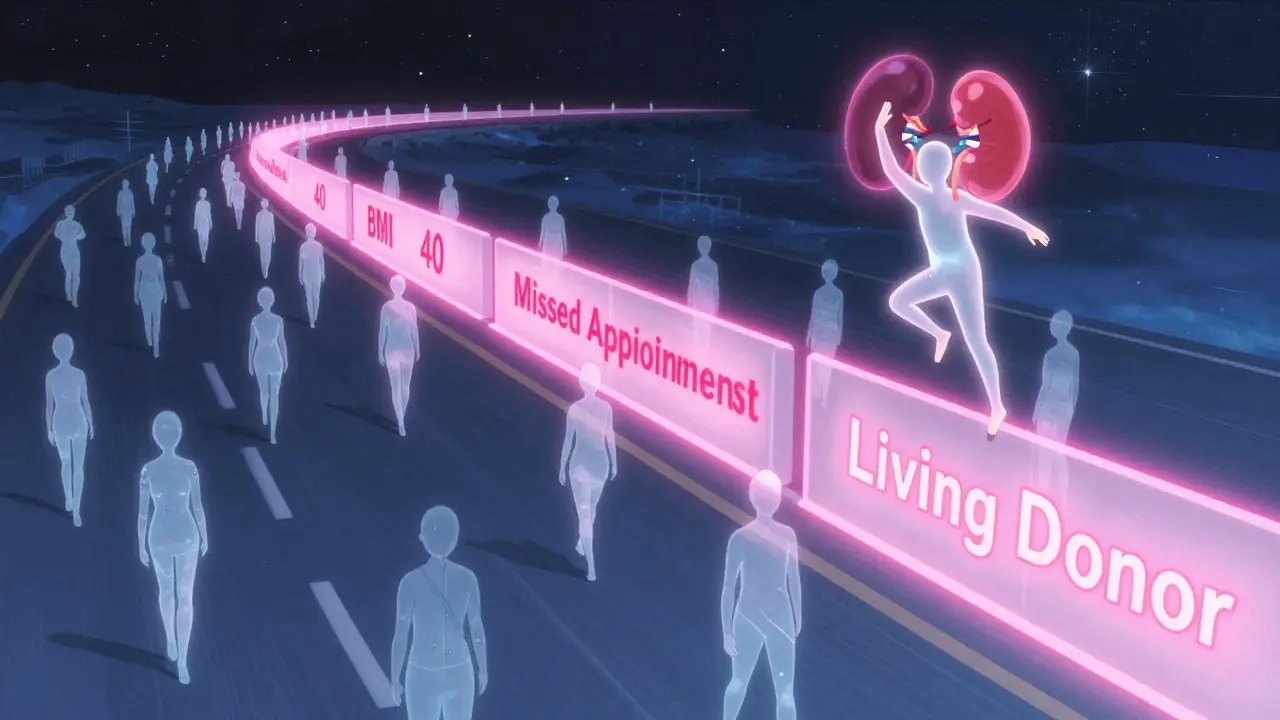
Living Donors: The Fastest Path
About 40% of kidney transplants in the U.S. come from living donors. That’s not a small number. It’s the majority of successful transplants. And here’s why: living donor kidneys last longer. One-year survival? 96.3%. Deceased donor? 94.1%. That’s a real difference. A living donor can be a family member, a friend, or even a stranger. But they have to be healthy. They’ll go through their own evaluation-blood type match, kidney function tests, heart screening, psychological check. They can’t have diabetes, high blood pressure, or cancer. They can’t be overweight. They need to be emotionally stable. The good news? The process is faster now. Leading centers use “rapid crossmatch” protocols. What used to take six to eight weeks now takes two to three. Some centers can match and transplant in under a month. There’s also the Kidney Paired Donation Program. If your friend wants to donate but isn’t a match for you, they can donate to someone else-and you get a kidney from someone else’s donor. In 2023, this program helped 1,872 people get transplants. But here’s the catch: most people don’t ask. They wait for someone to offer. That’s why only 1 in 3 patients on the waitlist ever get a living donor kidney. If you have someone in mind, talk to them. Bring them to your evaluation appointment. Let the team guide them. Don’t wait for permission. Start the conversation.What You Can Do Right Now
You don’t have to wait for your doctor to refer you. If your eGFR is below 20, ask for a transplant evaluation. Don’t wait until you’re on dialysis. Early referral improves survival. Gather your records. Get your insurance details. Write down your support system. Who will help you? Who will drive you? Who will watch your kids if you’re in the hospital? Track your appointments. Use a notebook or a phone app. Write down every test, every date, every person you talk to. If you miss a step, you’ll be sent back to the beginning. And if you’re feeling overwhelmed? You’re not alone. Two in three patients report anxiety during evaluation. The psychosocial interview is the most stressful part. But it’s not a test of your character. It’s a way to make sure you have the support you need.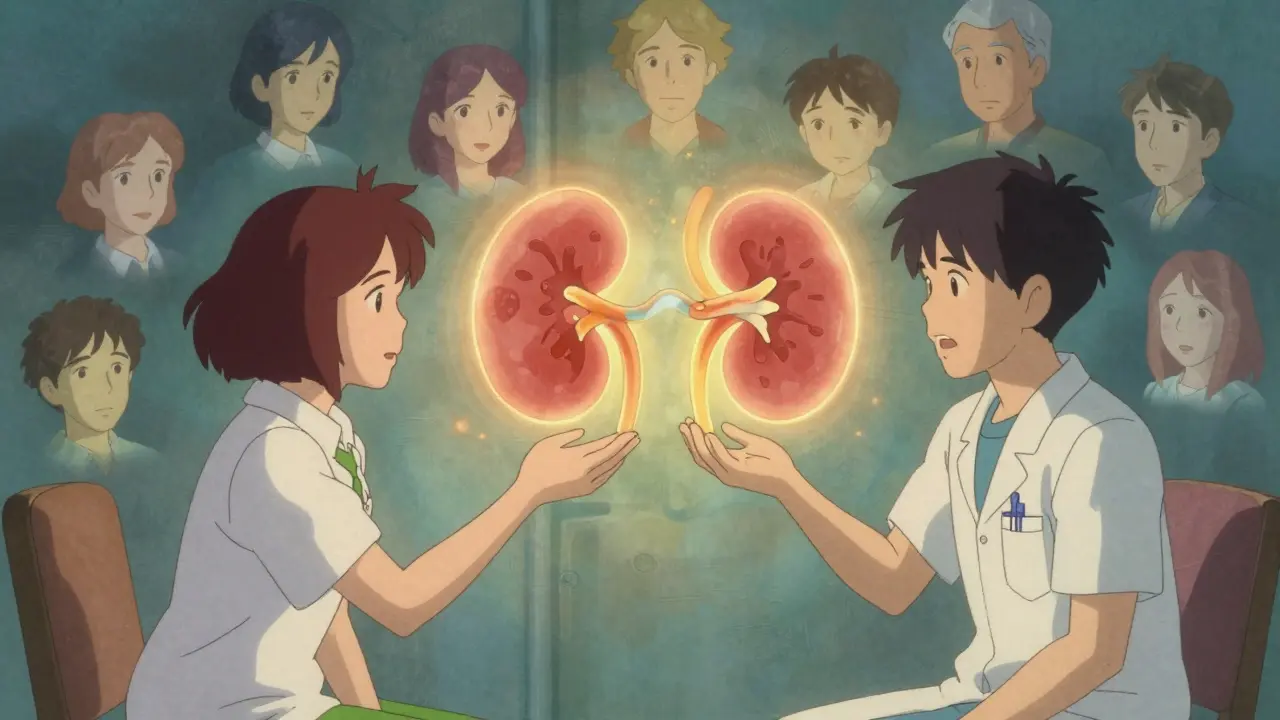
What’s Changing in 2026
The system is getting better. The End-Stage Renal Disease Transplant Act is expanding financial help for donors and recipients. By 2026, CMS expects a 15-20% drop in people dropping out of evaluation because they can’t afford it. HIV-positive patients can now receive kidneys from other HIV-positive donors. In 2023, 217 such transplants happened-up from zero in 2013. That’s progress. But there’s still a gap. Black patients wait 28.4% longer than white patients to complete evaluation. Centers that use structured pathways have cut that gap to 12.1%. You can help close it. Ask your center: Do you have a standardized evaluation plan? Are you tracking disparities?Final Thoughts
Preparing for a transplant isn’t about hoping. It’s about doing. It’s about showing up. It’s about asking questions. It’s about telling your family, your friends, your coworkers: I need help. I need a kidney. I need you. The system isn’t perfect. But if you do the work, you can beat the odds. The average person waits 3.6 years. But if you complete your evaluation in 90 days and find a living donor, your wait could be under six months. Don’t wait for the perfect moment. Start now. Your new life is on the other side of the evaluation.How long does the kidney transplant evaluation take?
Most transplant centers aim to complete the full evaluation within 12 weeks. For people with a living donor, it can be as short as 8 weeks. For those relying on a deceased donor, it often takes 12 to 16 weeks. High-volume centers finish 23% faster than low-volume ones. Delays happen when tests are missed, insurance is slow, or appointments aren’t kept.
Can I be on the waitlist if I have diabetes?
Yes, but your diabetes must be well-controlled. If your HbA1c is above 8% or you have severe complications like advanced nerve damage or kidney failure from diabetes, you may be denied. Some centers require you to stabilize your blood sugar for 3 to 6 months before listing. You’ll also need a detailed eye and foot exam to rule out damage.
What if I can’t afford the transplant medications?
Medication costs average $32,000 per year. Medicare covers 80% for three years, then you must buy a private plan. Many centers require proof of financial planning before listing. If you can’t afford it, ask about patient assistance programs. The American Kidney Fund, National Kidney Foundation, and pharmaceutical companies offer grants. Some states also have transplant aid programs. Don’t assume you’re ineligible-ask early.
Can a living donor be paid for their kidney?
No. Under U.S. law, it’s illegal to pay for organs. But donors can get help with travel, lodging, lost wages, and medical costs. The National Living Donor Assistance Center offers grants up to $6,000 for these expenses. Many employers also offer paid leave for organ donation. Don’t let cost stop someone from donating-there are resources to help.
What happens if I’m turned down for a transplant?
You’re not out of options. If you’re denied for obesity, you may be able to reapply after losing weight. If it’s because of heart disease, you might get cleared after treatment. If it’s psychosocial, you can work with a counselor and return later. Some centers allow re-evaluation after six months. Ask for a written reason for denial. Then ask what you need to change. Most rejections are fixable.
How do I find a living donor?
Start with family and close friends. Then expand to coworkers, neighbors, and community groups. Many centers offer social media campaigns to help patients find donors. You can also join online groups like the National Kidney Foundation’s donor network. Be honest: say what you need, how it will change your life, and that there’s no pressure. Many donors say they wish they’d asked sooner.
Do I need to be on dialysis to qualify for a transplant?
No. In fact, getting evaluated before starting dialysis gives you the best chance. Transplant centers prefer patients with an eGFR below 20, even if they’re not yet on dialysis. Early listing means you’re more likely to get a transplant before dialysis weakens your body. Waiting until you’re on dialysis can add months to your wait time and lower your survival odds.




Let me tell you something nobody else will: the whole transplant system is rigged. You think they care if you live? Nah. They care if you’re ‘compliant.’ I had a cousin get denied because she missed one dialysis appointment after her dog died. Meanwhile, some rich guy in Florida got approved with a BMI of 42 because he donated $50K to the hospital’s ‘transplant fund.’ This isn’t medicine-it’s a lottery with a side of classism.
My sister went through this last year 😭 She got approved in 7 weeks because she had a living donor (her best friend from college). But the psych eval? Brutal. They asked her if she’d still take the kidney if her friend got sick later. She cried. They didn’t. But she passed. If you’re reading this and scared? You’re not alone. And you’re stronger than you think. 💪❤️
While the article presents a comprehensive overview of the pre-transplant evaluation process, it lacks critical contextualization regarding regional disparities in access to transplant centers. For instance, rural populations in the American Midwest experience a 47% longer median time to initial evaluation due to logistical and infrastructural constraints, as documented in the 2023 Journal of Transplant Medicine. Furthermore, the assertion that insurance coverage is uniform across Medicaid and private insurers is statistically inaccurate-state-level Medicaid policies vary significantly in pre-authorization protocols.
Been there. Got the scar. Took me 14 months just to get past the eval. Insurance kept saying ‘needs more documentation’ for the same test three times. Finally just went to the hospital with a printed copy of the CDC guidelines and said ‘I’m not leaving until you schedule me.’ They did. Still waiting on a donor. But at least I’m on the list. Keep going. It’s slow, but it’s not impossible.
wait so u can get a kidney from someone who has hiv? thats wild. i thought that was still a no go. also why do they make you have 3500 in savings? like… i dont even have 350 in savings. this system is so broken.
They don’t tell you this, but the real test isn’t your kidneys. It’s your will. The paperwork. The waiting. The silence when your phone doesn’t ring. You think you’re ready? You’re not. Not until you’ve sat in that clinic for six hours, staring at a clock, wondering if today’s the day. And then you do it again. And again. And again. That’s the real transplant.
Ah, the sacred ritual of the transplant committee-a modern-day oracle, clad in lab coats, dispensing divine verdicts on who merits life and who must perish in bureaucratic purgatory. The system doesn’t evaluate fitness-it evaluates virtue. Who among us is morally worthy of a new organ? The one who keeps their meds? The one who doesn’t cry in front of the social worker? The one who can afford the $3,500? This isn’t medicine. It’s a morality play disguised as healthcare. And we’re all just extras in someone else’s tragedy.
Thank you for this thorough and clinically accurate overview. As a representative of the Canadian Transplant Society, I can confirm that the principles outlined align with international best practices. However, I would like to emphasize that the integration of psychosocial assessments must be culturally sensitive. In many immigrant communities, the concept of ‘support system’ is not limited to immediate family but includes extended kinship networks and community elders-a nuance often overlooked in U.S.-based protocols.
My brother got his kidney last year-living donor, his sister. The whole process? Took 6 months. But the paperwork? Oh my god. They asked for his tax returns, his pay stubs, his mental health history, his driver’s license, his dog’s vaccination records (seriously), and a signed affidavit from his landlord confirming he lives there. And then they said, ‘We’ll call you.’ I swear, if I had to do it again, I’d just move to Iceland.
Just wanna say-you’re not a burden for asking. I asked my cousin for a kidney. I cried. She said yes. Now we’re both in recovery. It’s messy. It’s scary. But it’s real. If you’re reading this and thinking ‘who would do that for me?’-someone will. You just gotta say it out loud. I promise. Don’t be shy. Your life matters. And so does your voice.
My mom got her transplant last year and she’s running marathons now. Seriously. She was on dialysis for 2 years. But she never gave up. She kept a journal. She made a playlist for her ‘new kidney’ days. She told everyone she knew. And guess what? A coworker stepped up. Don’t wait for a miracle. Be the person who starts the conversation. You’ve got this.
Let’s be real-living donors are the only reason this system hasn’t collapsed. The waitlist is a death sentence disguised as hope. And don’t get me started on the ‘2026 reforms.’ That’s just PR. Meanwhile, Black patients wait longer, poor people get denied for ‘noncompliance,’ and the rich get priority because they can afford to ‘optimize their health.’ This isn’t a healthcare system. It’s a caste system with stethoscopes.